Charming the Pandemic Hobgoblins, Part 2
What We Talk About When We Talk About COVID: Neoliberalism Edition
Note: This was originally posted to my Substack on May 6, 2022. I deleted that Substack a couple years ago and I’m reposting these blogs so they won’t be lost.
This is the second part of a piece looking at the COVID pandemic not as a biological phenomenon but as a social phenomenon. Not the pandemic as the global transmission of a dangerous disease, but the pandemic as the large-scale social implications of that transmission — most importantly the reaction to those implications. Two ideologies reacted to the pandemic by rejecting its real impact. On the one hand are the Hyperrealists, who insist that the pandemic cannot exist; the reason why is in part 1. On the other hand are the Neoliberals, who insist that the pandemic cannot continue to exist. You don’t have to read part 1 to understand part 2.
“Ever get the feeling you’ve been cheated?” - Johnny Rotten, 1978
Four stories about America:
From Revolution to Retirement. A wave of speculation and greed in America resulted in the crash of the Great Depression. A combination of New Deal welfare policies and WWII pulled the US into an unprecedented post-war boom economy. Many children of that prosperity demanded a more just and equal society. Just when it looked like it might be achieved, their dream was quashed by the old powers. The post-war boom thudded to a halt. Their allegiances split apart; former allies became enemies. Their faith in American government institutions were shaken in the 1970s, from the release of the Pentagon Papers in 1971 to the resignation of President Richard Nixon in disgrace in 1974. Their glory days over, disillusioned about the potential of politics to improve society, they turned inward, finding inspiration only in personal health and personal wealth and thus proclaiming their belief in “personal responsibility.” Collective struggle had proved fruitless; all that remained was individual success. They entered their long twilight years pulling up the ladder behind them, the beneficiaries of a generous society they had lost faith in and so dismantled.
From Revolution to Revenge. In 1954 the Supreme Court of the United State came to the conclusion that racial segregation of children in public schools was unconstitutional. A year later, motivated by this victory, the nascent forces of the post-war US civil rights movement coalesced into a mass movement. Despite the “massive resistance” strategy of the racist Jim Crow state leaders, the Civil Rights Act of 1964 outlawed discrimination based on race, color, religion, sex, or national origin for the first time in American history. After that high-water mark, the counterrevolution began, one determined to roll back civil rights to before Brown v. Board, restore “states rights” and reversing popular acceptance of racial, gender, and equality. When racial desegregation proved too popular, right-wing religious leaders looked to the 1973 Roe v. Wade decision as a rallying point for a coalition of religious, political, and cultural reactionaries and their funders. This coalition came to power in 1980 with the election of Ronald Reagan. After decades of capturing legal institutions, rolling back civil rights and voting laws, reversing policies of racial and economic inequality, they finally achieved their goal of erasing two generations of social progress in the reversal of Roe in 2022. To cement and protect their gains, they had enlisted police departments, violent thugs, bigoted petty bourgeois, and right-wing lawyers as their vanguard. Nevertheless, despite their triumphs they clung to their conviction that they will forever be victims of a corrupt, degenerate, Godless society. Their mission mutated into an endless struggle to destroy their own society in order to redeem it.
The Power of Currency. The foundation of the amazing post-war American economy was an alliance between the federal and local governments, giant corporations, banking and finance, and labor. As long as the economic pie got bigger there were always enough slices to go around. The Federal Reserve Bank went about its duty of full employment, ensuring the prosperity was shared. Then in the mid 1970s came the turning point. The end of the Bretton Woods agreement, the Nixon Shock, the oil crisis, stagflation. The pie shrank and the bitter fights over the smaller pieces tore the post-war alliance apart. In the late 1970s the finance sector formed a new partnership with American politicians. Financial institutions and their corporate appendages would manage the economy by unleashing markets free from oversight, supported by policies that favored social stability and greater profits above all. In return the government would shrink, eliminating its previous function of providing basic social welfare and safeguarding civil society against corruption. The demand for stability led naturally to conservative — even reactionary — politics, and greater profits demanded economic austerity for the American populace. These two demands were the essence of neoliberalism, and they became the guiding principles of American politics for the next forty years. Unions were undermined and rendered powerless by global companies chasing low operating costs, as demanded by their shareholders. Wages stagnated in 1979 and never rose again even as worker productivity continued to increase. The idea of public good was replaced by an ethos of unforgiving individualism. Aspects of everyday existence like work, transportation, and health care were privatized, monetized, and thus controlled by gigantic monopolistic institutions immune from public scrutiny. At the same time, the broader economic growth promised by the neoliberals was nowhere to be found. Instead came rentier capitalism, arbitrage, unsustainable venture capital, tax breaks for giant corporations, subsidies, pyramid schemes, hidden wealth, and speculative bubbles. Profits were privatized, losses were socialized. American millionaires became billionaires, then trillionaires. The markets held sway over all.
The Currency of Power. To keep the population from challenging the harsh inequality of the neoliberal economy, a massive system of surveillance, incarceration, and lawfully protected violence was inaugurated. In the wake of the 9/11 attacks, this latter system of violent social repression became a self-justifying, self-sustaining entity, beyond the control of the politicians and financiers who had created it for their own ends. The self-styled citizens of this shadow carceral state began to see themselves as the true stewards of the United States. Unmoored from any socio-political purpose, radicalized by right-wing media, energized by Internet-fed moral panics, they actively embraced several basic tenets of fascism: nationalism as an identity; loathing of other races and genders; unreflective action for its own sake; life as permanent warfare; syncretic occultism; hyper-gendered patriarchy; and insisting that they alone are the true voice of the people, no matter how small their numbers or unpopular their beliefs. Right-wing American politicians tried once more to assert control over this fascist crypto-party, only to be overtaken yet again by the anarchic police riots and paramilitary rallies of 2014-2020. The apotheosis came with the storming of the Capitol building on January 6, 2021. At that moment the crypto-party absorbed the actual Republican party.
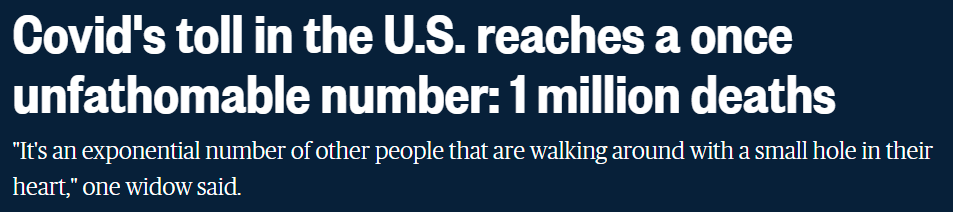
What Was Neoliberalism?
The common thread of these stories — the skewer impaling every piece of American society — is an ideology that pretends to disdain ideologies in general: neoliberalism.
What was neoliberalism? I’m going to ignore the ongoing debate around the precise definition and lay out what everyone commonly agrees are the basics.
(Quick note that neoliberalism has nothing to do with liberal politics.)
Classical economic theory had thrown the US post-WWI prosperity into the bottomless pit of the Great Depression by 1930. To dig out of the hole of 24% unemployment, the establishment turned away from the old boom-and-bust cycles and towards Keynesian economics. Keynes articulated the link between the labor market and the stock market, especially the inverse relationship between interest rates and unemployment. The government could directly inject money into the economy to smooth out the boom-bust cycles which in turn kept unemployment manageable. It brought the US into the largest, longest boom in its history.
The price the government eventually paid for this fiscal policy was inflation — too much money chasing too few goods. Keynes thought high inflation would only kick in at full employment; besides, manageable inflation was the sign of an economy that was growing, not stagnant. But in the mid-1970s the economy both stagnated and hyper-inflated. The Keynesians couldn’t explain this nor figure out a way to stop it. The economy was eventually pulled out of this morass — in no small part by the Federal Reserve engineering mass unemployment and the US government dismantling the welfare state created by the New Deal. (This created a wave of poverty and homelessness that continues to the present.)
Keynesian economics was discredited; classical economics was exhumed. But the new classicists went farther than their predecessors. After the Great Depression the federal government put in place financial safeguards and legal guardrails to keep the corporate/financial sphere subordinate to the political sphere. The purpose of having an economy, after all, was to create and spread prosperity for all citizens, as equally as possible. The neoliberals flipped this on its head. If the American government wanted the economy to grow again it would have to get comfortable with things getting worse for some citizens in order for things to get better for others. Equality of opportunity would replace equality of outcome, meaning each individual’s poverty reflected their own determination to succeed, not a policy . Competition would replace cooperation; this naturally meant an economy of individuals, not cooperatives like unions or activist organizations. National sovereignty itself would give way before the World Bank, the International Monetary Fund, and the World Trade Organization. The ideology of The People would diminish so the non-ideology of The Market would rise in its place.
The political, cultural, and financial ruling class spent the years between 1980 and 2007 recalibrating every aspect of America to match the vision of a society shaped by corporations and devoted to deregulating and expanding global markets. If the results of this free market society were Dickensian squalor or rampant corruption and speculation it must be that the markets themselves were not free enough. Capital itself — and thus its devotees — was not motivated by good or evil; its amorality rendered it innocent of consequences.
Then the whole thing fell apart, at the same time, all over the world.
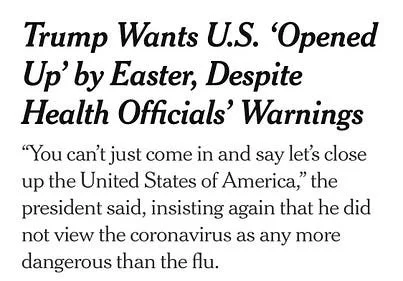
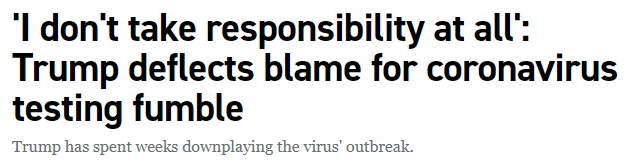
Dead Plan Walking
There were numerous, complex reasons the global economy collapsed in late 2007 and 2008. They were all just the proximate causes. Neoliberal socio-economics was the ultimate cause.
Just as the Great Depression made classical economics obsolete and stagflation discredited Keynes, the Global Financial Collapse exposed the rotten core of neoliberalism. It should have been replaced with a theory to match the new realities of the world, one which might have emphasized the value of international collaboration around potential mega-projects like reversing the climate crisis. Or it could have led to a reflective, domestic economics, using new technologies and a renewed labor alliance to create a new age of of prosperity and leisure, lifting millions out of poverty. More than enough wealth had been created over the last four decades, it just needed to be tapped into. But nothing changed.
It may be … that the most catastrophic feature of neoliberalism was the belief that it was a thing. It was not. It was not an order. While it certainly had durable features: capital’s urge to break worker power, say, or the ruthless march into all quarters of atomizing market logic, these cannot provide a particular period’s internal logic. They are inbuilt to capitalism: there at the beginning, there at the end. If “neoliberalism” describes a certain level of development for these features (and we are not sure it does even that) it cannot simultaneously explain how they reached those levels. Meanwhile, what seems increasingly clear to us is that the span was characterized by no particular social coordination conscious or automatic, liberatory or maleficent. Neither capital nor its antagonists had a plan, really. “The new spirit of capitalism” was attrition, extraction, and exhaustion. Growth ended and stayed ended. For all the chitchat about hyperpartisanship and polarization, the center endured, a gray parade of necromancers one after the next pretending to raise accumulation from the dead. There was a bunch of path dependency. It further immiserated a vast portion of a largely immiserated world. The last couple of years have absolutely felt like a kind of passage. And yet: volatility has given onto volatility, impasse onto impasse. - Nikhil Pal Singh and Joshua Clover, “Static and Signal: Part One”
Nothing new has has overthrown neoliberalism. No ethos of commonwealth has replaced Americans’ obsession with personal wealth. If anything the hyper-individuality has intensified. It’s every person for themselves without a net, especially when it comes to social problems like health care, education, the environment, housing, exploitation at work, and personal safety. The latter category includes factors outside our personal control, like gun violence, food safety, physical and mental disability, and car safety.
That finally brings us to the pandemic.
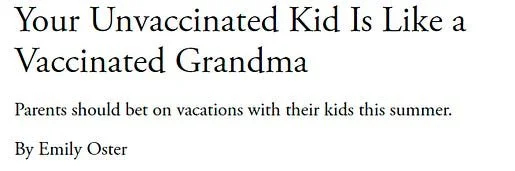
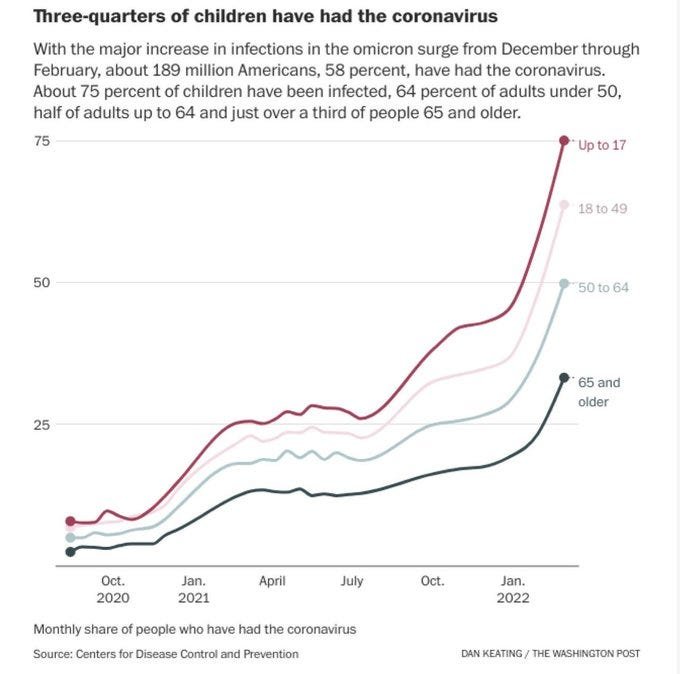
If I were to ask you if the pandemic is a health crisis or an economic crisis, what would you say? You would probably say a health crisis, obviously. You might say both. I’m going to guess you wouldn’t say it was a cash flow problem that should be handled by managers, consultants, and markets.
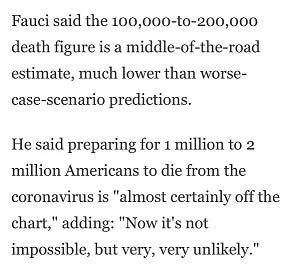
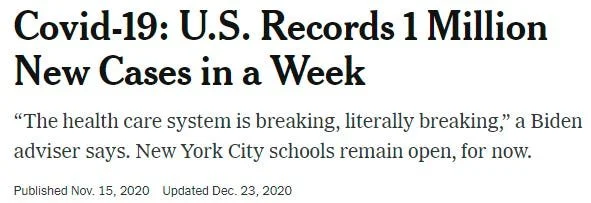
Nobody disputes that the Trump administration made the pandemic worse in every possible way. The media likes to say they “bungled” it but that doesn’t sound strong enough for 25 million confirmed coronavirus cases in the US, over 400,000 of which resulted in death. Trump has always valued his own family’s enrichment above all, so in March 2020 he chose Jared Kushner to manage the government response. It resulted in a wave of corruption that at any other time would have been a massive scandal. Instead of choosing a new leader from the field of public health, Trump next turned to Peter Navarro, his trade advisor, whose January 2020 warnings about CORONA Trump had ignored. Unable to get a response from Trump, Navarro privatized the response just like Kushner had, and just as incompetently. After spending a billion dollars on supply contracts with nothing to show for it, he shifted in May 2020 to pushing hydroxychloroquine as a COVID cure-all. All while Trump insisted over and over that businesses and schools in America had to “reopen.” After years of incompetence and inaction, surely Joe Biden would put the public health experts in charge.
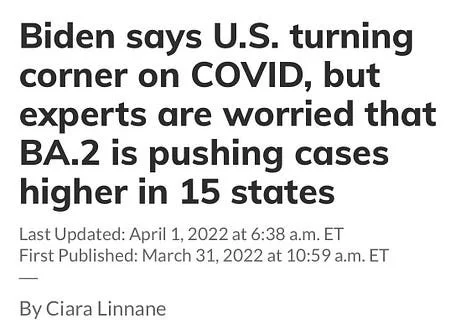
In December 2020, Biden assigned the COVID logistics job to Jeffrey Zients. Zients had directed the National Economic Council; had assisted Barack Obama with economic policy; served as the chairman, CEO, and COO of the Advisory Board Company, a health care business consulting group; served as the chairman of the Corporate Executive Board; founded the the investment firm Portfolio Logic, which focused on the health care business; was the CEO of Cranemere; and served on Facebook’s board of directors. This was the extent of his public health experience. He was supposed to bring managerial acumen to the implementation of Biden’s COVID policies along with coordinating the supply chains.
But Zients was part of the neoliberal establishment — a man of markets, not morals. If the public had looked closer, they might have noticed that he was as corrupt as anyone in the Trump administration. He could have used the Defense Production Act to finally mobilize an effective government response, but that was never a realistic possibility as long has the US Chamber of Commerce didn’t like the idea. Neoliberals didn’t like the idea of financial support for struggling Americans — we left government intervention behind with Keynes — so it stopped.
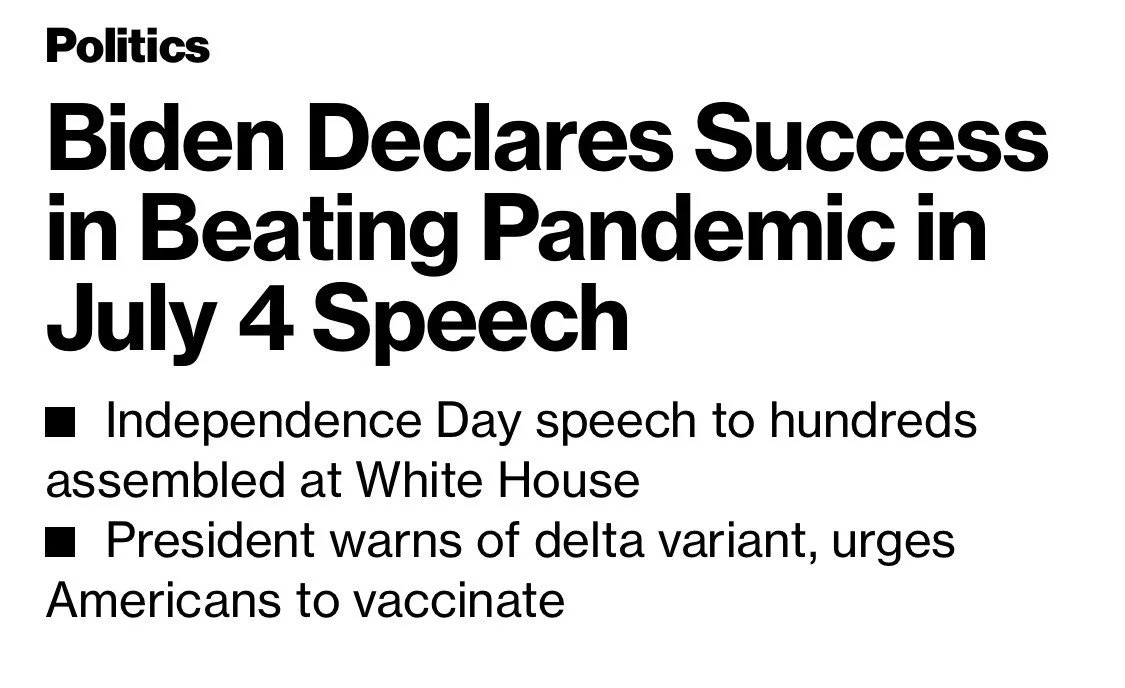
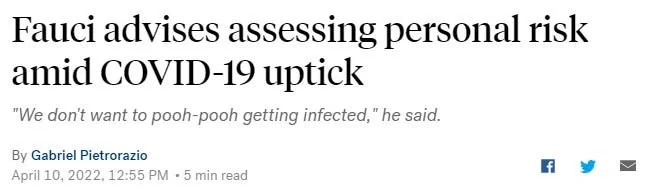
As the delta wave crested in the summer of 2021, the CDC (via Zients) claimed that vaccinated people had nothing to worry about; it was now a “pandemic of the unvaccinated.” This was neoliberalism at its neoliberaliest: you, an individual, had to make the rational choice to avail yourself of the vaccine. Public health had to make way for private health. When the omicron wave hit, the new mantra became “we have the tools” to fight the virus: vaccines, masks, and testing. Of course you didn’t have to get the vaccine or even get tested if you didn’t want to; you didn’t have to wear a mask around other people; and tests were hard if not impossible to get. It was all a matter of assessing your own personal risk, because everything was personal. The dismissal of immunocompromised people, Black Americans, and other high-risk groups bordered on eugenics. From an economic point of view the real victims were landlords and upper management. The markets, however, soared into the stratosphere.
When it looked like omicron was finally over and before another wave had a chance to appear, Jeff Zients quit. By then both the Hyperrealists and the neoliberals had joined forces to create what Tom Scocca calls “the ideology of Unlimited Covid.”
Supported by an alliance of conservative and liberal officials and amplified by both groups' preferred media, Unlimited Covid has evolved from a de facto national strategy to an explicit ideology. Rural farmers, suburban business owners, and urban professionals alike are now working diligently toward the goal.
The result is the world's highest overall coronavirus death toll and the highest current daily number of deaths, as the nation of 330 million encourages the omicron variant to spread. Since the start of the pandemic, American life expectancy has declined by at least 1.8 years.
Rather than fight the pandemic, the nation has embraced a goal of fighting against the fight against the pandemic. While other countries monitor case counts or hospital capacity, the United States is focused on driving the number of closures, vaccination requirements, and mask orders down to zero. Even where there are no closures, the most dedicated Americans battle against them anyway.
The Neoliberal Society and its Future
In part 1 we talked about how Hyperrealism can only be resisted through taking away their power. No appeal to sacred democratic institutions or the better angels of their natures will have any effect. For all its terrorism, Hyperrealism’s dependency on power is its weak spot. Power can be resisted with power. The crucial point: it has to be collective, unified power. The right wing, despite its cruel stupidity, understands this. It’s how Roe v. Wade was nullified, with a century of civil rights soon to follow.
Neoliberalism has the same weakness. Sustained collective action, mutual aid, and rolling back the gigantic carceral state are just three examples of how we can finally start to recover from the slow-motion disaster of the last half-century. Generosity, not austerity, might save us from the darkness of a neoliberal future. Voting as an individual act, isn’t a threat to neoliberalism. But collective direct action like the Black Lives Matter protests threaten both the soldiers of capital and the masters of the markets. Voting is especially useless because markets, by their nature, are undemocratic, even anti-democratic. They privilege property over people and always will.
Voters in a democratic country with a solidly neoliberal economy are choosing between conservative technocrats and ultra-conservative populists. The latter are obviously brutal, but the former are just quieter about their cruelty. In the case of Roe’s reversal, the technocrats wanted open debate, a hearing of both sides, free speech and opinion. The right-wingers wanted the power of life and death over women and their bodies; with nothing to stop them they reached out and took it. The technocrats’ framework allowed this violence to appear, violence which will now shred that framework from within. The logic of neoliberal economics leads to the violence of right-wing politics.
The future of a post-neoliberal civics will depend on the American middle class. Middle-class Americans embrace neoliberal socio-politics because they’re convinced there’s no alternative to the zero-sum death struggle inside the neoliberal thunderdome. Pretending otherwise, they believe, is naive, immature, even dangerous. Thus they rationalize away their inability to find common cause between classes, within their own class, and even within their own communities. Crises that require a collective response, like the pandemic or climate collapse are set aside, then indefinitely deferred.
There seems to be a dawning realization even among the middle class that living as atomized individuals under decades of economic austerity and an unchanging social status quo made them into suckers. Theodore Adorno put it this way:
The individual has been, as it were, merely invested with property by the class, and those in control are ready to take it back as soon as universalization of property seems likely to endanger its principle, which is precisely that of withholding.
In other words, just like the rest of us they won’t get an even break. So what do they have to lose but their chains?
Charming the Pandemic Hobgoblins
I’ve argued that the answer to charming away the two pandemic hobgoblins, the two frightening ideologies that got us here and won’t get us out of it, is power, amassed and used collectively, for mutual benefit. Easy for me to say. But it’s starting to happen. There will be a backlash, but those of us born since the mid-1970s have lived our whole lives in a backlash to the events of 1954 to 1970. We’re long past due for a backlash to the backlash.
Maybe there won’t be any lasting social impact from the COVID pandemic, just like the 1918-1919 influenza pandemic faded into near-obscurity when the worst was over. For the Hyperrealists the pandemic exists outside the America simulation, and thus never really existed at all; for the neoliberals the pandemic has to stop mattering so the markets can once more take precedence. There are ways for us to slip between these two dead ends, we just have to see one, set our feet on the path and start moving. As Adorno put it, “The almost insoluble task is to let neither the power of others, nor our own powerlessness, stupefy us.”
The Swans
I started this piece with a quote from Plato’s dialogue Phaedo, so I’ll end it with another quote from the same dialogue. It makes me think of how the pandemic has spent two years crushing Americans’ bodies and souls, whether or not we even caught the virus. You might think that would drain away our hope for a more just world. It hasn’t. If anything, Americans have begun to slowly change the status quo. Some took to the streets in huge numbers and directly challenged what is, essentially, a modern high-tech domestic army. Some changed the ruthless exploitation of their labor, either through organizing against incredible odds or clawing back some autonomy and self respect from their petty overlords. Some are working to make their communities safer and more hospitable after decades of neglect and brutalization. A better world is actually possible — maybe closer than it’s been in a long time, despite everything.
Socrates, condemned to death, has been talking with his companions about whether or not his soul will exist after his body dies. His companion Simmias explains that they all have doubts and question, but they don’t want to upset him in what will be Socrates’ last few minutes of life. In response, Socrates laughs.
You seem to think I am inferior in prophetic power to the swans who sing at other times also, but when they feel that they are to die, sing most and best in their joy that they are to go to the god whose servants they are. But men, because of their own fear of death, misrepresent the swans and say that they sing for sorrow, in mourning for their own death. They do not consider that no bird sings when it is hungry or cold or has any other trouble; no, not even the nightingale or the swallow or the hoopoe which are said to sing in lamentation. I do not believe they sing for grief, nor do the swans… they sing and rejoice on that day more than ever before.
Charming the Pandemic Hobgoblins, Part 1
What we talk about when we talk about COVID
Note: this was originally posted on my Substack back on April 30, 2022. I deleted that Substack a couple years ago and I’m posting these old blogs so they don’t get lost.
Mormo the Hobgoblin, or: How to Scare your Ancient Greek child
Every culture has its goblins that parents use to scare naughty kids into good behavior. Ancient Greece had Mormo. According to legend she was originally a woman from Corinth who (for some reason) ate her children, then flew away into the sky. If this sounds similar to tales of witches from 1692 CE Salem, Massachusetts, the common denominator is an intensely patriarchal society where women who committed violence against their own children were so irredeemable they became supernaturally demonic. So bad children had better beware!
Like all such spooks there’s no single description of what she looked like, which is the point: you’re supposed to imagine your own most frightening version. She’s spoken of as a phantom, a ghost, a specter; for kids her name meant the equivalent of boogeyman or bugbear. The name mormo has the plural form mormones, meaning fearful or hideous ones, and which is related to various words that signify fear. There’s even a record of Mormo being used by a Byzantine princess (in the Alexiad) to scare her own children around the time of the First Crusade.
Aristophanes invoked Mormo in his plays with a subtle twist. He uses the term mormolukeion (or in later Greek mormolykeion). In context this term implies not so much a monster as a mask — one designed to scare children but one which adults would know was made up and therefore harmless. It combines Mormo with -lyk, which is the root of “wolf” (as in lycanthrope - literally wolf-man). So this is Mormo as a wolf mask (lykeia), scary to youngsters but not to elders.
The Death of Socrates
It’s possible Plato heard this coinage at a performance of a play by Aristophanes (they were contemporaries) because Plato uses it in the same way in his dialogue Phaedo, written ca. 360 BCE. The dramatic frame for the dialogue: Socrates has been condemned to death, and it ends with Socrates drinking poison and dying. The dialogue is mostly a back-and-forth between Socrates and his friends about death and the possible immortality of the soul; in the background of all the philosophical talk is Socrates trying to comfort his companions in the face of his immanent death.
At one point Socrates is arguing with Cebes about Cebes’ fear that after death a person’s soul would simply dissipate into nothingness. Socrates says:
“You have the childish fear that when the soul goes out from the body the wind will really blow it away and scatter it, especially if a man happens to die in a high wind and not in calm weather.”
And Cebes laughed and said, “Assume that we have that fear, Socrates, and try to convince us; or rather, do not assume that we are afraid, but perhaps there is a child within us, who has such fears. Let us try to persuade him not to fear death as if it were a hobgoblin.” (mormolukeia)
“Ah,” said Socrates, “you must sing charms to him every day until you charm away his fear.” - Phaedo 77e, trans. H.N. Fowler
The long years since 2020 have been infested with hobgoblins. If we can look past the masks maybe we’ll see how to charm them away.
The Two Pandemic Hobgoblins
We still think of human disease as the work of an organized, modernized kind of demonology, in which the bacteria are the most visible and centrally placed of our adversaries. We assume that they must somehow relish what they do. They come after us for profit, and there are so many of them that disease seems inevitable, a natural part of the human condition; if we succeed in eliminating one kind of disease there will always be a new one at hand, waiting to take its place.
These are paranoid delusions on a social scale, explainable in part by our need for enemies… - Lewis Thomas, The Lives of a Cell: Notes of a Biology Watcher (1975)
Social Disease
Let’s consider the pandemic not as a biological phenomenon but instead as a social phenomenon. Not the pandemic as the global transmission of a dangerous disease, but the pandemic as the large-scale social implications of that transmission — most importantly the reaction to those implications. (I’m going to be dealing with this phenomenon is the US, by the way, since that’s what I’m personally living through; I know this is a limited perspective.)
To do this we have to distinguish between the virus, which I’m defining as a biological reality, and the pandemic, which I’m defining as a social reality. The virus scientifically labeled as COVID-19 is obviously real, has infected millions of people worldwide, and has killed at the very least one million people just in the US. The last two years have showed how divorced that biological reality is from the social reality.
Hyperrealists and Neoliberals
There are two groups in particular for whom the pandemic doesn’t exist, to the point that the biological virus is meaningless and therefore irrelevant. For each group, the pandemic cannot be real.
The first group is the Hyperrealists. For the Hyperrealists the pandemic is both the product of, and the ongoing engine of, a false reality; therefore the pandemic cannot exist.
The second group is the Neoliberals. For the Neoliberals the pandemic is the both the symptom of, and the ongoing cause of, a massive disruption in the operation of the global marketplace that defines the social order; therefore the pandemic cannot continue to exist.
The average person — especially those grieving their dead — are flanked by these groups, each declaring that the pandemic is either over or never happened at all. We are in the strange position of having to insist that the pandemic has always been real and continues to be real. For our own sanity these are the two hobgoblins we have to dispel.
The Hyperreal Hobgoblin
The Conspiracy Virus
For the Hyperrealists, the virus doesn’t exist. And even if it did exist, the vaccines and masks don’t help stop the spread, they either make things worse (the vaccine) don’t do anything at all (masks) or both. And even if vaccines and masks did help stop the virus from spreading, the pandemic as a whole was a conspiracy designed to control the population and make vast profits off the suffering.
This group is labeled “conspiracy theorists” as a way to dismiss them. But governments and powerful organizations conspire to fool and manipulate their citizens all the time. Sometimes they have political agendas, but most global conspiracies are plots to gain and hoard as much wealth and power as possible; most of these plots are perfectly legal. So it’s not stupid to theorize about actual conspiracies in general. But giving those theories weight would require that theorist to stand on a solid foundation of ethics, social justice, and economic equality. Then the theory could be used to critique and contest the power behind the conspiracy. But solid foundations are not the hallmark of hyperrealism.
The Spectacle and Earth Prime
In order to define what I mean by the term hyppereal I have to start with the concept of “the Spectacle” laid out by Guy Debord in his book The Society of the Spectacle in 1967. “The Spectacle” is Debord’s collective label for the media landscape: television, movies, advertising, fame and celebrity, popular culture, all produced and driven foremost by flows of capital. It’s tempting to see this as just an ahead-of-its-time label for what we now think of as the World of the Screen: the 24 hour news cycle, social media, the constant hate-drone of Fox News, all of the above etc. But the Spectacle isn’t ephemeral. Unlike the media and Internet ionosphere of information and outrage, the Spectacle is solidly real, and it defines the way we interact with the world and with each other.
The spectacle is not a collection of images; it is a social relation between people that is mediated by images.
The spectacle cannot be understood as a mere visual excess produced by mass-media technologies. It is a worldview that has actually been materialized, that has become an objective reality.
The spectacle that falsifies reality is nevertheless a real product of that reality, while lived reality is materially invaded by the contemplation of the spectacle and ends up absorbing it and aligning itself with it. Objective reality is present on both sides. Each of these seemingly fixed concepts has no other basis than it’s transformation into its opposite: reality emerges within the spectacle, and the spectacle is real. This reciprocal alienation is the essence and support of the existing society.
All quotes from: Guy Debord, The Society of the Spectacle (1967), trans. Ken Knabb
If that sounds opaque welcome to French philosophy!
The Spectacle is not the media landscape that is observed from the outside by people external to it; the Spectacle is the way people relate to each other using the media landscape to do it. The Spectacle isn’t a digital projection or a phone app or something similar that only exists in the “screen world.” The Spectacle exists in our “Earth Prime” real world. How is that possible?
Earth Prime ←→ The Spectacle
The information conveyed by the Spectacle is full of untruths, but the Spectacle itself emerges from and exists within our Earth Prime real world. At the same time, we Earth Prime people use the Spectacle as the way to socially relate to each other, making the Spectacle an inextricable part of Earth Prime. As a result of this cross-contamination, Earth Prime and the Spectacle are both objectively real.
Not only that, within their shared reality Earth Prime and the Spectacle are each trying to transform into the other — meatspace trying to sublimate into cyberspace, cyberspace trying to solidify into meatspace (I’ll explain this more below). This process of back-and-forth “reciprocal alienation” is what supports our current capitalistic society.
The Spectacle is a Series of Tubes
Think of the Internet. No matter how bizarre any content on the Internet is, it’s not some astral dimension separate from reality. It’s existence and influence are part of the non-Internet world, which should be obvious given the last few years. Ideas, fads, social movements, cults, doxxing, swatting, NFTs, on and on: millions of people trying to use the Internet to alter non-Internet reality, using the Internet as their medium of social relation. At the same time non-Internet reality is constantly creeping into Internet reality, with posts, vines, instagrams, tik toks, all the descendants of reality television. The Russia-Ukraine War exists as much digitally/online as on the front line (though it sounds disgusting to say it): Vladimir Zelensky uses the Internet to get popular support, which results in more weapons, which results in images and videos of destroyed Russian tanks, and the cycle repeats. Cyberspace and meatspace constantly swapping places in our reality, every move monetized and commodified.
True vs. False, vs. Real vs. Unreal
If there is no hard line dividing the Internet and the non-Internet world, that might suggest that there is a shared sense of common reality across Internet and non-Internet, Spectacle and Earth Prime, no matter what anyone’s disagreements. The assumption of a commonly shared sense of reality is the frame of American liberal politics. Because if there is a shared reality, the practice of politics is a discussion of policy, a contest between what is useful or not, or — at the extreme — true or false, the goal being to reach a democratic consensus. Instead 21st century America has been defined by a constant back-and-forth struggle not about what is useful or not but a life-or-death combat about what is real or not. That’s a struggle for power, the power to successfully define reality and reap everything that follows. Liberals have no countermove in this scenario.
Imprisoned in a flattened universe bounded by the screen of the spectacle, behind which his own life has been exiled, the spectator’s consciousness no longer knows anyone but the false interlocutors who subject to him to a one-way monologue about their commodities and the politics of their commodities.
When it comes to the anti-vax ecosystem, does this sound familiar? Tucker Carlson, Joe Rogan, Donald Trump? YouTube? Internet radicalization in general? Anti-vax “doctors”, fake medical associations, medical professionals “just asking questions,” self-appointed experts shilling hydroxychloroquine and horse dewormer? The wrinkle in 2022 is that with social media, anyone can be plucked from obscurity by right-wing dark money operatives and have their entire social existence weaponized for stochastic terrorism. Those human weapons are, in the end, disposable. But the “false interlocutors” are not.
Where We’re Going We Don’t Need Reality
We could say that our society is shaped by real and unreal constantly churning together and stop there. The thing is, the phrase “real and unreal” has an subtle assumption built into it. The assumption is that the word “real” is a signifier pointing to something that exists. For example, the word “shoe” is not, itself, a shoe; you can’t wear a “shoe.” So “shoe” indicates either a particular shoe or the concept of a shoe or both. It’s the difference between a map and the territory modeled by the map.
In the same way, the word “real” indicates that state of general existence which reflects things as they are, as opposed to things that are non-existent or imaginary.
But now imagine a simulation of reality, i.e. a simulation of that state of general existence which reflects things as they are.
What if the word “real” was used to indicate that simulation of the state of general existence?
What if the word “real”, uttered by someone on the inside of that simulation, could only refer to the version of reality present within the simulation, not the “original” reality being simulated?
The Metaverse Simulated Reality
It was crucial to establish that the Spectacle is real, not some kind of trick of the light projected onto the surface of reality. Because it’s not enough to say that someone in 2022, who has lived through the alpha wave, the delta wave, and the omicron wave, and still insists that vaccine’s don’t work etc. is out of touch with objective reality. As if there were some way to convince that person that they had been misinformed, or misled, and if only they would stop going on Facebook and start listening to the scientists they would see the light.
When anti-vaxers use the word “real” they’re not referring to the same thing you and I are. The rest of us are living in the push-and-pull of the Spectacle and Earth-Prime; anti-vaxers have immersed themselves into pure Spectacle as much they can. That immersion shifts them into something different. Not an illusion or a falsehood, because the Spectacle is real, not fakery. But it’s a different kind of reality: a simulated reality.
In the simulated reality, the word “real” still refers to a state of general existence, but a simulated existence. In the simulation, “real” folds back on itself like a mobius strip. There, “real” can only refer to things as they are within the simulation. The non-existence of the pandemic is foundational to that simulation.
Anti-vaxers are fond of the phrase “do your own research” — by which they mean “enter the simulation; until you do, you will not be as awakened and informed as I am.” Of course the anti-vaxers think that you and I are the ones living in a simulation. They love to refer to themselves as “taking the red pill” to get reborn out of The Matrix into what they think of as the true original unsimulated reality (ignoring that the Matrix movies were an extended allegory about coming out as trans). This mentality is what allows anti-vaxers to treat their own families with indifference, even contempt, over masks and vaccines. It’s because they love you so much that they don’t want you to get the vaccine, or wear masks, etc etc., can’t you see? Just enter our simulation and it will all become clear, you will be liberated. The simulation has freed itself from having to pretend to be associated with our reality; everything within the simulation can only refer to something else in that simulation. Inside the anti-vax simulation, the pandemic (as a social phenomenon) isn’t fake. The pandemic is real, but it manifests as a conspiracy and/or mass delusion. This might sound like semantics but it’s necessary for comprehending why most anti-vaxers can’t be “brought back to reality.” As far as they are concerned their simulation is reality.
If you’re wondering how you and I know that we are not, in fact, the ones in a simulation: the fact you even asked that question is the difference between skepticism and solipsism. Or you could look at the death rates for unvaccinated people if you want physical evidence. But hang on to that question because it will be important later.
When anti-vax media mogul Marcus Lamb was dying of COVID, his son’s response: “There’s no doubt in my mind that this is a spiritual attack from the enemy.” Jonathan Lamb was Marcus Lamb’s son. On his father’s Daystar Television Network, Jonathan talked about the “alternative” treatments (like Ivermectin and prayer) pushed by his parents and their television guests. “There’s no doubt that the enemy is not happy about that. And he’s doing everything he can to take down my Dad.” Marcus Lamb died a shortly afterwards. He helped build the simulated reality that killed him; his son inhabits that same reality and will most likely continue his fathers work. The list of people killed inside the simulation they helped create is long and not finished yet.
I should also mention that the Daystar Television Network got about $4 million of taxpayer cash from the US government Paycheck Protection Program. Two weeks later the Lambs bought a private jet they used for going on family vacations. They said they got the money from “investments” and the vacations were “leadership retreats with his family.” When the story was picked up by the media, the Lambs said they paid the PPP money back but no one knows if that is true.
That cash flow is significant because capitalism and consumption are the carbon atoms of the Spectacle and thus the anti-vax simulation. The Spectacle of 2022 mainly exists to sell pandemic commodities, tangible ones like Ivermectin or cultural ones like prayer. Anti-vax profiteering is the engine of the simulation.
If you’re still with me you are a blessed person and I appreciate you…
Finally I can explain why I think the people in the simulation should be called Hyperrealists instead of simply anti-vaxers. “Hyperreality” is a word coined by Jean Baudrillard. He uses it to describe the condition of living in a world where we can’t discern true reality from a simulated reality. This might sound like what we’ve already discussed, and in 2022 it sounds almost trite. What’s not trite are the implications that Baudrillard spins out from the concept of hyperreality.
A simulation that can only use “reality” to refer to itself is unsettling enough as it implies that there might be no way to extricate yourself from the simulation. Now imagine that there was no real “real,” that everything was simulations all the way down. Baudrillard calls this the “procession of simulacra.” In a hyperreal world, the word “real” no longer indicates that state of general existence which reflects things as they are, because there is no longer a “real real” to be referred to. The word “real” becomes a kind of mask used to hide the fact that there is nothing outside the world of simulations. As Baudrillard puts it:
The transition from a sign that dissimulates something to signs that dissimulate that there is nothing marks a decisive turning point. - Jean Baudrillard, Simulation and Simulacra (1981, trans. Sheila Faria Glaser; my emphasis)
I’m not sure that all of us are living in full-on hyperreality but I do think anti-vaxers are. They exist within a procession of simulacra, multiple simulations that constantly shift and overlap. In Baudrillard’s words, in the anti-vax world “the search for proof, indeed the objectivity of the facts does not put an end to the vertigo of interpretation. We are in a logic of simulation, which no longer has anything to do with a logic of order and reason. … Illusion is no longer possible, because the real is no longer possible.” At this stage of hyperreality there is no longer an “outside” to the simulations. The very idea of waking out of the simulation is hypocritical and immoral.
The Hyperrealist Simulation Network
There’s a chaotic swarm of simulations at play here. The Republican Party; Trumpist fifth-columnists; corrupt and/or anti-vax public officials; Internet cults and religious fanatics; fascist media personalities; brownshirt street gangs, vigilantes, and militias; supporters of police brutality and the carceral state; Internet bullies, harassers, and stalkers; propagandists inciting violence; slavery apologists; right-wing lawyers; homophobic and transphobic bigots and their fellow travelers; xenophobes; and dark money oligarchs. A vast network of simulacra. Parsing out the differences between these groups is like arguing over the subgenres of heavy metal. The songs each sound different but the genre is the same. The endgame of the Hyperrealists: violence, terror, and elimination.
Dark Disneyworld
You can sum up these overlapping ecosystems in the metaphor of a theme park. The closest is Disneyworld, with multiple parks each containing multiple themes, rides, and experiences. You could spend your entire life in the park and you wouldn’t run out of things to do. Almost all the people wandering the park enjoying the rides are white. They used to live someplace outside the park, but that was generations ago. Right now the grownups and the kids are having fun and going on adventures.
The darkness creeps in when you see all the Haunted Mansions. As far as the eye can see, going back decades, even centuries. They make the parkgoers scared and angry, which is important because the power in the park runs on rage. The newest Haunted Mansion is the Pandemic Ride. It’s scarier than the others because not everyone comes out the other side; but in the end it’s just a dark ride full of props and effects. Don’t look at the bodies piled up behind the scenery. Return to the magical world.
It’s all to easy for you and me to dismiss Dark Disneyworld as a mirage, something used to trick gullible fools into retreating from reality and giving away their money. I hope you see now that’s not the case. Millions — millions —of Americans have gone through the gates of Dark Disneyworld. In fact if you think that you and I live in a better America, one with higher ideals than this, you have it backwards. Dark Disneyworld is the true America. As Baudrillard puts it:
Disneyland is presented as imaginary in order to make us believe that the rest is real, whereas all of Los Angeles and the America that surrounds it are no longer real, but belong to the hyperreal order and to the order of simulation.
In other words there is no “better America.” That’s the illusion, meant to obscure the fact that Dark Disneyworld is the true America and always has been. The history of America is an endless day spent riding the rides.
Powering Down the America Simulation
I mentioned earlier that liberals have no political countermove against the forces of the right. How could they? They insist that they are outside Dark Disneyworld, maybe in a parking lot somewhere. But they are in here with the rest of us. While they argue with each other about civility and decorum there’s a parade down Main Street USA. Trying to transform the America Simulation into a better version of itself through technocracy, cynical pragmatism, or incremental improvements would require America to be something other than what it has been from the start.
It sounds bleak but we don’t have to go along for the ride. The America Simulation has always been structured around getting, keeping, and exercising power. The old heirarchies of race, gender, class etc. reflect this in our past and present. So that’s the target. To break the hold of these heirarchies on our lives, we need to challenge that power; to claim the right to hold power, to take a claim and refuse to relinquish it no matter what. If you think that’s impossible, or even improbable, remember 2020. The pushback was so severe and violent because the operators of Dark Disneyland recognized it for what it was: an effective attack on their position.
Getting and holding power in the service of justice is the first step towards charming this pandemic hobgoblin.
Next Time…
The other pandemic hobgoblin: neoliberalism. No French philosophy I promise!
Last Stop on the Anthropocene
Riding to the end of the planetary landscape
Note: this was originally posted on my Substack on Nov. 30, 2021. I deleted that Substack several months ago and I’m reposting these blogs here so they won’t be lost.
Embarking
It's November: the breezes blow chill, the trees stand bare as needles, and I've been riding the train again. November is Leaf Season here in east-central Massachusetts. When enough wet leaves carpet the train tracks, they cause slippery rail, or "low railhead adhesion" -- with not enough friction between the wheels and the rails, the will skid across the tracks when the 144-ton engine tries to start or stop. I've ridden the train enough that my body's center of gravity remembers the regular rhythms of the stations on the line. When I hear the train brake and anticipate the shift and we slowly, slowly skid past the station, I feel the disquiet in my chest. Through the window I see the dismay on the passing faces before the brakes finally seize the rails. There's a metaphor somewhere, the great symbol of modern industry defeated by a few wet leaves, but as far as the engineer is concerned it's just aggravating.
As I wool-gather at the window my eyes project the illusion of a migratory landscape onto the glass. The train window is the oldest type of glass interface -- predating the film projector lens, the television screen, the computer monitor, the smartphone. Always the deceit of movement on the other side of the border; but the landscape on the other side of the train-window glass exists in our material world. The window cuts an edge between my train seat and the world outside, as if the landscape is moving around me while keeping its distance. Like the movement, this separation is an illusion. Me, the window, the train, the rails, the trees and their wet leaves, the metal fences lining the tracks, the crumbling back-of-the-building parking lots, the yards hosting scattered plastic furniture and children's toys. The city and the wild, the human and the unhuman, all of us clasped together in the Anthropocene.
First stop: Human Landscape
The landscape flickers in my window, humans flicker in and out of landscapes. The landscapes interlock and overlap. Always moving into and across them, that's our personal experience of Planet Earth. As individuals we receive the whole as a series of smudged pieces, as we are received in them. Fragments among fragments, the human and the unhuman marking each other. In the Anthropocene the human marks are everywhere and indelible.
I live in north-central Massachusetts, where the indigenous Pennacook peoples ("the People at the Bottom of the Hill" in Abenaki) also lived. They were sometimes called the Pawtucket or the Merrimack, and were made up of several kin-groups -- the main being Agawam, Nashua, Naumkeag, Pentucket, Wachuset, Wamesit and Weshacum, with some of these having smaller sub-groups. The groups dwelled near each other in something neighborhoods crossed with collectives, where they would negotiate with each other over the rights to gather and use resources on their various plots of land. Families like to quarrel, so Pennacock society was mostly level in order to keep the kin-groups from fighting each other over supplies.
There were two features of the landscape that the Pennacook truly venerated: rivers and forests. Rivers like the Merrimack were lined with fertile soil to grow their squash, corn, and maize. Waterways were also the fastest travel routes -- allowing for long-distance trade by cutting through the rocky domes and sharp eskers of quartz and granite and clearing a path through the marvelous, immeasurable forests.
To explain about the forests, I have to quote from George H.W. Foster:
The extent to which the Massachusetts forest governed Indian life is hard to imagine today. It contributed food directly - fruit, seeds, and acorns and other nuts - and also indirectly, by furnishing habitat for wildlife, headwaters for fish and shellfish, and nutrients for crops grown in forest clearings. Medicines were derived from the forest, as well as housing, which consisted of frameworks of saplings covered by sheets of bark held together by tree-root lashings. Strips of the inner bark of cedar or basswood were used for mats and baskets. Canoes were built from trees felled with stone axes; hollowed out with fire; finished with stone, bone and shell scrapers; and propelled with ash and maple paddles. … Fire was an indispensable tool of the Indian culture. The friction of wooden drills and spindles sparked "touchwood" (often the Polyporus fungus found on tree roots). Cooking fires were fueled with windfalls and deadwood gleaned from the forest. Wildfire was the principal instrument used to maintain clearings for crops, obtain ash for fertilizer, and create conditions favorable for wildlife. … The forest also yielded the primary instruments for taking game: deadfalls were used for making snares; ash, for longbows; elder, for arrows; and tree bark, for quivers.
Those deep rivers and spacious, abundant forests were also the places of the Pennacooks' juxtaposition with the unhuman. For thousands of years the Pennacook painted their dead in red ochre and buried them in cemeteries full of great earthen mounds at the mouth of the Merrimack River. In the wooded swamps, "the abode of owls", the shamans -- the pauwaus -- congregated to seek guidance from beyond. They lived only by the grace of the landscape, reading the rhythms of seasons and migrations, grieving the dead, attending signs and portents. Someone in the twenty-first century might say the Pennacook were "in harmony with nature" as a way of comparing them favorably to our society of late-industrial blight. But nature isn't harmonious. Every ecosystem is a roiling mass of inert and vital matter caught in a throbbing web of birthing, eating, dying, decaying, eroding, invading, evolving. The Pennacook were like the other indigenous people of the Americas: technologically advanced enough to both read and manipulate their terrain in order to thrive in that landscape.
Before the European settlers arrived, there were about 100,000 indigenous Americans in New England, and around 12,000-16,000 of those were Pennacook. In 1524, they encountered a French expedition led by the Florentine explorer Giovanni da Verranzano. He had been working his way up the East Coast from North Carolina to Narragansett Bay, looking for a sea route to the Pacific Ocean on behalf of King Francis I. He went back empty-handed, and the Pennacook, in their inland villages by the Merrimack River, had no direct contact with Europeans for the next 90 years.
The Pennacook thrived in their landscape, but the Europeans had struggled in their own landscape for many centuries. Their roads and cities were strata of ruins upon ruins laid by decades of warfare, the land deforested and over-farmed. And of course they had the immunity left behind by generations of plagues, the germs of which they bore from their landscapes in France, Spain, and England all the way to the shores of the Merrimack.
The European diseases started to affect the Pennacook in the 1560s. An epidemic of typhus in 1586 was devastating. As the years went on there were waves of measles, influenza, and diphtheria. A terrible epidemic of what was probably smallpox in 1616-1619 killed hundreds, perhaps thousands. In 1620, the survivors met the English settlers who claimed the land of Plymouth. The Pennacook then numbered about 2,500.
The English settlers spent the 1600s claiming more and more land for themselves. Seeing no alternative, and raised in a society built around defusing conflicts, the sachem Passaconaway left his seat at Naumkeag at the falls of the Merrimack to meet with the English. In 1629, Passaconaway signed a formal treaty of alliance with the colonists and tried to appease them. But the English and the Pennacook had completely discordant ways of existing within their landscapes. To the European settlers the terrain the Pennacook had cultivated for thousands of years was a vast ocean of commodities, with land the most precious of all. The settler is defined by their insatiable appetite for land above all.
Relations with the English kept deteriorating. In 1642 forty Englishmen tried to arrest Passaconaway; when they couldn't find him, they took his son Wonalancet hostage. To see his son again Passaconaway agreed to a "treaty" in 1644 giving the Massachusetts colony claim over the Pennacook landscape. Between more waves of disease and attacks by the English-allied Mohawk, there were about 1,200 Pennacook left by 1660. Colonization made them refugees from their own landscape. They merged with the surviving Abenaki and moved north into Canada where their descendants have lived since. Their home was no longer a human landscape, it was part of a global landscape, claimed and ruled first by the global British Empire and later by the global hegemony of the United States.
Second stop: Globalized Landscape
What happened to the Pennacook has never stopped happening since. Human landscapes remade into global landscapes through colonialism, a combination of theory -- greed, racial bigotry, religious and nationalistic fanaticism -- and practice -- violence. Colonialism is at the core of the modern world, the engine driving the train we're on. Without colonialism, there can be no industrialized Anthropocene, and thus no human-made climate crisis.
I couldn't possibly say anything about the legacy of colonialism and/or industrial society that hasn't been said repeatedly by many people much more intelligent and educated about these topics than I am. So I'm just going to make a few observations about how we as a species got shunted onto our current track, with huge apologies for how over-simplified this is.
Obviously there's been something like a global economy for thousands of years. That economy was based on long-distance trade between people living in localized human-scaled landscapes. Colonialism changes that equation by demanding the mass production of particular commodities so they can be traded between nation-states, empires, and corporations in order to generate vast profits. In order to do this colonizers need land, and to take it, they will dispose of the people already living there. They will kill them, displace them, or violently compel them to produce their desired commodities. This terrible cycle might have somehow slowed or even stopped after, say, a thousand years when all the colonizable land on Earth was taken or the amount of labor and profit wrung from colonized people hit its maximum possible output. But industrialization swapped the old wood-fired steam train with a coal-burning engine. Industrialization dramatically increased productivity and output with almost no upper limit, as long as the factories could be built and staffed and the fuel to run them was extracted. Computerization put us on a diesel train by increasing productivity per output even more, and finally in the Internet Age we're on a modern high-speed railway.
After the era of colonialism seems to end -- in, say, the 1970s -- there's no going back to a pre-colonizer economy. Every human landscape on Earth is somehow, some way touched by the global economy. (On the train I ride the conductors work for Keolis Commuter Services, part of a multinational transportation company based in France; the engines and cars were mostly built by Kawasaki Rail Car, Inc. (Japan) then rebuilt by Alstom (Germany). The steel in the rails could have come from numerous countries, maybe more than one.) This has been so commonplace to everyone in the US since the 1990s that we no longer think much about it. It's too large to really comprehend, we just assume that most non-perishables in the US are assembled somewhere in China, a country that most Americans no essentially nothing about except that "it's where COVID came from" and a lot of think-tank types want us to go to war with them for some reason. It's impossible to truly grasp the idea that your landscapes, the particular spaces you call home, don't really belong to you. They don't "belong" to anyone -- they're part of an invisible, incomprehensible ever-shifting mass of globalized landscapes. Zoom out far enough to the singular massive unseen global landscape and that is the essence of the late Anthropocene.
Twenty years ago this was Our Exciting Future. In the 2000s this was there was a lot of "borderless world" propaganda about the global economy, how it had the potential to make everyone in the world into an entrepreneur or startup CEO if they are savvy enough. Instead we got the Walton Family, seven people collectively worth $244 billion in 2021 US dollars. A little less than it would take to wipe out hunger for the entire world, but not by much. The world's richest people are $5 trillion richer than they were in 2020. As of this writing 5,207,634 people have died from COVID since the WHO started counting. A bit less than a trillion dollars per death. This is part of the "late" in the late Anthropocene.
The other part of what makes this moment the late Anthropocene is our climate. As you probably know: "2020 was the second-warmest year on record based on NOAA’s temperature data, and land areas were record warm. Averaged across land and ocean, the 2020 surface temperature was 1.76° F (0.98° Celsius) warmer than the twentieth-century average of 57.0°F (13.9°C) and 2.14˚F (1.19˚C) warmer than the pre-industrial period (1880-1900). Despite a late-year La Niña event that cooled a wide swath of the tropical Pacific Ocean, 2020 came just 0.04˚ Fahrenheit (0.02˚Celsius) shy of tying 2016 for warmest year on record. The 10 warmest years on record have occurred since 2005."
The Earth's climate is by definition a global phenomenon, what changed is the legacy of colonialization tethering all of human civilization and culture to a global landscape as well. The debates and the anguish around climate change almost never touch on colonialism, maybe because the descendants of the colonizers still hold the commanding heights over the global economy and landscape. But the suffering of the Pennacook show that colonialism is both the genesis and the apotheosis of the Anthropocene. The Pennacook people were at ground zero of colonization, and they were forced to move far north to preserve their lives and their culture. As every environmentalist has been saying at the top of their lungs since at least 1970, homo sapiens has nowhere else to go, no landscapes to migrate to, just the global human and the planetary unhuman clenched together. We're headed down these rails together.
Last Stop: Planetary Landscape
The conversation around global climate change in the West is always about saving the future. Most of the popular discussion in the US -- where about 5% of the world's population still uses up 25% of the world's resources -- has to do with the possible effects on our quality of life. The people all over the world who are suffering the most from climate change don't talk about the future, they talk about saving their present. About In July 2005, the 100 or so residents of the South Pacific island of Tegua, part of the Torres Strait islands, were the first people to be declared climate change refugees when flooding caused by the risen sea level forced everyone on the island to evacuate permanently. Their landscape was no longer a human landscape, or even part of the global landscape. It had reverted to the unhuman, part now of the planetary landscape. On the level of the human and even the global landscapes, human matter at least a little, but the planetary landscape is totally indifferent to the existence of life itself. The planetary landscape will be the Anthropocene's final stop.
The current level of greenhouse gases in our atmosphere will, in the next several years, result in the temperature of the entire globe rising between one-half and one full degree Celsius above pre-industrial levels. You might not notice a difference of one degree Celsius when you walk outside, but you’ll definitely notice as the various ecosystems of the Earth begin to change. Huge parts of the western and mid-western US will dry out and become vast deserts, blowing dust and sandstorms across thousands of miles. Worldwide, the amount of fresh water available will start to dwindle away as once-mighty rivers vanish into hot mud banks or even miles-long sand-dunes. The permafrost in the tundra and the mountaintops has already begun to crumble and melt, leading to large-scale landslides and destabilized infrastructure. The melting permafrost will eventually dump massive amounts of methane, a greenhouse gas, into the atmosphere, intensifying the warming effect. The people and animals living in the arctic zones have begun to move southward as their living space melts away around them. Since there’s less and less snow to melt, the summer heat hangs in the air and enters the ground, eventually to return into the energy loop. And less snow means less reflection of the sun’s light back into space, adding to the heat absorbed by the land and sea. As the glaciers retreat, the surface of the ocean gets larger. Since that surface is dark, it absorbs more of the solar energy, raising temperatures even more, which makes it harder for the arctic ice to reform, which in turn raises the temperature still more. And of course all the extra water from the melted ice and snow means islands submerged, coastlines flooded, and hurricanes that are stronger and more frequent. When the globe warms by a full two degrees, summers will be marked by large numbers of deaths from heat stress and wildfires, not to mention the famines from desiccated crops with no water to irrigate them. The forests that don’t burn will stop growing, and the heat-stressed trees will release yet more carbon dioxide into the atmosphere. The lack of snow melt runoff from the Himalayas will leave the entire Indian subcontinent desperate for fresh water. Masses of people will start to move across the globe in search of food and water, sparking conflicts with the military forces of wealthier nation-states determined to hoard their own resources. Those masses will also be searching for higher ground as coastal cities flood with sea water. Animal species, especially those that migrate, will also be displaced. By 2050 more than a third of all living species will be facing possible extinction.
As the global temperature passes two degrees of warming from pre-industrial levels, more and more people will go hungry. Mass starvation will eventually become inescapable, as even the crops that can survive in hotter climates begin to die out. The Amazon rain forest will begin to die, depriving air-breathing animals of much-needed oxygen at the worst time. Trees will grow again in the arctic for the first time in three million years as Greenland melts and all the continental glaciers in the northern hemisphere vanish. As the soil gets warmer, bacteria in that soil break down more and more dead vegetation, releasing thousands of tons of carbon into the atmosphere, where it adds to the greenhouse effect. Also adding to the effect is the warmer ocean water, which absorbs less CO2. Around the year 2050, as the global temperature goes up by three degrees, the Earth’s carbon cycle will finally reach a crisis point and throw itself into reverse. Instead of absorbing carbon dioxide, the Earth’s soil and vegetation will release it. This will dump even more carbon dioxide into the atmosphere, so much that it pushes the global temperature up by another 1.5 degrees Celsius within 50 years. So-called super hurricanes will slam into the flooded coastlines of the world, laying waste to what remains of the coastal cities. Salt water will seep first into rivers and then into the ground water, making farming impossible, while reservoirs evaporate and the global droughts worsen. Wildfires will burn constantly in the dried-out forests and grasslands of the world. Masses of people will roam the land searching for food and water, especially as the Indian subcontinent becomes a dust bowl, triggering larger and more frequent deadly conflicts over precious fresh water and food. The remaining governments will stay in power by promising to repel the starving and parched masses at all costs.
When the global temperature gets more than three degrees higher than pre-industrial levels, the fabric of society will truly start to fray. Antarctica’s ice will be steadily melting, raising the sea level about a meter every 20 years. That may not sound like much, but it will, for example, reduce the UK to a series of tiny drought-ridden islands in the North Sea. The larger coastal cities will transform into island nations. The sheer number of displaced people moving north will overwhelm attempts to provide for them, even in the richest nations, leading to massive, crowded refugee camps. China’s farms will fail, leaving at least a billion people without a regular source of food. Summers will get longer and harsher, making some cities unbearably hot. But air conditioning will be difficult to find, since the rivers powering hydroelectric dams will have fallen, and ramping up fossil fuel power plants would only add to the problem. But that problem will be getting worse anyway, as the arctic permafrost melts away, dumping at least 500 billion tons of carbon into the atmosphere and raising the global temperature another full degree Celsius at least. This means that if the Earth warms by three degrees, it will inevitably warm by at least four degrees, and probably five.
When the global temperature moves upwards past four degrees Celsius from pre-industrial levels, the planet starts to become unrecognizable. The ice is gone from both poles, and even in the far Canadian and Siberian north, the summers are long and hot, making agriculture difficult if not impossible. The amazon rainforest has finished its transformation into a vast desert. It’s hard to imagine the massive migrations not triggering military conflicts, rendering even more of the Earth’s surface uninhabitable. Sea water has begun to flow into some continents’ interiors. We might see Mediterranean algae growing in the Arctic Ocean, and palm mangroves growing in the UK and Belgium. When the temperature hits five degrees of warming, the industrialized world will start to revert into hostile tribes jealously guarding their scarce resources. As farming becomes impossible, humans will try to eat whatever they can catch. But hunter-gatherers take up many times the amount of land to sustain themselves, making conflict even more inevitable. Most of the human population might resemble the groups in modern day Somalia and Sudan, where the nation-states have collapsed into constant internal warfare. There is a decent chance that a five degree warmer world will melt the remaining permafrost in the sea beds of the world. If that happens, the global temperature is guaranteed to continue to increase.
If the Earth surpasses five degrees Celsius of warming above pre-industrial levels, it will resemble the end of the Permian period. We won’t have the Siberian volcanoes this time, but we will have sea water which is so warm less oxygen can dissolve in it. As with the Permian extinction, this anoxic water will suffocate everything from plankton to sharks. Warmer water also expands, raising the sea levels even higher. And of course the warmer water would lead to even stronger hurricanes, causing massive flash floods across any land still above sea level. Gases long trapped in the sea bed will be released, creating shock waves as huge bubbles of methane hydrate shoot up through the water and hundreds of feet into the air. The shock waves from these exploding gas bubbles will trigger yet more gas eruptions. Methane is a greenhouse gas, but unlike carbon dioxide, methane is flammable, and will ignite in the air at concentrations of 5 percent or more. Lightning would ignite the methane in the atmosphere, sending giant fireballs shooting through the sky. A single methane fireball would have the power of a tactical military explosive. A larger fireball might have the power of 108 megatons of TNT, one hundred thousand times more powerful that the entire global stockpile of nuclear weapons. Anyone who survived these hellish explosions would eventually find themselves unable to breathe as silent, invisible clouds of hydrogen sulfide, released from the stagnant ocean, rolled in from the coasts and slowly across the remaining continental surfaces. And perhaps that’s just as well, for soon they would be riddled with cancerous tumors, as the ozone layer disappears completely and the radiation from the sun bathes the entire Earth in a deadly glow.
Disembarking
If I wanted to lie to you, this would be the part where I say: it's not too late for us to hit the brakes, fix the climate, and stop the Anthropocene. But you know that's not possible. 2008 was the year most climate scientists recognized that even if all greenhouse gas emissions on Earth could be halted immediately and simultaneously, it was already too late to stop the greenhouse effect from kicking in. The earth’s temperature will continue to rise for thousands of years to come. The protest movements and international discussions have come to nothing. Wealthy individuals, with wealthy nations following their lead, have already begun to make their own long term strategy evident. Rather than engage with the global community and treat climate change as a problem common to all humanity, one they mostly caused, they're building massive infrastructure projects like walls and other barriers, investing in powerful military forces, and popularizing rhetoric that excludes and demonizes refugees, immigrants, and other outsiders. The plan is to make their nations into fortresses. The super-rich are investing in what one observer called detachable infrastructure, like ships, submarines, planes, and space craft, which they can use to escape from the environmental and social impacts of the climate crisis. But there's no "outside" of the global landscape. Nobody gets to exit the Anthropocene train until it's reached its destination, wherever it ultimately ends up.
However: if we're honest about how colonialism is at the root and the heart of the Anthropocene -- how it put us on these rails in the first place, which were always going to lead us to this destination -- that provides us with a place to start as we try to imagine an alternative. Colonialism has the effect of defining all relations between humans, and between the human and the unhuman, as essentially property relations -- selfishness as the core of human nature. Systems of legality, governance, even morality are founded on concepts based in property relations, in order to, for example, limit the power of the state. This is a total oversimplification of course but you get the idea. The Pennacook didn't subscribe to this view of human nature. They adjudicated their disputes by collectively agreeing to maintain equitable access to resources. Doing this allowed them to maintain a democratic, stable society for centuries. They're not the only people who imagine a different kind of human nature. It means thinking past the Anthropocene, not just stopping the train or changing tracks but getting on a whole new train altogether. If there is hope for the human landscape after the Anthropocene, and I wouldn't have written all this if I thought otherwise, this is it. If that sounds impossible, consider that the colonial era only started in 1500 and the industrial era only started around 1800. In September 2021, scientists found human footprints in White Sands National Park, New Mexico, that are about 23,000 years old.
You and I might not be there to see it, but the train rolls on.
I Hope This Well Finds You
Going to the well for redemption and revolution
Note: This was originally posted to my old Substack back on November 13, 2021. I deleted that Substack a few years ago so I’m reposting these old blogs so they don’t get lost.
Disclaimer: most of this text is about Martin Luther King, Jr., and racial justice in America. I’m a middle-aged White man who has never experienced racial discrimination and never will. I would understand if you think it’s presumptuous or misguided of me to write about these topics as someone whose role should be primarily to listen, not talk. So I have grounded my thoughts in the words of Dr. King. You will judge if I succeeded in speaking with humility and in a spirit of amplification, not self-importance.
Hello and Holla
The word "hello" always bothered me because no one seemed to know what it meant. Every time I answered the phone or greeted someone a little language-imp perched on my shoulder, wrinkling its nose. What was I saying? I finally asked my seventh grade English teacher what hello meant. She was both faintly amused and vaguely pained. It's just what people say when they greet each other, she said. But what did it actually mean? We went around for a while until she understood that I wanted to know what the content of hello was. "Rock" means a rock and "red" means a color. So what is a "hello"? At this point my teacher was suddenly very busy, looking down at her papers and shuffling them intently, indicating that she deeply desired me to be anywhere else at that moment. should be headed somewhere else.
Hullo and Ahoy
The etymology of "hello" doesn't help, but it does tell you that the modern English word "hello" comes from an older French form spelled "holla," meaning "hold up" (close to the British "what's all this then"). When Missy Elliot shouts holla! in the middle of Get Ur Freak On she's using old French to say "whoa there!" When we say it on the phone it's because Thomas Edison was once startled by his phone ringing and blurted out something that sounded like "hullo!" and it stuck. Alexander Graham Bell liked to say "ahoy" when he answered the phone. As if the person calling was a vessel passing through thick fog, trying to hail you through the darkness, hoping for a response.
Evocations and Salutations
Some words describe and some words evoke. They can summon powerful and frightening spirits into the world, who cleave reality apart, into what was real before the words were used and what is real in the aftermath. "I now pronounce you wed"; "this has been declared an unlawful assembly"; "you are under arrest"; "I hereby sentence you"; "fire". But some evocations are gentle gestures of affection and friendship, like salutations and closings in correspondence. "Dear X"; "best regards"; "yours most sincerely." Salutations and closings persist in our emails, the way the save icon for MS Word is still a 3.5 inch floppy disk and how fact we call digital objects "files." It's a horseless carriage effect -- misapplying our old familiar words to newborn technology, using our comprehended past to brace ourselves against the incomprehensible present.
I Hope This Finds You Well
Back in the late 1990s, beginning an email with "Dear X" was, I believed, what you were supposed to do if you were writing to anybody over 30. Our Elders disdained email as shabby and informal (or so we heard) so to placate them we wrote electronic mail messages as if they were magical missives washed up from the ocean-sized Information Superhighway. Thirty years later those emails read like they were scribed on parchment by a quill pen daubed in iron-gall ink flitting above a candle-lit writing desk. Finding the right register for an email is somehow distressing and a dull chore. It it's too officious ("X, the memo is attached") it scans as icy or angry; too effusive ("Hi X!!") and it looks close to madness. So we compromise with standard openings. And there is one of these that everybody hates: "I hope this finds you well." Maybe because it's 2021 and no one who isn't unbelievably rich and powerful is physically and/or mentally well. Maybe because it feels like it goes even farther and projects stoicism onto the recipient -- hope you are keeping that upper lip stiff! Maybe the sender has to earn the right to claim hope before they can proclaim it to you in an email salutation.
I Hope This Well Finds You
There's something inherently sacred about a well, and humans have always known it. Every culture on earth has a version of holy wells, going back farther than we have written records. The most dried-out, used-up well keeps enough magic for itself that people use it to make wishes. Even the roots of the word "well" are tangled up with the word "wish" because both words meant abundance and satisfaction. There’s something mysterious about a well, a straw piercing the rind of the earth. Isn't it nice to think that we each have a well somewhere? Waiting to bring us abundance and satisfaction? Maybe you already found yours and draw from it every day. If you haven't found yours yet, I hope your well finds you. I hope this well finds you.
I am an Archivist
I've been a professional archivist at Boston University for about 20 years. My official title is Assistant Director for Manuscripts, which my daughter likes because it "sounds witchy." An archival repository consists of collections, aka papers; these collections can be made up of almost anything: drafts, notes, letters, journals, media (photographs, audio/video etc.), artwork, textiles, newspapers, even digital objects. Archival collections are enchanting because their contents are usually unique and irreplaceable in a global economy built on mass production, reproduction, consumption, and disposal. (But even modern garbage can be a historical collection.) What the creator or collector of the material chose to keep in the papers, what they discarded, and how they arranged everything — all these choices are also unique to that collection. Researchers treasure archival collections because they offer access to things that are hidden, insights into the process. Archives aren’t for information retrieval, they’re for knowledge production. That’s a rare thing in a data-science-society that values aggregation not inspiration.
The Martin Luther King, Jr. Papers
The collection I work with the most is the Martin Luther King, Jr. Papers. I was the project supervisor on a major re-cataloging project on the papers in 2007-2009, and I'm the only staff member from that project still remaining at BU who worked on it. The finding aid (which is what archivists call inventories or catalogs) for the King papers describes every scrap of paper in the entire collection. The papers only go from the early 1950s -- when he was a graduate student studying for his doctorate at the BU School of Theology -- to about 1963. They're not comprehensive, and there are other major King collections out there, especially at Morehouse College in Atlanta. BU's King Papers stop right before the March on Washington for Jobs and Freedom, held on August 28, 1963 in Washington, DC. Which is what I really wanted to talk about.
Improvising the Dream
Part of my job is to answer people's questions about our collections, and one of the most common questions I get is: do you have Dr. King's original draft of the "I Have a Dream" speech he gave at the March on Washington? Imagine if we could unveil his thought-process on that! We don't have it; nobody has it because it doesn't exist. No single draft survives. The March was such a huge undertaking that MLK barely had any time to prepare any remarks at all. What everyone really wants to see is the original draft of the section that starts with "I have a dream," but one of the greatest feats of oratory in American history was improvised. A common story about how it happened: as he approached the end of his written text, the voice of the legendary Mahalia Jackson rang out. One of the greatest gospel singers of all time and a close friend to MLK, she had preceded his speech singing an old, old spiritual, "I've Been 'Buked and I've Been Scorned," about holding on to your faith and hope against an entire world whose fuel is your sweat and blood. "Tell them about the dream Martin!" she cried. Some words describe and some words evoke. Speeches and sermons are obviously forcible evocations. “I Have a Dream” was so powerful American space-time has curved itself around it ever since.
Inward and Outward Prophecy
IHAD is a prophecy. Prophetic language is an ancient method of evocation, in two styles: inward and outward. Inward prophecy addresses the self and the past, calling the people who have fallen into faithlessness back to the principles they have forsaken.
In an early section of IHAD, MLK says:
In a sense we've come to our nation's capital to cash a check. When the architects of our republic wrote the magnificent words of the Constitution and the Declaration of Independence, they were signing a promissory note to which every American was to fall heir. This note was a promise that all men, yes, black men as well as white men, would be guaranteed the "unalienable Rights" of "Life, Liberty and the pursuit of Happiness." It is obvious today that America has defaulted on this promissory note, insofar as her citizens of color are concerned. Instead of honoring this sacred obligation, America has given the Negro people a bad check, a check which has come back marked "insufficient funds." But we refuse to believe that the bank of justice is bankrupt. We refuse to believe that there are insufficient funds in the great vaults of opportunity of this nation. And so, we've come to cash this check, a check that will give us upon demand the riches of freedom and the security of justice.
This is MLK’s inward prophecy: The state and the citizens of the United States strayed from the justice promised at the moment of national creation. His demand is redemption.
Outward prophecy looks to society and the future; it widens the horizon of possibility to brings the principles into our shared material reality — the dream of making a just world in our present life.
MLK immediately follows the section above with this:
It would be fatal for the nation to overlook the urgency of the moment. This sweltering summer of the Negro's legitimate discontent will not pass until there is an invigorating autumn of freedom and equality. Nineteen sixty-three is not an end, but a beginning. And those who hope that the Negro needed to blow off steam and will now be content will have a rude awakening if the nation returns to business as usual. And there will be neither rest nor tranquility in America until the Negro is granted his citizenship rights. The whirlwinds of revolt will continue to shake the foundations of our nation until the bright day of justice emerges.
This is MLK’s outward prophecy, a new world that won’t be delayed or denied any longer. His demand is revolution. MLK had recently made this demand already in his Letter from Birmingham Jail, published two months before the March on Washington. (Another text with no surviving original draft, probably because there was no single original draft.)
Dr. King was a preacher of the Christian gospel, he knew this prophetic language down to his bones. Like any good sermon, IHAD blends the two kinds kinds of prophetic language together, alternating between the past…
And so even though we face the difficulties of today and tomorrow, I still have a dream. It is a dream deeply rooted in the American dream.
I have a dream that one day this nation will rise up and live out the true meaning of its creed: "We hold these truths to be self-evident, that all men are created equal."
… and the future:
I have a dream that one day on the red hills of Georgia, the sons of former slaves and the sons of former slave owners will be able to sit down together at the table of brotherhood.
I have a dream that one day even the state of Mississippi, a state sweltering with the heat of injustice, sweltering with the heat of oppression, will be transformed into an oasis of freedom and justice.
I have a dream that my four little children will one day live in a nation where they will not be judged by the color of their skin but by the content of their character.
That last sentence is the most misused, misappropriated text in the United States since at least 1980. How and why did that happen?
Redemption and Revolution
The ideology of racism and the brutality of enslavement and its aftermath are obviously woven through the entire history of the United States going back to the colonial era. Racial oppression has always been an essential part of the American economy. MLK wasn’t naive about this history. Despite the liberation rhetoric in the Declaration of Independence and the US Constitution, he knew there was no true promise of universal equality and justice intended there. So MLK is careful to make his inward and outward prophecies inseparable: no revolution without redemption, no redemption without revolution. “I have a dream that one day this nation will rise up [revolution] and live out the true meaning of its creed [redemption]: We hold these truths to be self-evident, that all men are created equal” [transforming the meaning of the original language].
The work of the US civil rights movement has always been both redemptive and revolutionary. Trying to redeem American democracy through equal access to the ballot, for example; trying to revolutionize American society through equity in the streets, public spaces, trains and buses, hospitals, shop floors, boardrooms, everywhere. Revolutionary because it would mean justly reclaiming everything withheld by the enforcers of our old national ideology: housing, wages, education, health care, freedom of movement, safety from violence by the state and its permitted vigilantes. In other words, a revolution in wealth.
Neither Redemption Nor Revolution
Wealth has always equated to power in American society, so to equalize American wealth the ruling class would have to relinquish their absolute control over the existing political economy. A just share of wealth, and thus power, would be an unassailable birthright of the people. Can you imagine living in such a moral society? (It’s not hard to understand many conservatives since the 1950s thought MLK was obviously a communist.) American wealth and power is more concentrated in an untouchable group of White aristocrats and their families than it has ever been. Republicans are shrinking access to the ballot. Our horizon of possibility is chased into remoteness. And one of the great paradoxes of US politics since 1968 is how MLK’s words played a role in bringing this about.
IHAD was shorn of its redemptive, revolutionary demands by White aristocrats, their politicians, and their followers in the US of the 1980s. Their mission was to reframe MLK’s rhetoric so it appeared to support White supremacy instead of attacking it. They disregarded the historical context of three hundred years of injustice and microscopically focused on the phrase “…not be judged by the color of their skin but by the content of their character.” This is what it looks like, from an address by Ronald Reagan in January 1986, where he was defending himself against critics pointing out that his administration had tried to roll back civil rights laws, poverty relief, and affirmative action :
We are committed to a society in which all men and women have equal opportunities to succeed, and so we oppose the use of quotas. We want a color-blind society.
And again, from February 1986:
We want what I think Martin Luther King asked for: We want a colorblind society. The ideal will be when we have achieved the moment when no one--or when nothing is done to or for anyone because of race, differences, or religion, or ethnic origin; and it's done not because of those things, but in spite of them.
In 1991, Senator Alan Simpson said this during the US Senate hearings on the nomination of Clarence Thomas to the Supreme Court:
[MLK was the] greatest . . . civil rights leader. . . [who] asked only that he and his children be judged, quote, 'based on the content of their character and not on the color of their skin,' unquote. Isn't what he was asking for was [sic] a colorblind judgment, and isn't that exactly what Judge Thomas is advocating?
There are too many examples to quote them all.
None of this is news to anyone who is familiar with the history of US civil rights since 1970. But it’s worth repeating just to point out how insidious it is that colorblindness became the mainstream interpretation of IHAD for generations of White Americans.
Equivocation and Counterrevolution
Because of MLK’s status as an unimpeachable martyr for civil rights, one whom baby boomers and their parents felt bound to respect, the “colorblind” framing of IHAD obtained moral weight in the White imagination and was passed on as the correct reading. Conveniently for the status quo, colorblindness assured the favored that their elevated status was not the symptom of a morally sick society. According to colorblindness, racism was not a hateful ideology incarnated by violence, injustice, poverty, and exploitation; it was simply bigotry. Pointing out the historical context of three hundred years — that was the real racism.
To complete the rhetorical reversal, in the 1980s-1990s American politicians shifted their language away from addressing racial inequality in society in order to talk about crime. Talking about the “race problem” went out, talking about the “crime rate” and “superpredators” came in. The terminology of crime, safety and property rights allowed Americans to embrace racist sentiments without overtly using racist words. By this logic tough-on-crime rhetoric and mass incarceration were not ideological projects designed to ruin the lives of thousands of Black Americans, they were initiatives intended to make the entire nation “safer.”
The phrase Black Lives Matter came into common usage after the murder of Trayvon Martin by George Zimmerman in 2012. Echoing MLK it declares the value of the lives of Black Americans against the constant threat of violence and oppression. The conservative backlash to this righteous declaration was the phrase “All Lives Matter,” descended from colorblind rhetoric. It weaponizes the abstract concept of equality in order to neutralize any shift towards justice in our material reality. The ultimate mutation is the perverse phrase “Blue Lives Matter,” an advertisement of American police’s aggressive opposition to anything that might restrain their capability to terrorize not just Black Lives but All Lives.
The Giant Triplets
By the time of his 1967 speech “Beyond Vietnam,” MLK had shifted his prophecy towards the outward, revolutionary posture:
I am convinced that if we are to get on the right side of the world revolution, we as a nation must undergo a radical revolution of values. We must rapidly begin... we must rapidly begin the shift from a thing-oriented society to a person-oriented society. When machines and computers, profit motives and property rights, are considered more important than people, the giant triplets of racism, extreme materialism, and militarism are incapable of being conquered.
Racism, materialism, and militarism are the pillars of American dominance and hegemony across the planet. To attack them is to undermine everything that keeps America “strong”. Acting against them is taboo. That’s why true activism provokes an extreme reaction by the ruling class and their media and military wings. Activism stakes out a place of power, refuses to relinquish it, and uses that power on behalf of the people against injustice.
I Hope This Well Finds Us
In IHAD, Dr. King says: “we are not satisfied, and we will not be satisfied until justice rolls down like waters, and righteousness like a mighty stream.” The roots of the world “well” and “wish”, abundance and satisfaction, are also connected to the word “will”. Is abundance and satisfaction, in the form of justice in our society, something we can both wish for and will into reality? Is there such a generous well somewhere waiting to bring us abundance and satisfaction? Maybe we will find it and draw from it every day. I hope this well finds us.
Archives and Empathy

1857 bill of sale for 13 female slaves from New Orleans, purchased by cotton magnate Benjamin Roach for $16,000. © The Dolph Briscoe Center for American History, The University of Texas at Austin, 2006-2026.
(Just a heads up: this gets into some dark territory.)
I know that I haven't written anything on this blog in over year. I also know that what I'm going to talk about here -- namely, the Stanford Rape Case -- might not seem related to archives at first. But I hope you bear with me here.
A couple days ago, I started to reading the woman's victim statement, and found I couldn't stop reading, even as it got more and more painful. Reading it all the way through felt like a necessary act of bearing witness, and apparently numerous others felt the same way. I couldn't get this awful crime out of my head (and learning of the rapist's light sentence and his oblivious father and friends made it worse), but there was something about it that particularly ate away at me, apart from the obvious horror of his actions and subsequent denial of any guilt on his part.
Finally I realized what was haunting me about this case: someone very close to me was attacked in a similar way many years ago. She too was sexually assaulted after passing out at a party. But she never pressed charges or publicly accused her attacker. I firmly believe that he hasn't lost a moment of sleep since, or even spent a single moment of thought considering his actions that night. I wouldn't be surprised if he's completely forgotten about it; if he was reminded, I can only imagine the numerous denials and excuses he would make for his behavior. Like almost all rapists he'll never suffer any consequences at all for the violence he committed. Consequences are for victims and those that love them.
Committing an act of violence against another person is like a man dropping a rock into a still pond; the ripples spread out, strong at first, weaker over time, but taking a long while to fully disappear. And now there's a constant rhythm of stones dropping into water, and the ripples criss-cross each other, and overlap, and the surface is never still, almost boiling, and that's the world we're born to and the one we've made.
But beyond the fear and rage they inspire in us, there's something ... uninteresting about those men with their stones, something banal and repetitive about men who are truly hateful. Whatever social, religious, and/or political wrapping they choose, the rancid contents are the same as they've ever been: greed, jealousy, rage, and the old-as-humanity-itself pure tribal fear of the outsider and the stranger. That tribalism is why Brock Turner's family and friends, who I'm sure are otherwise decent human beings, will defend him. It's a failure of empathy. Their circle of compassion is only as wide as their tribe, at least in this case, and why they think he should not only not be punished but not suffer any consequences at all. Consequences are for victims and those that love them.
What really matters -- in the big, big picture -- isn't hateful individuals, but hateful institutions, which project that tribal fear and loathing through space and time. Individual racists, for all the violence they may commit, don't matter; racist institutions cause mass suffering and can tear whole societies apart. Brock Turner as an individual doesn't really matter, he's just one more hateful man in a literally endless succession of them. But Turner's defenders, apologists, and enablers are different, because their tribalism is tangled up with the institutions of family and the legal system. Just like individuals and their tribes, institutions have their own ways of justifying the limits of their empathy. Usually, they claim that they had to act in a particular way because of some responsibility to an even greater force: corporations are beholden to their stockholders and investors; political parties are to their donors and primary voters; universities to their trustees and alumni; governments are to "national security" and "jobs". And institutions will retroactively justify their actions, as well as their continued existence, using the discourse of history. Tradition, Heritage, Honor, Memory, Etc.
The reason I created this blog, as I suggested in my first post, is to uncover ways archives can complicate and subvert those very "historical" narratives to which institutions so dearly cling. But the most lively conversation/argument taking place in the archives field over the past ten years (outside of What To Do About Interns/Volunteers/Paraprofessionals) has been around ethics and archives. What does it mean to be an ethical archivist when one is split three ways between professional standards, personal beliefs, and duties to one's job and colleagues? And when many of the records we administer were themselves created and/or acquired unethically? More recent discussions have focused on how archivists can best use their work to forward the realization of social justice in their communities, locally and nationally.
Is that what archivists are for? What are archivists for? Obviously the answer is "many, many things," but if one of those things is "increasing social justice," then the follow-up question is "how would archivists do that?" I submit that one answer is already embedded in the material we work with every day. Many of the records that arrange, describe and preserve tell the stories of individual human beings; apart from personal papers, even organizational records -- which make up the bulk of the records in US archives -- have individual histories embedded in them if you know where to look. We can recover those histories if we try. Attempting an authentic recovery of those histories -- comprehending those individuals on their own terms, not ours or some institution's -- means using our imagination, our will, our knowledge, and also our empathy. And I believe that process, that movement of the mind through space and time, can itself increase not just the knowledge but also the empathy of those who undertake it.
This might sound naive to you, or just wrong. But you've probably seen something like this yourself. Have you seen someone become fascinated by one of your records? There's a kind of invisible connection made between a person and a document, a book, an artwork, an object from the past that he or she suddenly feels connected to. I've felt it myself and seen it happen to others. Sometimes folks will approach historical artifacts with a particular arrogance, ready to either fit things into preconceived notions of what "really happened" or ignore them altogether; those folks, usually older, are lost causes. But then that true connection happens it's real, and it can be meaningful to the person making it.
And maybe that's a first step down a path of broader horizons and new understandings for that person. I want to facilitate that experience if I can, I want them to feel it for themselves rather than explain it to them secondhand. I want that person to look at the names of women sold as slaves in this country and think, "who were those women? What where their lives like? Why was this happening to them? How could supposedly good people treat other human beings this way?" So often the reaction to any discussion of slavery is denial and evasion; "it wasn't really that bad..." "they could have just run away..." "poor whites had it just as bad..." "the Irish were the real slaves..." "it doesn't have any bearing on our lives now..." and so on. But if I can get someone to push through that disgusting layer of ignorance, cynicism, and stupidity, to want to reach out mentally and emotionally, to want to ask the hard questions that follow, to have more empathy, I've done something worth doing.
Like most people I like to believe that my work does something, however small, to improve things; I think this might be one way archives and archivists do that. I don't believe that I make "the world" a better place -- the world is now and always has been a terrible place, full of violence and suffering, and it will always be that way, no matter what I or anyone else does. But within that large world of the present, we have microcosms that have captured the past, small worlds that can be fully entered and understood only with an open mind and an open heart. We beckon others to come in, to open their minds and hearts as well. It's something. Isn't it?