"A Victory for White Life," pt. 2

How Republicans fused anti-abortion with the Great Replacement

Note: this was originally posted on my Substack on July 4, 2022. I deleted that Substack a couple years ago and I’m reposting these here so they don’t get lost.


Hope is not optimism, which expects things to turn out well, but something rooted in the conviction that there is good worth working for. — Seamus Heaney

Evangelical Christians in America stayed mostly on the sidelines of electoral politics since the repeal of Prohibition. What brought them off the bench was the end of segregation.
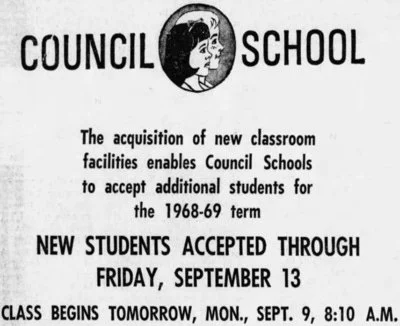
A 1968 advertisement for segregated private schools operated by the Citizens' Councils; caption via Wikipedia.

In the wake of Brown v. Board of Education, white evangelical parents fled from public schools into segregation academies — private whites-only schools run by evangelical leaders in Virginia, Arkansas, Mississippi, Alabama, and elsewhere. Running a school was expensive, so the administrators relied on the academies’ tax-exempt status as religious schools to cover their costs. Several Black parents in Holmes County, Mississippi successfully sued, meaning that as of 1971 any organization engaging in racial discrimination could legally be a charitable institution and thus has no right to claim exemption from taxes. White evangelicals had tried and failed (and have mostly succeeded ever since) to carve out a whites-only, government-free enclave within American society; the idea of joining an integrated, egalitarian nation horrified them and mobilized them into action. Jerry Falwell, the head of a segregation academy in Lynchburg, Virginia, seized the moment to become the public face of the new politicized evangelical churches.

The 1973 Roe v. Wade decision was the tipping point. Before Roe, conservative and evangelical Christian churches hadn’t taken much interest in abortion. But by 1976 they had become uneasy at the increase in the rate of abortions. To describe what happened next, I’ll quote historian Paul Boyer:

In the wake of Roe, many evangelical Protestants overcame their suspicions of Rome to unite with Catholics in opposition. (Protestants and Catholics had earlier found common ground, of course, in a shared anti-Communism.) The Catholic-evangelical rapprochement represents a crucial development in the post-1970 reorientation of American religion. … Waning denominational loyalties and the emergence of special-interest lobbies, plus Pope John XXIII’s liberalizing innovations, encouraged a new ecumenism built around shared cultural values and objectives. This, in turn, eroded anti-Catholic prejudices dating to the earliest English settlements in North America and later reinforced by heavy Catholic immigration. … Doctrinal differences persisted after 1970s, and evangelical and Pentecostal proselytizing among Hispanic Catholics continued to irritate Catholic leaders. But overall, evangelical-Catholic relations improved dramatically after 1970.¹
Paul Weyrich

This was good timing for right-wing activist Paul Weyrich. Now that the white evangelicals were off the bench, he was looking for an issue he could use to harness their potential voting power. Past conservatives had tried anti-Communism, but this was the pre-Reagan détente era; they tried economic issues, but it was still the tail end of the post-war boom. Even basic racism was no longer the go-to issue for grassroots evangelicals. They shifted instead to “cultural” issues, like government overreach (i.e., the IRS) and changing gender roles. But to the conservatives’ frustration it was Jimmy Carter of all politicians who had success with evangelical voters.

In 1978 Weyrich finally figured out the magic issue that would bring evangelicals to the Republican party: abortion. Weyrich connected with right-wing activists and leaders like Jerry Falwell to make overturning Roe a core value for evangelicals. When Falwell formed the Moral Majority in 1979, it gave the Republican party a solid base of right-wing, white evangelical voters. They turned decisively against Carter towards Reagan and never looked back. It also had the effect of locking the Republican party into a peculiar position. Conservative Catholics and evangelicals expected the Republican party to keep their anti-abortion ideology as a core doctrine in order to maintain their loyalty, despite its unpopularity. Opposition to abortion continued to decline over time — it was commonly accepted that an American woman had the rights of privacy and sovereignty over her body. Fanatical campaigns like the 1991 “Summer of Mercy” by the anti-abortion extremists of Operation Rescue did nothing but drive anti-abortionists further out of the mainstream. Adding to that trend was anti-abortion terrorism in the 1990s — like John Salvi’s attack on a clinic in Massachusetts; the assassination of George Tiller; and the clinic bombings by Eric Robert Rudolph.

Anti-abortion terrorist Rachelle “Shelley” Shannon in 1993 after shooting George Tiller; Tiller survived but was killed in 2008 by Scott Roeder.

The opposition to Roe became smaller but more concentrated and partisan, especially as the Republican party itself receded into a electoral minority (just barely). The narrow seizing of the Presidency in 2000 via Bush v. Gore taught the Republicans they could continue their grip on power even when out-voted as long as they manipulated the process. The ability of the Republican leadership to paralyze Congress and thwart the Obama administration confirmed their new model of purely partisan governance.

Their goal was no longer policy but power. Every American political institution, from state legislatures and circuit courts to Congress and the Supreme Court, was fair game to be dismantled and sold off to wealthy donors, mega-rich families, foreign lobbyists, and business trade associations. The success of the Tea Party movement in unseating established GOP leaders convinced the party leaders that their survival meant never getting outflanked on the right again.

By the 2010s the party was in a feedback loop. They wanted to keep their evangelical base, maintain control despite their shrinking demographic, and pursue their grandiose goal of permanently cementing their power via gerrymandering, the filibuster, and capturing the judiciary. To do all this they had to keep moving rightwards (taking the “centrist” Democrats with them) until there where was nowhere left to go within the boundaries of the existing Republican Party coalition. The only group left was the true fringe, the outsiders on the margins — Christian nationalists, hard-core libertarians, Internet cults, fascist militias. Anyone who could keep these groups engaged and energized would be the future face of the Republicans.

Donald Trump in 2019. Credit: Evan Vucci/AP

Before 2015, Donald Trump’s pointless Presidential campaigns combined massive egotism, shameless advertising for the Trump brand, and the paranoid insistence that Barack Obama was a Kenyan Muslim radical. But when Trump gained some traction the second time around he was suddenly the obvious choice to represent the party and what it stood for — inflicting suffering on the party’s enemies and designated targets, the kind of cruelty and revenge Trump had embraced from an early age. Republican donors and their politicians who ran the party thought they could use Trump as a tool to continue going as they had been. It didn’t work out that way.

It was supposed to be a two-pronged strategy. From the bottom up, Trump’s faux-populism would keep the remaining constituency engaged, using, among other things, the old anti-immigration race panic of the Great Replacement. From the top down, wealthy evangelicals and Leonard Leo-approved judges would focus on eliminating women’s rights, keeping with their almost-50-year-old goal.

Trump immediately went off the rails. Over the course of his 2015-2016 campaign, it became obvious to both parties that the GOP wasn’t using Trump as a tool, he was absorbing it instead. An ecosystem of mania and extremism took over the entire enterprise. Trump was no longer the face of the party’s future, he was the party’s future. It happened so quickly that most Republican Americans don’t actually know what their own party believes anymore.

The Great Replacement was part of that future. It had always been part of the party’s anti-immigration policy. After Trump was elected, his first wave of advisors included Steve Bannon, proudly open racist and right-wing ideologue; and Steven Miller, who openly embraced xenophobia and white nationalism. The influence of Trump, his family, and his enablers within the party continued to grow; the national conservative media, disciplined and trained to support the party leaders, couldn’t contradict Trump and his bigotry even if it wanted to.
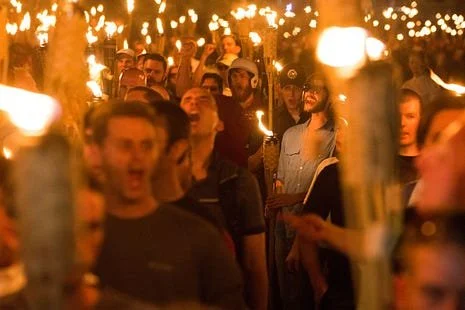
Unite the Right. Credit: Zach D. Roberts/NurPhoto

The ascendance of the Great Replacement in the modern GOP was completed in August 2017 at the “Unite the Right” rally in Charlottesville, Virginia. On the night of August 11, a torch-wielding mob chanted the phrase “you will not replace us!” which was a popular fascist slogan at that time. This quickly morphed into “Jews will not replace us!” echoing the earliest versions of the Great Replacement. When Trump refused to clearly comment them it was a signal of things to come. The party and its acolytes had already assimilated law enforcement with the emergence of Blue Lives Matter police cadres after the Ferguson protests in 2014. By 2017 it was clear there was a permeable membrane between police and vigilantes. To the party faithful this is how it should be; this alliance is vital to protecting party members from both an oppressive federal government and imaginary hordes of criminals, migrants, and degenerates. In a tradition going back to pre-Civil War slave revolts, white citizens imagined they and their property were constantly under an imaginary threat and thus perpetually justified in preemptive violence.

COVID-19 accelerated everything. The new party faithful had two responses: xenophobic violence (against Asians and immigrants) and paranoid delusions. How could the party do otherwise? But the refusal of the true believers to adhere to basic health protocols managed to shrink the overall party demographic even further, by how much is not yet known. It was so bad that despite the still-large number of party voters and the huge asymmetrical advantages rural, conservative states enjoy in the electoral college, Trump lost in 2020.
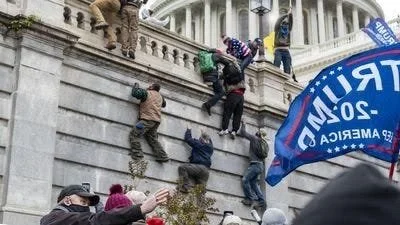
Photo: Blink O’faneye/Flickr

The party had no more right-wing constituencies to capture. It could expand by winning over some newly conservative voters, but that might take years and might just replace the aging party members. Efforts to recruit younger voters mostly resulted in more extremists joining the party, as they were the only young people interested. The only thing to left to do: make it as difficult as possible for anyone not in the party to vote, organize, protest, or participate in politics at all.

It was an old Jim Crow-era strategy of violence and intimidation — approved by parents, pastors and politicians, enforced by cops, judges, and jailers. It was kicked off by the mob attack on Congress on January 6, 2021. Trump intended to stage a coup that day, using the mob as his weapon. Even though that failed, the attack itself was successful in the historic feat of occupying and sacking the Capitol building. It inaugurated a nationwide campaign of terror and violence that hasn’t stopped since, coordinated by the party’s media apparatus, political leadership, funders, and armed militant wing. There are excellent accounts of the present state of the party but they usually try to suggest, or hope, that the party will come to its senses. In retrospect, however, the status quo reached in 2020 looks inevitable. [Editorial note from 2026: and of course Trump recaptured the White House anyway and went on to be one of the most unpopular Presidents in American history.]

Where was the Democratic Party? To quote Nikhil Pal Singh:

In the face of this challenge, it is difficult to judge the Democratic Party as anything more than a feckless, mildly recalcitrant partner. Over the past 40 years, it has alternatively sought to ratify, in gentler tones, GOP-driven projects and demands to lower corporate taxes, get tough on crime, end welfare as we know it, expand the ambit of deportation and sustain open-ended military authorisations. It has sought to placate vulnerable constituents with forms of symbolic recognition and modest regulatory action, often undergirded by weak executive authority and moral sentiment. It is the undeniably saner and more constructive of the two electoral options Americans are forced to choose between. But it also operates an effective pincer movement against alternatives further to the left that seek to transform skewed imbalances in the power of capital and labour, police authority and public safety. When constituents choose to fight, for example, against police abuse, or for labour rights, Democrats are missing in action, or else warning against unpopular opinions that will awaken the monster on the right. Forever counselling that we choose the lesser evil, they have instead grown habituated to living with the fox inside the chicken coop.

That finally brings us to the end of Roe.

Samuel Alito, Amy Coney Barrett, John Roberts, Clarence Thomas, Neil Gorsuch and Brett Kavanaugh committed a monstrous act of violence against American women and their families. In the context of 2022 that act has to be seen as part of the ongoing Republican campaign of psychological and actual warfare. It’s also meant to reverse to the Great Replacement, alongside all the mass killings inspired by that old race panic. Post-Roe America is a joint white evangelical/right-wing Catholic eugenics project. White women are forced to carry their children to term while the “unfit” are excised from the nation. “A victory for white life.”
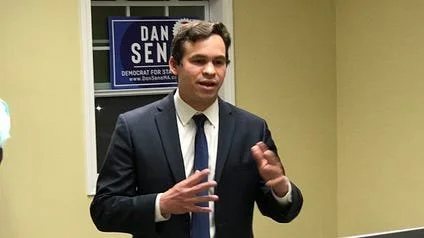
Danillo Sena. Credit: Nashoba Valley Voice

A couple years ago, a stranger knocked on our door. He told us his name was Danillo Sena. He was running for a seat in the Massachusetts House of Representatives and was canvassing the neighborhood. This was during the 2020 Presidential race and our north-central Mass. town was upholstered with Trump flags. Danillo saw our pride flag draped over our porch rail so he felt comfortable paying us a visit.. He was running for the seat against a local Republican woman who happened to be the realtor who sold us our house. Danillo told us he was born in Brazil in the 1980s; now he was living in Acton. As we talked it occurred to me that I’d never had an American politician in my kitchen and probably never will again. He was proudly progressive and clearly excited to be running in the hopes of making a difference to his community. We wished him the best but he didn’t need it — he won the election against the realtor by about 2,800 votes. The realtor only won her own hometown, which happens to by the town I live in. Even she had to admit that he “ran a good campaign and is a very nice young man.” He won his next election too. It felt different that the usual liberal talk of how great voting is, and how the idea of voting itself will save us. This time it wasn’t a lesser evil, we were affirmatively voting for someone we liked and agreed with. It had been a long time.

Does it mean anything that a young progressive Brazilian immigrant can beat the odds in 2020 and 2021? I choose to believe it does and I want to to believe that too. Everything that led to the criminalization of abortion might have building for 40 years but that also means it’s in the past. The future is people like Danillo Sena. It’s the fact that almost 1 out of 6 young people identify as LGBTQ+. It’s the unbelievable return of unions to the United States. It’s Americans realizing their government has no use for them so they will take care of themselves instead. Stirrings of suspicion about law enforcement, the widespread realization the US government could be more supportive any time it wanted to, real proof that it doesn’t just feel like everything has gotten worse over time, it truly has, at a time when most of the world’s wealth is passed around between the same few individuals. In themselves these aren’t necessarily inspiring, but they might be if they wake up the non-conservative masses to the truth that things don’t have to be this way. Not to mention: it’s not 1973. There are organizations and networks in place to get people what they need, sometimes out of sight because if the cops could find them they would crush them. It’s not the kind of activity that needs celebrities, or charity balls, or Democratic party co-optation. They need money, and resources, and protection, and time to grow. Sometimes you burrow down and gather and wait until the time is right to surface again. Maybe once the shellshock and numbness of the last two years have worn off, maybe long after that. Evil isn’t the only force in the world that can execute a 40-year plan.
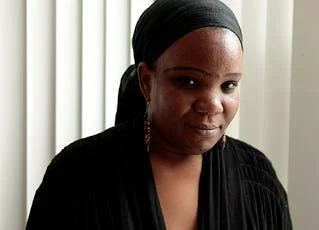
Miriame Kaba. Credit: Terrence Antonio James/Chicago Tribune

There’s a well-known quote by the activist Miriame Kaba: '“hope is a discipline.” In January 2018 she explained where that came from in a conversation with Brian Sonenstein and Kim Wilson on the Toward Freedom podcast:

The idea of hope being a discipline is something I heard from a nun many years ago who was talking about it in conjunction with making wire we were of the world and in the world. … The hope she was talking about was this grounded hope that was practiced every day, that people actually practiced all the time. … That speaks to me as a philosophy of living, that hope is a discipline and we have to practice it every single day. Because in the world which we live in, it’s easy to feel a sense of hopelessness, that everything is all bad all the time, that there is nothing going to change ever, that people are evil and bad at the bottom. … I choose to think in a different way and I choose to act in a different way. … Hope is really believing in spite of the evidence and watching the evidence change. … I believe ultimately that we’re going to win, because I believe there are more people who want justice, real justice, than there are those who are working against that.

Footnote (1): Paul Boyer, “The Evangelical Resurgence in 1970s American Protestantism,” in Rightward Bound: Making America Conservative in the 1970s, ed. Bruce J. Shulman and Julian E. Zelizer (Harvard University Press: Cambridge, Mass., 2008).
"A Victory for White Life," pt. 1

Dobbs and the Great Replacement ideology

Note: this was originally posted on my Substack on June 30, 2022. I deleted that Substack a couple years ago and I’m reposting these here so they don’t get lost.

Now that the US Supreme Court has stripped women of their constitutional right to privacy and autonomy over their own bodies, anti-abortionists are taking a victory lap to gloat and celebrate their triumph over 50% of the US population. Among the festivities was a old-fashioned Trump rally June 25. These kind of right-wing entertainments have become normalized in 2020s America so mass media was set to ignore it — until a proclamation from Republican Rep. Mary Miller from Illinois gave away the game. “President Trump, on behalf of all the MAGA patriots in America, I want to thank you for the historic victory for white life in the Supreme Court yesterday.” Her spokesman Isaiah Wartman tried to walk back her comments by saying that (a) it was “a mix-up of words” and (b) she is the grandparents of several non-white grandchildren, which apparently gives her a pass. (Isaiah Wartman is not just a right-wing mouthpiece who works has also worked for Marjorie Taylor Greene, he has multiple PACs of his own in Georgia.) But when Wartman claims that Miller had a “mix-up” he is admitting that she had a Freudian slip; she said what she really wanted to say whether she consciously intended to or not. Of course she might have just been voicing her true opinion, which happens to be the same as the neo-Nazi motto of the 14 words. From the ADL:

"14 Words" is a reference to the most popular white supremacist slogan in the world: "We must secure the existence of our people and a future for white children." The slogan was coined by David Lane, a member of the white supremacist terrorist group known as The Order (Lane died in prison in 2007). The term reflects the primary white supremacist worldview in the late 20th and early 21st centuries: that unless immediate action is taken, the white race is doomed to extinction by an alleged "rising tide of color" purportedly controlled and manipulated by Jews.

This is the core of “Great Replacement,” the aspect of the white supremacist ideology that worries about the white “race” going extinct as a result of low white birth rates, high non-white birth rates, and immigration into those bastions of whiteness Europe and North America; thus it’s been a core belief in right-wing racist thought for generations in Europe and the US. It’s become especially popular among mass killers all over the world in the last few years, from Brenton Tarrant to Payton Gendron. (Not that anti-abortionists have any problem with violence.)

Mass media in 2022 has cringed over the movement of the Great Replacement panic from the militia fringe to the mainstream via Tucker Carlson, but a panic over whites losing their unique racial power and identity has been part of American politics for hundreds of years — the entire immigration policy of the US was founded on it. Mary Miller’s public declaration is perfectly in line with this history. But to fully understand the ramifications of Miller’s specific words we have to connect the dots between two different lines of racist thought: eugenics and the misogyny that expresses itself as anti-abortionism.

Anti-abortion extremists have long been fond of saying that birth control (including abortion) is equivalent to a policy of eugenics against Black children. It’s one of the arguments undergirding Clarence’s Thomas’s legal reasoning in Dobbs. When Clarence Thomas linked abortion with eugenics in 2019, he was, as usual, making up a historical precedent in an attempt to inject the barest tinge of tradition into his obsession with stripping Americans of their rights. His ahistorical linkage of eugenics and abortion appeared again in the decision making women second-class American citizens. So there’s at least a fifty percent chance Thomas actually believes it.

Even though Thomas gets his history wrong — his decisions are the raw exercise of unchecked power anyway, so he doesn’t care about historical fidelity — a link between the concept of eugenics and the promoters of white race panic was forged in the 1970s. The Great Replacement is that link.

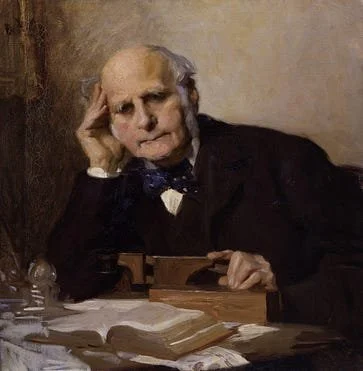
Francis Galton

The story begins with Francis Galton. Galton was born in 1822 in Birmingham, England. For the sake of space I’m going to gloss over Galton’s early years as a child prodigy and world traveler. When Galton finally settled back in England, he found his true calling: science and invention.

Galton was obsessed with numbers and counting — his personal motto was “whenever you can, count” — which led him to make great advances in statistics, where he invented concepts like the median and standard deviation. This in turn led him to advances and inventions in several other fields, including: meteorology, where he create the first weather map; forensics, where he separated fingerprints into six major types; perception, where he invented the Galton Whistle to test hearing, which became the first dog whistle; psychology, where he pioneered the use of questionnaires to gather data on large numbers of subjects; and various others, including a study on how to make the perfect cup of tea. But among these innovations, Galton’s real legacy would be in a field he personally created and named: eugenics.

Galton’s life was changed when his cousin, Charles Darwin, had his book The Origin of Species published in 1859. Galton was obsessed with the book, especially the section that dealt with the breeding of animals. Darwin only hints at using his theories to study variations in homo sapiens, so Galton decided he would go down that path himself. He was determined to unlock the secrets of human heredity by analyzing traits like height, fingerprints, facial features, and, crucially, mental characteristics like intelligence, which Galton assumed was inherited.

Since Gregor Mendel’s research was still unknown, Galton had to rely on gathering large amounts of data from a wide range of subjects, a project well-suited to his innovative statistical techniques and questionnaires. Using a technique he called “historiometry,” Galton analyzed numerous biographies of prominent men — judges, statesmen, scholars, premiers, scientists, military commanders, writers, and artists. He quantified this biographical information and converted it into tables and charts. Galton also looked closely at the families of these men, to see if they too had eminent relatives and if so, where their rise to eminence began.

Overall he analyzed 300 families and about 1000 individuals in total. He found that the “eminence” dropped off a bit for each preceding generation, and for the distance from the person in question; for example, cousins were less eminent than brothers. This pattern confirmed for Galton that genius was an inherited trait that accumulated over time. He published his findings in an 1869 book, Hereditary Genius. To say that this book doesn’t withstand modern scrutiny is putting it mildly. And despite the influence of Darwin, whose theories laid waste to centuries of “race science,” Galton recreates the old racial hierarchy inherited from physical anthropology by suggesting that the “negro race” is two levels of intelligence below the Anglo-Saxon race.

What made Hereditary Genius a landmark work was Galton’s suggestion that humans could use the inheritance of genius to actively direct the course of their evolution.

I propose to show in this book that a man's natural abilities are derived by inheritance, under exactly the same limitations as are the form and physical features of the whole organic world. Consequently, as it is easy, notwithstanding those limitations, to obtain by careful selection a permanent breed of dogs or horses gifted with peculiar powers of running, or of doing anything else, so it would be quite practicable to produce a highly-gifted race of men by judicious marriages during several consecutive generations. I shall show that social agencies of an ordinary character, whose influences are little suspected, are at this moment working towards the degradation of human nature, and that others are working towards its improvement. I conclude that each generation has enormous power over the natural gifts of those that follow, and maintain that it is a duty we owe to humanity to investigate the range of that power, and to exercise it in a way that, without being unwise towards ourselves, shall be most advantageous to future inhabitants of the earth.

Galton goes further and suggests that it will be necessary for the more advanced races like the Anglo-Saxons to consciously evolve in order to adapt to their own civilization, otherwise they are be in danger of dying out. Galton is especially worried that white families are delaying marriage to later and later ages and thus having fewer children.

The effect of this, he writes,

would be such as to cause the race of the prudent [i.e., those having fewer children] to fall, after a few centuries, into an almost incredible inferiority of numbers to that of the imprudent, and it is therefore calculated to bring utter ruin upon the breed of any country where the doctrine prevailed. I protest against the abler races being encouraged to withdraw in this way from the struggle for existence. It may seem monstrous that the weak should be crowded out by the strong, but it is still more monstrous that the races best fitted to play their part on the stage of life, should be crowded out by the incompetent, the ailing, and the desponding.

I’m quoting so much from Hereditary Genius because this is ground zero for Great Replacement rhetoric.

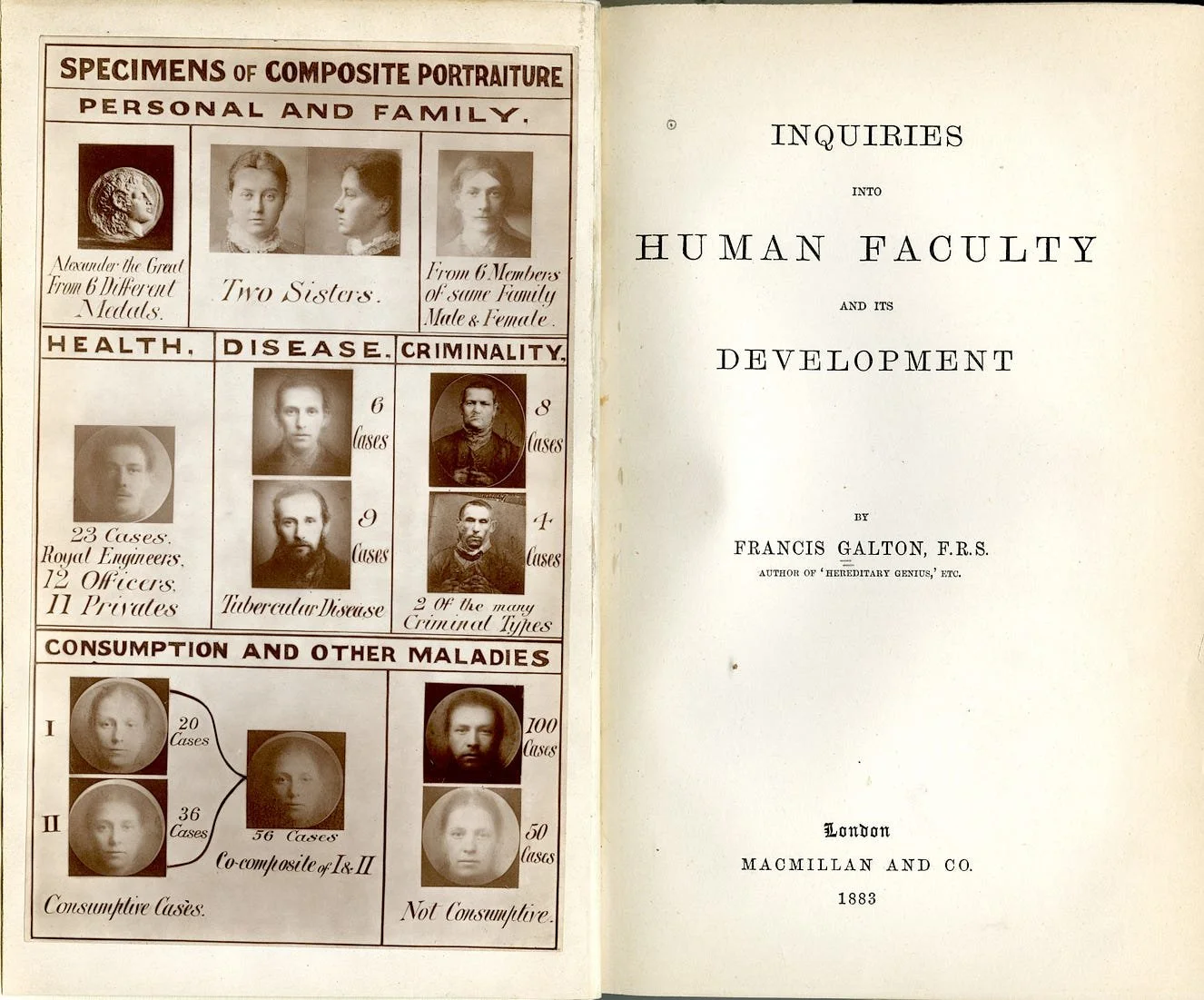
Inquiries into Human Faculty and Development, 1883

Galton’s contemporaries were skeptical. Hereditary Genius scrambles together complex mathematics and statistics with blanket assumptions and wild guesses. But Charles Darwin, at least, was impressed; in his book The Descent of Man he wrote: “We now know, through the admirable labours of Mr. Galton, that genius . . . tends to be inherited.” In his follow up book, Inquiries into Human Faculty and its Development (1883), Galton invents the term “eugenics” to describe this active improvement of humanity through selective breeding. A new pseudo-science, racialism wrapped in the trappings and rhetoric of rigorous science, was born. To understand how “white families should have more children” became the Great Replacement, we need to look at the work of a German doctor named Alfred Ploetz.

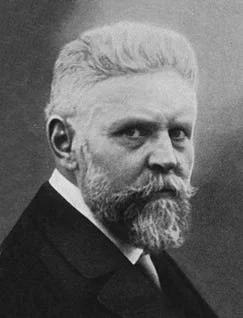
Alfred Ploetz

Alfred Ploetz was born in Germany in 1860. I’ll have to pass over his early years as well, though I will mention that he became committed to racist eugenics in his 20s and became a medical doctor at the age of 30.

While Francis Galton was receiving accolades for his eugenic ideas in Britain, Ploetz was quietly reshaping the future of eugenics with his 1895 book The Efficiency of Our Race and Protection of the Weak. Galton wanted governments and nations to encourage the best families to have more children; Ploetz emphasized the importance of preventing so-called degenerates from breeding. Marriages and children, he wrote, should only be allowed by society and the state. For the sake of the nation the sick, the weak, the disabled, twins, and those whose parents were too old or too young should be, in Ploetz’s words, “eliminated.” Ploetz’s ideas were the logical end point of Galton’s eugenics. Whereas Galton was content to rhapsodize about a better world through elites having large families, Ploetz’s racist eugenics was how Galton’s ideas were put into practice.v1895 was also the year that Ploetz created the term Rassenhygiene, “race hygiene,” to describe his approach. It was a term that would stick as he found that the German-British-American science axis was a receptive audience for his ideas.

Grundlinien einer Rassen-Hygiene, 1895

On June 22, 1905, Ploetz founded the German Society for Racial Hygiene with only 31 members, but two years later it had grown to the point where it renamed itself the International Society for Racial Hygiene. Its goal, according to Ploetz, was "for society to return to a healthy and blooming, strong and beautiful life.” The Society received strong support from the German imperial government, and their ideas began to take root elsewhere, as similar societies formed in the United States, Sweden, the Netherlands, and Britain. The United States was especially interested in applying “race hygiene” to a specific problem: immigration.

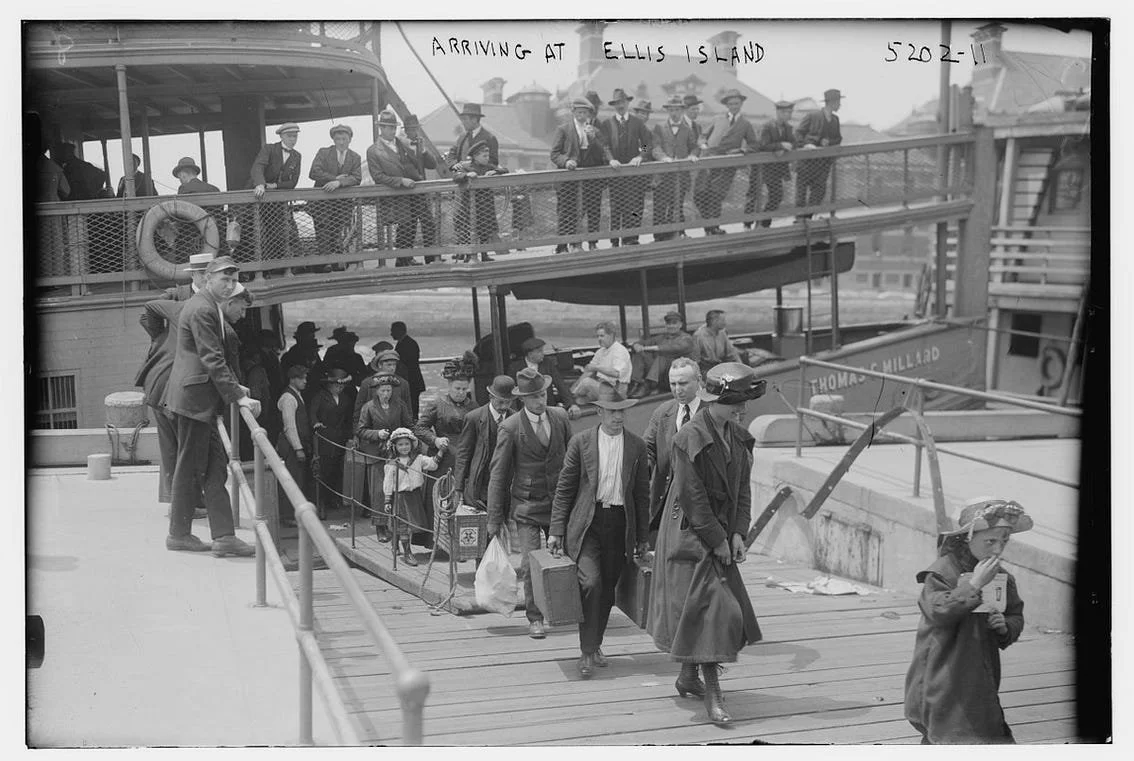
Between 1870 and 1900, twelve million immigrants settled in the United States. It was the largest influx of immigrants in US history to that point. They were mostly from Germany, England, Ireland, Scandinavia, and China, the latter of whom had already been coming in large numbers to work on massive railroad projects in the Western US. 70 percent of these 12 million immigrants came through New York City, and if they didn’t settle there, they usually traveled to other urban centers like Chicago or Philadelphia to look for work.

These new arrivals were treated badly. The public and private sectors discriminated against them, which in turn kept them in a state of economic insecurity at best and hunger and poverty at worst. They were thus stereotyped as dirty, lazy and stupid, which encouraged discrimination against them, forming a feedback loop of bigotry. “Anglo-Saxon” white Americans were deeply anxious that their bloodlines would be diluted and eventually erased completely by the sheer numbers of these physically diseased and inferior specimens, especially those from Italy, Greece, Spain, or Central Europe. This centuries-old anxiety about vice and degeneracy as a moral and physical contagion could now be validated by the discourse of science and medicine, via the scientific literature and professional associations devoted to eugenics.

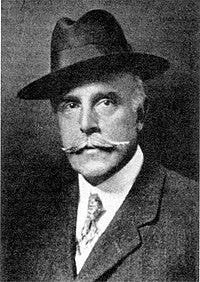
Madison Grant

White American anxiety over immigration was the perfect moment for Madison Grant. His book The Passing of the Great Race was published in 1916. It was the most popular and influential book on race science before World War I. It was the first true expression of Great Replacement rhetoric, with Adolph Hitler admired Grant’s work though he preferred the term Aryan to Nordic. In 1930s Hitler wrote Grant a fan letter where he called The Passing of the Great Race “his Bible.”

Madison Grant brought the eliminationist racism at the root of Ploetz’s eugenics to the forefront of American discourse. In Grant’s 1916 version, the superior Nordic race is under threat by immigrants from southern and eastern Europe. “A rigid system of selection,” he writes, “through the elimination of those who are weak or unfit – in other words, social failures, would solve the whole question in one hundred years, as well as enable us to get rid of the undesirables who crowd our jails, hospitals, and insane asylums.” He thought that “unfavorable” races should be segregated into ghettos, overseen by public health officers given absolute power. This would prevent the superior Nordic race from committing “race suicide” by marrying and having children with inferior races.

At the very time The Passing of the Great Race was published, the supposedly superior white Europeans were slaughtering each other by the hundreds of thousands. The Great War interrupted the German side of the eugenics axis, but in the United States, the war would be the final piece that transformed the US into a full-fledged eugenicist republic.

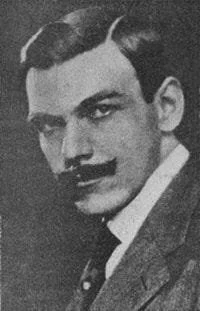
Lothrop Stoddard

In the aftermath of the Great War, a wave of xenophobia swept across Europe and America. A wave of violent racism directed against African-Americans, Jews, and ethnic minorities swept the country; late winter through early autumn of 1919 came to be known as the Red Summer because so many hundreds of black Americans were attacked, lynched, or murdered across the US by rioting white Americans. It was also the first Red Scare, when Americans became paranoid about the influence of Bolshevism and Anarchism infiltrating the US — not only through Jewish and Italian immigrants but also African-American labor organizers and civil rights leaders. The Klu Klux Klan had been re-founded in 1915 and now its numbers swelled. Perhaps the most prominent member of this new Klan was Madison Grant’s protégé, Lothrop Stoddard.

Stoddard’s 1920 book The Rising Tide of Color Against White World-Supremacy made Grant’s racist theories of the white civilization against non-white barbarism even more popular. Stoddard’s book The Rising Tide of Color Against White World-Supremacy But things had changed in just the four years since The Passing of the Great Race —whereas Grant was concerned with the Nordic race diluting its purity by mixing with those from the Mediterranean or Russia, Stoddard focused his racist ire on black Americans and the poor.

Stoddard was also a member of the American Eugenics Society. Founded in 1923, it was mostly made up of 28 state committees that used state fairs to popularize the concepts and practice of eugenics. In addition to these efforts, the AES also lobbied for the wider use of intelligence tests on students and immigrants to the US. But at this point the lobbying was almost unnecessary, as the US government had was determined to restrict immigration to almost nothing, thanks to the work of American psychologist Robert Yerkes.

The Great Replacement paranoia was now codified into federal government policy over immigration and sterilization (since the Buck v. Bell case), the latter of which is a huge topic I can’t cover here. To understand how this all connected with the backlash to Roe v. Wade, we have to fast forward to the 1970s. I’ll cover that and more in part 2.

WE SHALL BE CRIMINALS

How to Survive in America

Note: this was originally posted on my Substack back on May 27, 2022. I deleted that Substack a couple years ago and I’m posting these here so they won’t be lost.

WE SHALL BE CRIMINALS because the law has declared that we are one angry cop, one medical bill, one wellness check, one housing shortage, one traffic stop, one power outage, one biased judge, one fascist vigilante, one border checkpoint, one polluted river, one pregnancy, one viral infection, one drone strike away from death; because the law believes with all its heart that these deaths are right and just; because the law has made our identities, our everyday actions, and our existence criminal;

WE SHALL BE CRIMINALS because shoplifting is a crime but wage theft is legal; because being unhoused is a crime but evicting people to build empty luxury apartments is legal; because you or I not paying our taxes is a crime but when the wealthiest people in history ignore or evade their taxes it is legal; because resisting arrest is a crime but elected politicians overthrowing the government is legal; because manslaughter is a crime but 1 million Americans dead from COVID is legal;

WE SHALL BE CRIMINALS because we will reclaim our right over own bodies; because getting an abortion makes us criminals; because transitioning makes us and our families criminals; because using our preferred pronouns makes us criminals; because being a woman means the law will not protect you from harassment, violence, and terror; because being disabled makes us disposable; because being a minor gives one no standing or protection before the law;

WE SHALL BE CRIMINALS because criminals are not satisfied with Facebook posts and human resources seminars and Instagram posts and book clubs and tweets and diversity, equity, and inclusion initiatives and YouTube videos and cable television interviews and Twitch streams and corporate logos and political speeches and thoughts and prayers;

WE SHALL BE CRIMINALS because Metacomet and Nat Turner and Tecumseh and John Brown and Harriet Tubman and Ellen and William Craft and Henry “Box” Brown and Sojourner Truth and Frederick Douglass and William Lloyd Garrison and Ida B. Wells and Alice Paul and Eugene Debs and Emma Goldman and Big Bill Haywood and Rosa Parks and Diane Nash and A.J. Muste and John Lewis and Anne Braden and Bayard Rustin and Martin Luther King, Jr. and Fannie Lou Hamer and Malcolm X and Kwame Ture and Leonard Peltier and Fred Hampton and Dolores Huerta and Susan Rosenberg and Rasmieh Yousef Odeh and Chelsea Manning and the Standing Rock Sioux Tribe and a thousand others were criminals;

WE SHALL BE CRIMINALS because people who are not rich or not white or don’t speak perfect English who try to enter the United States are ignored for years; because people to try to cross America’s imaginary border without waiting for years are labeled illegals by the law and stripped of their human rights; because the illegals have their children taken from them; because the children of the illegals are housed in camps where they are starved, abused and drugged; because the illegals are hunted, captured, jailed, and deported, no matter how long they have lived in the United States; because the the law has decided the illegals can be cheated, exploited, and killed at work with no consequences;

WE SHALL BE CRIMINALS because our geography is sculpted by the law; because the law is founded in private property and the law determines what counts as private property; because littering is a crime but polluting waterways and oceans is ignored; because when a corporation breaks the law on a massive scale and pays a fine as a result, the corporation considers it a cost of doing business;

WE SHALL BE CRIMINALS because Americans cherish catching criminals using forensic science like pattern matching evidence, DNA analysis, hair analysis, firearm analysis, shoe print analysis, tire track analysis, handwriting analysis, bite mark analysis, line-ups, breathalyzer tests, psychological profiles, and lie detector tests, even though there is no proof that these methods are reliable, useful, or honest; because it is legal for the law to lie to you; because it is legal for the law to pressure you to confess to a crime you did not commit; because innocent prisoners are not allowed to show proof of their innocence or that their lawyers were incompetent;

WE SHALL BE CRIMINALS because the law in America gets qualified immunity; because the law shoots an average of 1,000 people every year; because the law has filled the jails to overflowing; because the law sees mass shootings coming a mile away does nothing to stop them; because the law forms gangs within their own ranks; because the law plants evidence; because the law gets the vast amounts of money shoveled into its budget while vital social programs disappear; because the law embezzles public money and seizes assets; because the law kills 3 times as many black Americans that any other racial group; because the law in America in known around the world for being arbitrary and brutal;

WE SHALL BE CRIMINALS because there are more people incarcerated in the United States than anywhere else in the world; because the law allows us no alternative; because we break the law by talking about breaking the law; under the law there is nothing to do, nowhere to go, and no one to be that will not be against the law; because criminals will be brave in America; criminals will thrive in America, criminals will survive in America.

Charming the Pandemic Hobgoblins, Part 2

What We Talk About When We Talk About COVID: Neoliberalism Edition

Note: This was originally posted to my Substack on May 6, 2022. I deleted that Substack a couple years ago and I’m reposting these blogs so they won’t be lost.

This is the second part of a piece looking at the COVID pandemic not as a biological phenomenon but as a social phenomenon. Not the pandemic as the global transmission of a dangerous disease, but the pandemic as the large-scale social implications of that transmission — most importantly the reaction to those implications. Two ideologies reacted to the pandemic by rejecting its real impact. On the one hand are the Hyperrealists, who insist that the pandemic cannot exist; the reason why is in part 1. On the other hand are the Neoliberals, who insist that the pandemic cannot continue to exist. You don’t have to read part 1 to understand part 2.

Ever get the feeling you’ve been cheated?” - Johnny Rotten, 1978


Fables of the Deconstruction

Four stories about America:

From Revolution to Retirement. A wave of speculation and greed in America resulted in the crash of the Great Depression. A combination of New Deal welfare policies and WWII pulled the US into an unprecedented post-war boom economy. Many children of that prosperity demanded a more just and equal society. Just when it looked like it might be achieved, their dream was quashed by the old powers. The post-war boom thudded to a halt. Their allegiances split apart; former allies became enemies. Their faith in American government institutions were shaken in the 1970s, from the release of the Pentagon Papers in 1971 to the resignation of President Richard Nixon in disgrace in 1974. Their glory days over, disillusioned about the potential of politics to improve society, they turned inward, finding inspiration only in personal health and personal wealth and thus proclaiming their belief in “personal responsibility.” Collective struggle had proved fruitless; all that remained was individual success. They entered their long twilight years pulling up the ladder behind them, the beneficiaries of a generous society they had lost faith in and so dismantled.

From Revolution to Revenge. In 1954 the Supreme Court of the United State came to the conclusion that racial segregation of children in public schools was unconstitutional. A year later, motivated by this victory, the nascent forces of the post-war US civil rights movement coalesced into a mass movement. Despite the “massive resistance” strategy of the racist Jim Crow state leaders, the Civil Rights Act of 1964 outlawed discrimination based on race, color, religion, sex, or national origin for the first time in American history. After that high-water mark, the counterrevolution began, one determined to roll back civil rights to before Brown v. Board, restore “states rights” and reversing popular acceptance of racial, gender, and equality. When racial desegregation proved too popular, right-wing religious leaders looked to the 1973 Roe v. Wade decision as a rallying point for a coalition of religious, political, and cultural reactionaries and their funders. This coalition came to power in 1980 with the election of Ronald Reagan. After decades of capturing legal institutions, rolling back civil rights and voting laws, reversing policies of racial and economic inequality, they finally achieved their goal of erasing two generations of social progress in the reversal of Roe in 2022. To cement and protect their gains, they had enlisted police departments, violent thugs, bigoted petty bourgeois, and right-wing lawyers as their vanguard. Nevertheless, despite their triumphs they clung to their conviction that they will forever be victims of a corrupt, degenerate, Godless society. Their mission mutated into an endless struggle to destroy their own society in order to redeem it.

The Power of Currency. The foundation of the amazing post-war American economy was an alliance between the federal and local governments, giant corporations, banking and finance, and labor. As long as the economic pie got bigger there were always enough slices to go around. The Federal Reserve Bank went about its duty of full employment, ensuring the prosperity was shared. Then in the mid 1970s came the turning point. The end of the Bretton Woods agreement, the Nixon Shock, the oil crisis, stagflation. The pie shrank and the bitter fights over the smaller pieces tore the post-war alliance apart. In the late 1970s the finance sector formed a new partnership with American politicians. Financial institutions and their corporate appendages would manage the economy by unleashing markets free from oversight, supported by policies that favored social stability and greater profits above all. In return the government would shrink, eliminating its previous function of providing basic social welfare and safeguarding civil society against corruption. The demand for stability led naturally to conservative — even reactionary — politics, and greater profits demanded economic austerity for the American populace. These two demands were the essence of neoliberalism, and they became the guiding principles of American politics for the next forty years. Unions were undermined and rendered powerless by global companies chasing low operating costs, as demanded by their shareholders. Wages stagnated in 1979 and never rose again even as worker productivity continued to increase. The idea of public good was replaced by an ethos of unforgiving individualism. Aspects of everyday existence like work, transportation, and health care were privatized, monetized, and thus controlled by gigantic monopolistic institutions immune from public scrutiny. At the same time, the broader economic growth promised by the neoliberals was nowhere to be found. Instead came rentier capitalism, arbitrage, unsustainable venture capital, tax breaks for giant corporations, subsidies, pyramid schemes, hidden wealth, and speculative bubbles. Profits were privatized, losses were socialized. American millionaires became billionaires, then trillionaires. The markets held sway over all.

The Currency of Power. To keep the population from challenging the harsh inequality of the neoliberal economy, a massive system of surveillance, incarceration, and lawfully protected violence was inaugurated. In the wake of the 9/11 attacks, this latter system of violent social repression became a self-justifying, self-sustaining entity, beyond the control of the politicians and financiers who had created it for their own ends. The self-styled citizens of this shadow carceral state began to see themselves as the true stewards of the United States. Unmoored from any socio-political purpose, radicalized by right-wing media, energized by Internet-fed moral panics, they actively embraced several basic tenets of fascism: nationalism as an identity; loathing of other races and genders; unreflective action for its own sake; life as permanent warfare; syncretic occultism; hyper-gendered patriarchy; and insisting that they alone are the true voice of the people, no matter how small their numbers or unpopular their beliefs. Right-wing American politicians tried once more to assert control over this fascist crypto-party, only to be overtaken yet again by the anarchic police riots and paramilitary rallies of 2014-2020. The apotheosis came with the storming of the Capitol building on January 6, 2021. At that moment the crypto-party absorbed the actual Republican party.

What Was Neoliberalism?

The common thread of these stories — the skewer impaling every piece of American society — is an ideology that pretends to disdain ideologies in general: neoliberalism.

What was neoliberalism? I’m going to ignore the ongoing debate around the precise definition and lay out what everyone commonly agrees are the basics.

(Quick note that neoliberalism has nothing to do with liberal politics.)

Classical economic theory had thrown the US post-WWI prosperity into the bottomless pit of the Great Depression by 1930. To dig out of the hole of 24% unemployment, the establishment turned away from the old boom-and-bust cycles and towards Keynesian economics. Keynes articulated the link between the labor market and the stock market, especially the inverse relationship between interest rates and unemployment. The government could directly inject money into the economy to smooth out the boom-bust cycles which in turn kept unemployment manageable. It brought the US into the largest, longest boom in its history.

The price the government eventually paid for this fiscal policy was inflation — too much money chasing too few goods. Keynes thought high inflation would only kick in at full employment; besides, manageable inflation was the sign of an economy that was growing, not stagnant. But in the mid-1970s the economy both stagnated and hyper-inflated. The Keynesians couldn’t explain this nor figure out a way to stop it. The economy was eventually pulled out of this morass — in no small part by the Federal Reserve engineering mass unemployment and the US government dismantling the welfare state created by the New Deal. (This created a wave of poverty and homelessness that continues to the present.)

Keynesian economics was discredited; classical economics was exhumed. But the new classicists went farther than their predecessors. After the Great Depression the federal government put in place financial safeguards and legal guardrails to keep the corporate/financial sphere subordinate to the political sphere. The purpose of having an economy, after all, was to create and spread prosperity for all citizens, as equally as possible. The neoliberals flipped this on its head. If the American government wanted the economy to grow again it would have to get comfortable with things getting worse for some citizens in order for things to get better for others. Equality of opportunity would replace equality of outcome, meaning each individual’s poverty reflected their own determination to succeed, not a policy . Competition would replace cooperation; this naturally meant an economy of individuals, not cooperatives like unions or activist organizations. National sovereignty itself would give way before the World Bank, the International Monetary Fund, and the World Trade Organization. The ideology of The People would diminish so the non-ideology of The Market would rise in its place.

The political, cultural, and financial ruling class spent the years between 1980 and 2007 recalibrating every aspect of America to match the vision of a society shaped by corporations and devoted to deregulating and expanding global markets. If the results of this free market society were Dickensian squalor or rampant corruption and speculation it must be that the markets themselves were not free enough. Capital itself — and thus its devotees — was not motivated by good or evil; its amorality rendered it innocent of consequences.

Then the whole thing fell apart, at the same time, all over the world.

Dead Plan Walking

There were numerous, complex reasons the global economy collapsed in late 2007 and 2008. They were all just the proximate causes. Neoliberal socio-economics was the ultimate cause.

Just as the Great Depression made classical economics obsolete and stagflation discredited Keynes, the Global Financial Collapse exposed the rotten core of neoliberalism. It should have been replaced with a theory to match the new realities of the world, one which might have emphasized the value of international collaboration around potential mega-projects like reversing the climate crisis. Or it could have led to a reflective, domestic economics, using new technologies and a renewed labor alliance to create a new age of of prosperity and leisure, lifting millions out of poverty. More than enough wealth had been created over the last four decades, it just needed to be tapped into. But nothing changed.

It may be … that the most catastrophic feature of neoliberalism was the belief that it was a thing. It was not. It was not an order. While it certainly had durable features: capital’s urge to break worker power, say, or the ruthless march into all quarters of atomizing market logic, these cannot provide a particular period’s internal logic. They are inbuilt to capitalism: there at the beginning, there at the end. If “neoliberalism” describes a certain level of development for these features (and we are not sure it does even that) it cannot simultaneously explain how they reached those levels. Meanwhile, what seems increasingly clear to us is that the span was characterized by no particular social coordination conscious or automatic, liberatory or maleficent. Neither capital nor its antagonists had a plan, really. “The new spirit of capitalism” was attrition, extraction, and exhaustion. Growth ended and stayed ended. For all the chitchat about hyperpartisanship and polarization, the center endured, a gray parade of necromancers one after the next pretending to raise accumulation from the dead. There was a bunch of path dependency. It further immiserated a vast portion of a largely immiserated world. The last couple of years have absolutely felt like a kind of passage. And yet: volatility has given onto volatility, impasse onto impasse. - Nikhil Pal Singh and Joshua Clover, “Static and Signal: Part One

Nothing new has has overthrown neoliberalism. No ethos of commonwealth has replaced Americans’ obsession with personal wealth. If anything the hyper-individuality has intensified. It’s every person for themselves without a net, especially when it comes to social problems like health care, education, the environment, housing, exploitation at work, and personal safety. The latter category includes factors outside our personal control, like gun violence, food safety, physical and mental disability, and car safety.

That finally brings us to the pandemic.


Get Down with the Sickness

If I were to ask you if the pandemic is a health crisis or an economic crisis, what would you say? You would probably say a health crisis, obviously. You might say both. I’m going to guess you wouldn’t say it was a cash flow problem that should be handled by managers, consultants, and markets.

Nobody disputes that the Trump administration made the pandemic worse in every possible way. The media likes to say they “bungled” it but that doesn’t sound strong enough for 25 million confirmed coronavirus cases in the US, over 400,000 of which resulted in death. Trump has always valued his own family’s enrichment above all, so in March 2020 he chose Jared Kushner to manage the government response. It resulted in a wave of corruption that at any other time would have been a massive scandal. Instead of choosing a new leader from the field of public health, Trump next turned to Peter Navarro, his trade advisor, whose January 2020 warnings about CORONA Trump had ignored. Unable to get a response from Trump, Navarro privatized the response just like Kushner had, and just as incompetently. After spending a billion dollars on supply contracts with nothing to show for it, he shifted in May 2020 to pushing hydroxychloroquine as a COVID cure-all. All while Trump insisted over and over that businesses and schools in America had to “reopen.” After years of incompetence and inaction, surely Joe Biden would put the public health experts in charge.

In December 2020, Biden assigned the COVID logistics job to Jeffrey Zients. Zients had directed the National Economic Council; had assisted Barack Obama with economic policy; served as the chairman, CEO, and COO of the Advisory Board Company, a health care business consulting group; served as the chairman of the Corporate Executive Board; founded the the investment firm Portfolio Logic, which focused on the health care business; was the CEO of Cranemere; and served on Facebook’s board of directors. This was the extent of his public health experience. He was supposed to bring managerial acumen to the implementation of Biden’s COVID policies along with coordinating the supply chains.

But Zients was part of the neoliberal establishment — a man of markets, not morals. If the public had looked closer, they might have noticed that he was as corrupt as anyone in the Trump administration. He could have used the Defense Production Act to finally mobilize an effective government response, but that was never a realistic possibility as long has the US Chamber of Commerce didn’t like the idea. Neoliberals didn’t like the idea of financial support for struggling Americans — we left government intervention behind with Keynes — so it stopped.

As the delta wave crested in the summer of 2021, the CDC (via Zients) claimed that vaccinated people had nothing to worry about; it was now a “pandemic of the unvaccinated.” This was neoliberalism at its neoliberaliest: you, an individual, had to make the rational choice to avail yourself of the vaccine. Public health had to make way for private health. When the omicron wave hit, the new mantra became “we have the tools” to fight the virus: vaccines, masks, and testing. Of course you didn’t have to get the vaccine or even get tested if you didn’t want to; you didn’t have to wear a mask around other people; and tests were hard if not impossible to get. It was all a matter of assessing your own personal risk, because everything was personal. The dismissal of immunocompromised people, Black Americans, and other high-risk groups bordered on eugenics. From an economic point of view the real victims were landlords and upper management. The markets, however, soared into the stratosphere.

When it looked like omicron was finally over and before another wave had a chance to appear, Jeff Zients quit. By then both the Hyperrealists and the neoliberals had joined forces to create what Tom Scocca calls “the ideology of Unlimited Covid.”

Supported by an alliance of conservative and liberal officials and amplified by both groups' preferred media, Unlimited Covid has evolved from a de facto national strategy to an explicit ideology. Rural farmers, suburban business owners, and urban professionals alike are now working diligently toward the goal. 

The result is the world's highest overall coronavirus death toll and the highest current daily number of deaths, as the nation of 330 million encourages the omicron variant to spread. Since the start of the pandemic, American life expectancy has declined by at least 1.8 years. 

Rather than fight the pandemic, the nation has embraced a goal of fighting against the fight against the pandemic. While other countries monitor case counts or hospital capacity, the United States is focused on driving the number of closures, vaccination requirements, and mask orders down to zero. Even where there are no closures, the most dedicated Americans battle against them anyway.  


The Neoliberal Society and its Future

In part 1 we talked about how Hyperrealism can only be resisted through taking away their power. No appeal to sacred democratic institutions or the better angels of their natures will have any effect. For all its terrorism, Hyperrealism’s dependency on power is its weak spot. Power can be resisted with power. The crucial point: it has to be collective, unified power. The right wing, despite its cruel stupidity, understands this. It’s how Roe v. Wade was nullified, with a century of civil rights soon to follow.

Neoliberalism has the same weakness. Sustained collective action, mutual aid, and rolling back the gigantic carceral state are just three examples of how we can finally start to recover from the slow-motion disaster of the last half-century. Generosity, not austerity, might save us from the darkness of a neoliberal future. Voting as an individual act, isn’t a threat to neoliberalism. But collective direct action like the Black Lives Matter protests threaten both the soldiers of capital and the masters of the markets. Voting is especially useless because markets, by their nature, are undemocratic, even anti-democratic. They privilege property over people and always will.

Voters in a democratic country with a solidly neoliberal economy are choosing between conservative technocrats and ultra-conservative populists. The latter are obviously brutal, but the former are just quieter about their cruelty. In the case of Roe’s reversal, the technocrats wanted open debate, a hearing of both sides, free speech and opinion. The right-wingers wanted the power of life and death over women and their bodies; with nothing to stop them they reached out and took it. The technocrats’ framework allowed this violence to appear, violence which will now shred that framework from within. The logic of neoliberal economics leads to the violence of right-wing politics.

The future of a post-neoliberal civics will depend on the American middle class. Middle-class Americans embrace neoliberal socio-politics because they’re convinced there’s no alternative to the zero-sum death struggle inside the neoliberal thunderdome. Pretending otherwise, they believe, is naive, immature, even dangerous. Thus they rationalize away their inability to find common cause between classes, within their own class, and even within their own communities. Crises that require a collective response, like the pandemic or climate collapse are set aside, then indefinitely deferred.

There seems to be a dawning realization even among the middle class that living as atomized individuals under decades of economic austerity and an unchanging social status quo made them into suckers. Theodore Adorno put it this way:

The individual has been, as it were, merely invested with property by the class, and those in control are ready to take it back as soon as universalization of property seems likely to endanger its principle, which is precisely that of withholding.

In other words, just like the rest of us they won’t get an even break. So what do they have to lose but their chains?

Charming the Pandemic Hobgoblins

I’ve argued that the answer to charming away the two pandemic hobgoblins, the two frightening ideologies that got us here and won’t get us out of it, is power, amassed and used collectively, for mutual benefit. Easy for me to say. But it’s starting to happen. There will be a backlash, but those of us born since the mid-1970s have lived our whole lives in a backlash to the events of 1954 to 1970. We’re long past due for a backlash to the backlash.

Maybe there won’t be any lasting social impact from the COVID pandemic, just like the 1918-1919 influenza pandemic faded into near-obscurity when the worst was over. For the Hyperrealists the pandemic exists outside the America simulation, and thus never really existed at all; for the neoliberals the pandemic has to stop mattering so the markets can once more take precedence. There are ways for us to slip between these two dead ends, we just have to see one, set our feet on the path and start moving. As Adorno put it, “The almost insoluble task is to let neither the power of others, nor our own powerlessness, stupefy us.”

The Swans

I started this piece with a quote from Plato’s dialogue Phaedo, so I’ll end it with another quote from the same dialogue. It makes me think of how the pandemic has spent two years crushing Americansbodies and souls, whether or not we even caught the virus. You might think that would drain away our hope for a more just world. It hasn’t. If anything, Americans have begun to slowly change the status quo. Some took to the streets in huge numbers and directly challenged what is, essentially, a modern high-tech domestic army. Some changed the ruthless exploitation of their labor, either through organizing against incredible odds or clawing back some autonomy and self respect from their petty overlords. Some are working to make their communities safer and more hospitable after decades of neglect and brutalization. A better world is actually possible — maybe closer than it’s been in a long time, despite everything.

Socrates, condemned to death, has been talking with his companions about whether or not his soul will exist after his body dies. His companion Simmias explains that they all have doubts and question, but they don’t want to upset him in what will be Socrates’ last few minutes of life. In response, Socrates laughs.

You seem to think I am inferior in prophetic power to the swans who sing at other times also, but when they feel that they are to die, sing most and best in their joy that they are to go to the god whose servants they are. But men, because of their own fear of death, misrepresent the swans and say that they sing for sorrow, in mourning for their own death. They do not consider that no bird sings when it is hungry or cold or has any other trouble; no, not even the nightingale or the swallow or the hoopoe which are said to sing in lamentation. I do not believe they sing for grief, nor do the swans… they sing and rejoice on that day more than ever before.

Charming the Pandemic Hobgoblins, Part 1

What we talk about when we talk about COVID

Note: this was originally posted on my Substack back on April 30, 2022. I deleted that Substack a couple years ago and I’m posting these old blogs so they don’t get lost.

Mormo the Hobgoblin, or: How to Scare your Ancient Greek child

Every culture has its goblins that parents use to scare naughty kids into good behavior. Ancient Greece had Mormo. According to legend she was originally a woman from Corinth who (for some reason) ate her children, then flew away into the sky. If this sounds similar to tales of witches from 1692 CE Salem, Massachusetts, the common denominator is an intensely patriarchal society where women who committed violence against their own children were so irredeemable they became supernaturally demonic. So bad children had better beware!

Like all such spooks there’s no single description of what she looked like, which is the point: you’re supposed to imagine your own most frightening version. She’s spoken of as a phantom, a ghost, a specter; for kids her name meant the equivalent of boogeyman or bugbear. The name mormo has the plural form mormones, meaning fearful or hideous ones, and which is related to various words that signify fear. There’s even a record of Mormo being used by a Byzantine princess (in the Alexiad) to scare her own children around the time of the First Crusade.

Aristophanes invoked Mormo in his plays with a subtle twist. He uses the term mormolukeion (or in later Greek mormolykeion). In context this term implies not so much a monster as a mask — one designed to scare children but one which adults would know was made up and therefore harmless. It combines Mormo with -lyk, which is the root of “wolf” (as in lycanthrope - literally wolf-man). So this is Mormo as a wolf mask (lykeia), scary to youngsters but not to elders.

The Death of Socrates

It’s possible Plato heard this coinage at a performance of a play by Aristophanes (they were contemporaries) because Plato uses it in the same way in his dialogue Phaedo, written ca. 360 BCE. The dramatic frame for the dialogue: Socrates has been condemned to death, and it ends with Socrates drinking poison and dying. The dialogue is mostly a back-and-forth between Socrates and his friends about death and the possible immortality of the soul; in the background of all the philosophical talk is Socrates trying to comfort his companions in the face of his immanent death.

At one point Socrates is arguing with Cebes about Cebes’ fear that after death a person’s soul would simply dissipate into nothingness. Socrates says:

“You have the childish fear that when the soul goes out from the body the wind will really blow it away and scatter it, especially if a man happens to die in a high wind and not in calm weather.”

And Cebes laughed and said, “Assume that we have that fear, Socrates, and try to convince us; or rather, do not assume that we are afraid, but perhaps there is a child within us, who has such fears. Let us try to persuade him not to fear death as if it were a hobgoblin.” (mormolukeia)

“Ah,” said Socrates, “you must sing charms to him every day until you charm away his fear.” - Phaedo 77e, trans. H.N. Fowler

The long years since 2020 have been infested with hobgoblins. If we can look past the masks maybe we’ll see how to charm them away.

The Two Pandemic Hobgoblins

We still think of human disease as the work of an organized, modernized kind of demonology, in which the bacteria are the most visible and centrally placed of our adversaries. We assume that they must somehow relish what they do. They come after us for profit, and there are so many of them that disease seems inevitable, a natural part of the human condition; if we succeed in eliminating one kind of disease there will always be a new one at hand, waiting to take its place.

These are paranoid delusions on a social scale, explainable in part by our need for enemies… - Lewis Thomas, The Lives of a Cell: Notes of a Biology Watcher (1975)

Social Disease

Let’s consider the pandemic not as a biological phenomenon but instead as a social phenomenon. Not the pandemic as the global transmission of a dangerous disease, but the pandemic as the large-scale social implications of that transmission — most importantly the reaction to those implications. (I’m going to be dealing with this phenomenon is the US, by the way, since that’s what I’m personally living through; I know this is a limited perspective.)

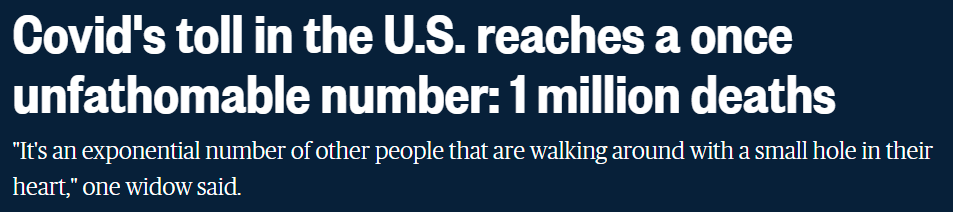
To do this we have to distinguish between the virus, which I’m defining as a biological reality, and the pandemic, which I’m defining as a social reality. The virus scientifically labeled as COVID-19 is obviously real, has infected millions of people worldwide, and has killed at the very least one million people just in the US. The last two years have showed how divorced that biological reality is from the social reality.

Hyperrealists and Neoliberals

There are two groups in particular for whom the pandemic doesn’t exist, to the point that the biological virus is meaningless and therefore irrelevant. For each group, the pandemic cannot be real.

The first group is the Hyperrealists. For the Hyperrealists the pandemic is both the product of, and the ongoing engine of, a false reality; therefore the pandemic cannot exist.

The second group is the Neoliberals. For the Neoliberals the pandemic is the both the symptom of, and the ongoing cause of, a massive disruption in the operation of the global marketplace that defines the social order; therefore the pandemic cannot continue to exist.

The average person — especially those grieving their dead — are flanked by these groups, each declaring that the pandemic is either over or never happened at all. We are in the strange position of having to insist that the pandemic has always been real and continues to be real. For our own sanity these are the two hobgoblins we have to dispel.

The Hyperreal Hobgoblin

The Conspiracy Virus

For the Hyperrealists, the virus doesn’t exist. And even if it did exist, the vaccines and masks don’t help stop the spread, they either make things worse (the vaccine) don’t do anything at all (masks) or both. And even if vaccines and masks did help stop the virus from spreading, the pandemic as a whole was a conspiracy designed to control the population and make vast profits off the suffering.

This group is labeled “conspiracy theorists” as a way to dismiss them. But governments and powerful organizations conspire to fool and manipulate their citizens all the time. Sometimes they have political agendas, but most global conspiracies are plots to gain and hoard as much wealth and power as possible; most of these plots are perfectly legal. So it’s not stupid to theorize about actual conspiracies in general. But giving those theories weight would require that theorist to stand on a solid foundation of ethics, social justice, and economic equality. Then the theory could be used to critique and contest the power behind the conspiracy. But solid foundations are not the hallmark of hyperrealism.

The Spectacle and Earth Prime

In order to define what I mean by the term hyppereal I have to start with the concept of “the Spectacle” laid out by Guy Debord in his book The Society of the Spectacle in 1967. “The Spectacle” is Debord’s collective label for the media landscape: television, movies, advertising, fame and celebrity, popular culture, all produced and driven foremost by flows of capital. It’s tempting to see this as just an ahead-of-its-time label for what we now think of as the World of the Screen: the 24 hour news cycle, social media, the constant hate-drone of Fox News, all of the above etc. But the Spectacle isn’t ephemeral. Unlike the media and Internet ionosphere of information and outrage, the Spectacle is solidly real, and it defines the way we interact with the world and with each other.

The spectacle is not a collection of images; it is a social relation between people that is mediated by images.

The spectacle cannot be understood as a mere visual excess produced by mass-media technologies. It is a worldview that has actually been materialized, that has become an objective reality.

The spectacle that falsifies reality is nevertheless a real product of that reality, while lived reality is materially invaded by the contemplation of the spectacle and ends up absorbing it and aligning itself with it. Objective reality is present on both sides. Each of these seemingly fixed concepts has no other basis than it’s transformation into its opposite: reality emerges within the spectacle, and the spectacle is real. This reciprocal alienation is the essence and support of the existing society.

All quotes from: Guy Debord, The Society of the Spectacle (1967), trans. Ken Knabb

If that sounds opaque welcome to French philosophy!

The Spectacle is not the media landscape that is observed from the outside by people external to it; the Spectacle is the way people relate to each other using the media landscape to do it. The Spectacle isn’t a digital projection or a phone app or something similar that only exists in the “screen world.” The Spectacle exists in our “Earth Primereal world. How is that possible?

Earth Prime ←→ The Spectacle

The information conveyed by the Spectacle is full of untruths, but the Spectacle itself emerges from and exists within our Earth Prime real world. At the same time, we Earth Prime people use the Spectacle as the way to socially relate to each other, making the Spectacle an inextricable part of Earth Prime. As a result of this cross-contamination, Earth Prime and the Spectacle are both objectively real.

Not only that, within their shared reality Earth Prime and the Spectacle are each trying to transform into the other — meatspace trying to sublimate into cyberspace, cyberspace trying to solidify into meatspace (I’ll explain this more below). This process of back-and-forth “reciprocal alienation” is what supports our current capitalistic society.

The Spectacle is a Series of Tubes

Think of the Internet. No matter how bizarre any content on the Internet is, it’s not some astral dimension separate from reality. It’s existence and influence are part of the non-Internet world, which should be obvious given the last few years. Ideas, fads, social movements, cults, doxxing, swatting, NFTs, on and on: millions of people trying to use the Internet to alter non-Internet reality, using the Internet as their medium of social relation. At the same time non-Internet reality is constantly creeping into Internet reality, with posts, vines, instagrams, tik toks, all the descendants of reality television. The Russia-Ukraine War exists as much digitally/online as on the front line (though it sounds disgusting to say it): Vladimir Zelensky uses the Internet to get popular support, which results in more weapons, which results in images and videos of destroyed Russian tanks, and the cycle repeats. Cyberspace and meatspace constantly swapping places in our reality, every move monetized and commodified.

True vs. False, vs. Real vs. Unreal

If there is no hard line dividing the Internet and the non-Internet world, that might suggest that there is a shared sense of common reality across Internet and non-Internet, Spectacle and Earth Prime, no matter what anyone’s disagreements. The assumption of a commonly shared sense of reality is the frame of American liberal politics. Because if there is a shared reality, the practice of politics is a discussion of policy, a contest between what is useful or not, or — at the extreme — true or false, the goal being to reach a democratic consensus. Instead 21st century America has been defined by a constant back-and-forth struggle not about what is useful or not but a life-or-death combat about what is real or not. That’s a struggle for power, the power to successfully define reality and reap everything that follows. Liberals have no countermove in this scenario.

Imprisoned in a flattened universe bounded by the screen of the spectacle, behind which his own life has been exiled, the spectator’s consciousness no longer knows anyone but the false interlocutors who subject to him to a one-way monologue about their commodities and the politics of their commodities.

When it comes to the anti-vax ecosystem, does this sound familiar? Tucker Carlson, Joe Rogan, Donald Trump? YouTube? Internet radicalization in general? Anti-vax “doctors”, fake medical associations, medical professionals “just asking questions,” self-appointed experts shilling hydroxychloroquine and horse dewormer? The wrinkle in 2022 is that with social media, anyone can be plucked from obscurity by right-wing dark money operatives and have their entire social existence weaponized for stochastic terrorism. Those human weapons are, in the end, disposable. But the “false interlocutors” are not.

Where We’re Going We Don’t Need Reality

We could say that our society is shaped by real and unreal constantly churning together and stop there. The thing is, the phrase “real and unreal” has an subtle assumption built into it. The assumption is that the word “real” is a signifier pointing to something that exists. For example, the word “shoe” is not, itself, a shoe; you can’t wear a “shoe.” So “shoe” indicates either a particular shoe or the concept of a shoe or both. It’s the difference between a map and the territory modeled by the map.

In the same way, the word “real” indicates that state of general existence which reflects things as they are, as opposed to things that are non-existent or imaginary.

But now imagine a simulation of reality, i.e. a simulation of that state of general existence which reflects things as they are.

What if the word “real” was used to indicate that simulation of the state of general existence?

What if the word “real”, uttered by someone on the inside of that simulation, could only refer to the version of reality present within the simulation, not the “original” reality being simulated?

The Metaverse Simulated Reality

It was crucial to establish that the Spectacle is real, not some kind of trick of the light projected onto the surface of reality. Because it’s not enough to say that someone in 2022, who has lived through the alpha wave, the delta wave, and the omicron wave, and still insists that vaccine’s don’t work etc. is out of touch with objective reality. As if there were some way to convince that person that they had been misinformed, or misled, and if only they would stop going on Facebook and start listening to the scientists they would see the light.

When anti-vaxers use the word “real” they’re not referring to the same thing you and I are. The rest of us are living in the push-and-pull of the Spectacle and Earth-Prime; anti-vaxers have immersed themselves into pure Spectacle as much they can. That immersion shifts them into something different. Not an illusion or a falsehood, because the Spectacle is real, not fakery. But it’s a different kind of reality: a simulated reality.

In the simulated reality, the word “real” still refers to a state of general existence, but a simulated existence. In the simulation, “real” folds back on itself like a mobius strip. There, “real” can only refer to things as they are within the simulation. The non-existence of the pandemic is foundational to that simulation.

Anti-vaxers are fond of the phrase “do your own research” — by which they mean “enter the simulation; until you do, you will not be as awakened and informed as I am.” Of course the anti-vaxers think that you and I are the ones living in a simulation. They love to refer to themselves as “taking the red pill” to get reborn out of The Matrix into what they think of as the true original unsimulated reality (ignoring that the Matrix movies were an extended allegory about coming out as trans). This mentality is what allows anti-vaxers to treat their own families with indifference, even contempt, over masks and vaccines. It’s because they love you so much that they don’t want you to get the vaccine, or wear masks, etc etc., can’t you see? Just enter our simulation and it will all become clear, you will be liberated. The simulation has freed itself from having to pretend to be associated with our reality; everything within the simulation can only refer to something else in that simulation. Inside the anti-vax simulation, the pandemic (as a social phenomenon) isn’t fake. The pandemic is real, but it manifests as a conspiracy and/or mass delusion. This might sound like semantics but it’s necessary for comprehending why most anti-vaxers can’t be “brought back to reality.” As far as they are concerned their simulation is reality.

If you’re wondering how you and I know that we are not, in fact, the ones in a simulation: the fact you even asked that question is the difference between skepticism and solipsism. Or you could look at the death rates for unvaccinated people if you want physical evidence. But hang on to that question because it will be important later.

Selling Jesus

When anti-vax media mogul Marcus Lamb was dying of COVID, his son’s response: “There’s no doubt in my mind that this is a spiritual attack from the enemy.” Jonathan Lamb was Marcus Lamb’s son. On his father’s Daystar Television Network, Jonathan talked about the “alternative” treatments (like Ivermectin and prayer) pushed by his parents and their television guests. “There’s no doubt that the enemy is not happy about that. And he’s doing everything he can to take down my Dad.” Marcus Lamb died a shortly afterwards. He helped build the simulated reality that killed him; his son inhabits that same reality and will most likely continue his fathers work. The list of people killed inside the simulation they helped create is long and not finished yet.

I should also mention that the Daystar Television Network got about $4 million of taxpayer cash from the US government Paycheck Protection Program. Two weeks later the Lambs bought a private jet they used for going on family vacations. They said they got the money from “investments” and the vacations were “leadership retreats with his family.” When the story was picked up by the media, the Lambs said they paid the PPP money back but no one knows if that is true.

That cash flow is significant because capitalism and consumption are the carbon atoms of the Spectacle and thus the anti-vax simulation. The Spectacle of 2022 mainly exists to sell pandemic commodities, tangible ones like Ivermectin or cultural ones like prayer. Anti-vax profiteering is the engine of the simulation.

Hyperactivate

If you’re still with me you are a blessed person and I appreciate you…

Finally I can explain why I think the people in the simulation should be called Hyperrealists instead of simply anti-vaxers. “Hyperreality” is a word coined by Jean Baudrillard. He uses it to describe the condition of living in a world where we can’t discern true reality from a simulated reality. This might sound like what we’ve already discussed, and in 2022 it sounds almost trite. What’s not trite are the implications that Baudrillard spins out from the concept of hyperreality.

A simulation that can only use “reality” to refer to itself is unsettling enough as it implies that there might be no way to extricate yourself from the simulation. Now imagine that there was no real “real,” that everything was simulations all the way down. Baudrillard calls this the “procession of simulacra.” In a hyperreal world, the word “real” no longer indicates that state of general existence which reflects things as they are, because there is no longer a “real real” to be referred to. The word “real” becomes a kind of mask used to hide the fact that there is nothing outside the world of simulations. As Baudrillard puts it:

The transition from a sign that dissimulates something to signs that dissimulate that there is nothing marks a decisive turning point. - Jean Baudrillard, Simulation and Simulacra (1981, trans. Sheila Faria Glaser; my emphasis)

I’m not sure that all of us are living in full-on hyperreality but I do think anti-vaxers are. They exist within a procession of simulacra, multiple simulations that constantly shift and overlap. In Baudrillard’s words, in the anti-vax world “the search for proof, indeed the objectivity of the facts does not put an end to the vertigo of interpretation. We are in a logic of simulation, which no longer has anything to do with a logic of order and reason. … Illusion is no longer possible, because the real is no longer possible.” At this stage of hyperreality there is no longer an “outside” to the simulations. The very idea of waking out of the simulation is hypocritical and immoral.

The Hyperrealist Simulation Network

There’s a chaotic swarm of simulations at play here. The Republican Party; Trumpist fifth-columnists; corrupt and/or anti-vax public officials; Internet cults and religious fanatics; fascist media personalities; brownshirt street gangs, vigilantes, and militias; supporters of police brutality and the carceral state; Internet bullies, harassers, and stalkers; propagandists inciting violence; slavery apologists; right-wing lawyers; homophobic and transphobic bigots and their fellow travelers; xenophobes; and dark money oligarchs. A vast network of simulacra. Parsing out the differences between these groups is like arguing over the subgenres of heavy metal. The songs each sound different but the genre is the same. The endgame of the Hyperrealists: violence, terror, and elimination.

Dark Disneyworld

You can sum up these overlapping ecosystems in the metaphor of a theme park. The closest is Disneyworld, with multiple parks each containing multiple themes, rides, and experiences. You could spend your entire life in the park and you wouldn’t run out of things to do. Almost all the people wandering the park enjoying the rides are white. They used to live someplace outside the park, but that was generations ago. Right now the grownups and the kids are having fun and going on adventures.

The darkness creeps in when you see all the Haunted Mansions. As far as the eye can see, going back decades, even centuries. They make the parkgoers scared and angry, which is important because the power in the park runs on rage. The newest Haunted Mansion is the Pandemic Ride. It’s scarier than the others because not everyone comes out the other side; but in the end it’s just a dark ride full of props and effects. Don’t look at the bodies piled up behind the scenery. Return to the magical world.

It’s all to easy for you and me to dismiss Dark Disneyworld as a mirage, something used to trick gullible fools into retreating from reality and giving away their money. I hope you see now that’s not the case. Millions — millions —of Americans have gone through the gates of Dark Disneyworld. In fact if you think that you and I live in a better America, one with higher ideals than this, you have it backwards. Dark Disneyworld is the true America. As Baudrillard puts it:

Disneyland is presented as imaginary in order to make us believe that the rest is real, whereas all of Los Angeles and the America that surrounds it are no longer real, but belong to the hyperreal order and to the order of simulation.

In other words there is no “better America.” That’s the illusion, meant to obscure the fact that Dark Disneyworld is the true America and always has been. The history of America is an endless day spent riding the rides.

Powering Down the America Simulation

I mentioned earlier that liberals have no political countermove against the forces of the right. How could they? They insist that they are outside Dark Disneyworld, maybe in a parking lot somewhere. But they are in here with the rest of us. While they argue with each other about civility and decorum there’s a parade down Main Street USA. Trying to transform the America Simulation into a better version of itself through technocracy, cynical pragmatism, or incremental improvements would require America to be something other than what it has been from the start.

It sounds bleak but we don’t have to go along for the ride. The America Simulation has always been structured around getting, keeping, and exercising power. The old heirarchies of race, gender, class etc. reflect this in our past and present. So that’s the target. To break the hold of these heirarchies on our lives, we need to challenge that power; to claim the right to hold power, to take a claim and refuse to relinquish it no matter what. If you think that’s impossible, or even improbable, remember 2020. The pushback was so severe and violent because the operators of Dark Disneyland recognized it for what it was: an effective attack on their position.

Getting and holding power in the service of justice is the first step towards charming this pandemic hobgoblin.

Next Time…

The other pandemic hobgoblin: neoliberalism. No French philosophy I promise!