The Past is a Grotesque Animal
It never was what it was.
Note: this was originally posted to my Substack on May 9, 2023. I deleted that Substack a couple years ago and I’m posting these pieces here so they don’t get lost. This post is a sequel of sorts to two previous posts, Raise Hight the Roots (from Dec. 2021) and Gallery of the Body (from Aug. 2022).
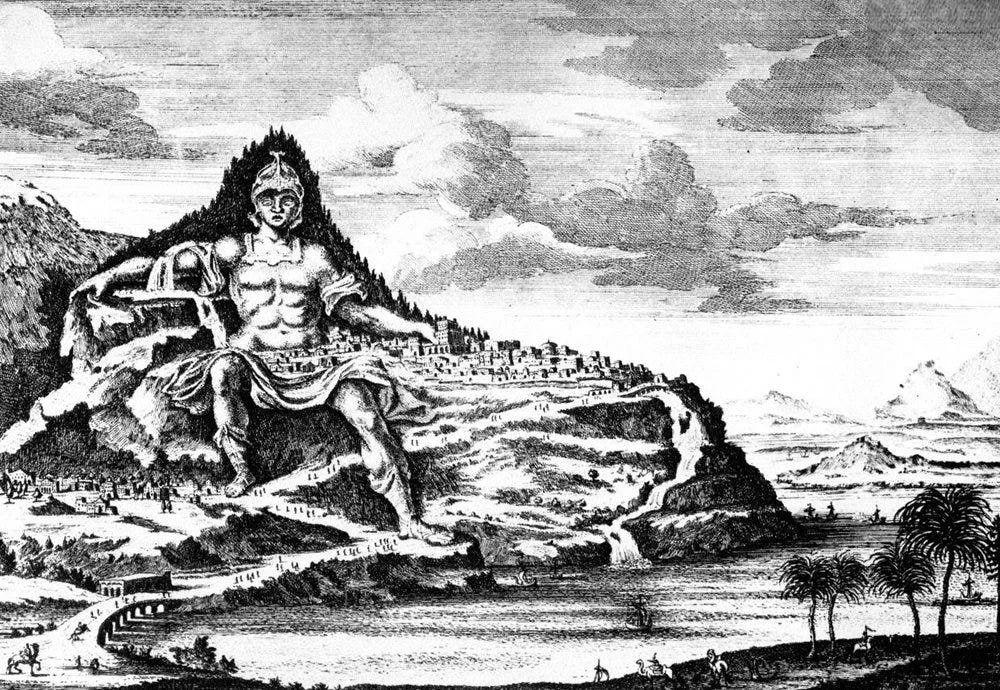
Johann Bernhard Fischer von Erlach, Mount Athos as a Colossal Statue (1721). Vitruvius describes how the Macedonian sculptor Dinocrates proposed to Alexander that he would “form Mount Athos into the statue of a man [Alexander] holding a spacious city in his left hand, and in his right a huge cup, into which shall be collected all the streams of the mountain, which shall then be poured into the sea."
I need a steam shovel mama to
Keep away the dead
I need a dump truck mama to
Unload my head
—Bob Dylan, “From a Buick 6”
Collectors and Collectees
At the archives where I work, we’ve always called the people whose papers we collect “collectees.” I used that made-up term for many years and thought nothing of it until I used it in front of an actual “collectee” and she let out an acrid chuckle. “Is that what we are?” She said this while we strolled past an aisle of glass cases exhibiting various archival documents, including items from her collection. “I suppose it does make you sound like specimens,” I said, tilting my tone slightly towards apology. Nevertheless there they were, the rare specimens, objects plucked from personal remains for being historic; if not, then representative of a career; if not, then visually stimulating or at least strange and fascinating; pinned to the boards and exposed under glass, the exotic beetles of a person’s life. The grotesquerie of the display wasn’t my intention nor my fault — our “personal papers” archives are, by their nature, snugly sleeved inside a casing of aging and death. Impossible to peruse them for long without hearing the awful sound of mortal dread stirring behind its padlocked psychic door. My culpability here is limited, so needs be my apology.
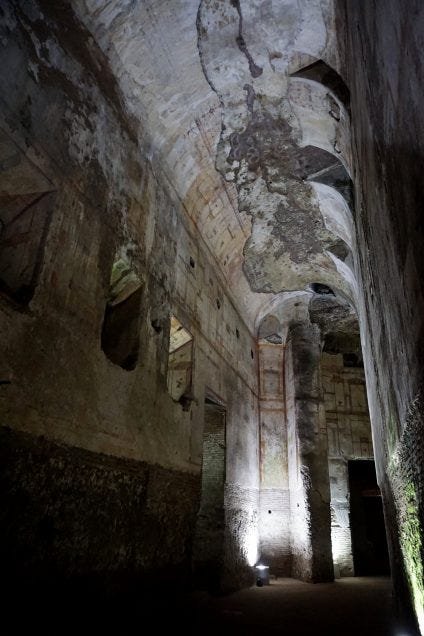
Cryptoporticus of the Domus Aurea, Rome (c. 64–8). Photo courtesy Sebastià Giralt, 2017, CC-SA 2.0.
Ruins of the Golden House
The word grotesque was created to describe a particular, wonderful encounter with the past, specifically by early modern Europeans living among the remains of the ancient Roman Empire. The story goes that one fine day around 1480 a young man strolling on the Esquiline Hill in Rome slipped through a fissure in the earth. He found himself in a mysterious underground grotto — though that word wouldn’t exist in Italian until the 1610s; the Romans would have called it a crypta (taken, of course, from the Greeks, who used the word krypte to mean “hidden place”); our young man might have called it a cropta. This cropta was like nothing else in 1480s Rome: an enormous gallery filled with carved, painted figures, its cavernous walls varnished with endless vibrant frescoes. The young man had accidentally re-discovered the legendary Domus Aurea (“Golden House”) of Emperor Nero.
In July 64 CE, a fire started somewhere among the merchant stalls hawking their wares near the Circus Maximus in Rome. After nine burning days the Great Fire of Rome had destroyed two-thirds of the city. Nero, in the midst of organizing relief, saw an opportunity in the suddenly-cleared land. While the burned-over areas were being rebuilt and improved from their old designs, Nero commissioned work on a massive personal palace-complex. It included its own aqueduct, feeding a monumental nymphaeum fountain-temple whose waters drained into an artificial lake, which was in turn surrounded by a kind of artificial countryside of villas, vineyards, and forests; an entire banquet hall that rotated in sync with the heavens (this might have been a legend until the hall and its mechanism were unearthed in 2009); the Colossus Neronis, an almost-100-foot-tall bronze statue of the Emperor himself; a sunken garden, various pavilions, an art gallery, over 300 rooms (but no bedrooms as it was an event space, not lodgings), endless hallways covered with frescoes, gems, and gold leaf. According to Suetonius (who really can’t be trusted, but is so entertaining he gets quoted anyway) “when the edifice was finished … and he dedicated it, he deigned to say nothing more in the way of approval than that he had at last begun to live like a human being.” Nevertheless, it was only four years into its construction when Nero killed himself in 68 CE at the age of 30.
The Domus Aurea was perhaps the most obvious, enduring public symbol of Nero’s legacy of wanton excess. The jewels, ivory, gold, and other valuable materials were methodically stripped out. Large portions were simply filled with dirt and paved over. I Vespasian built a great amphitheater over the artificial lake (after the Colossus Neronis was moved there it became known as the '“Colosseum”), Domitian commissioned a giant complex of baths (later the Baths of Trajan) built over the Esquiline Wing, Hadrian had the titanic Temple of Venus and Roma erected on top of much of what was left. Within forty years of Nero’s death the Domus Aurea was either destroyed or invisible. By 1480 it was all ruins sealed beneath other ruins.
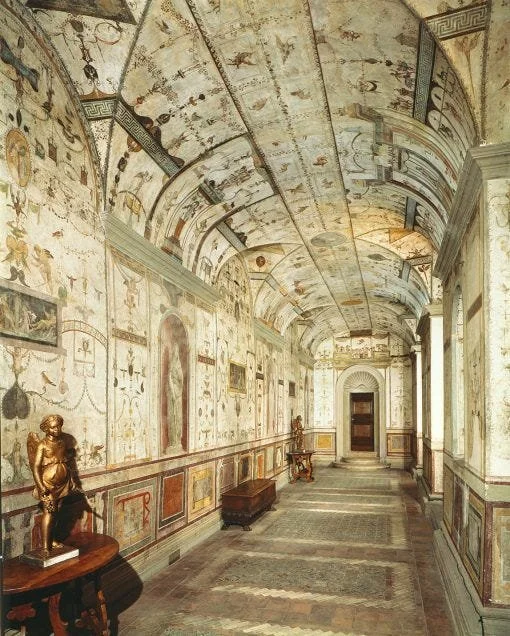
Raffaello Sanzio da Urbino, called Raphael, (1483–1520, Italy) and Giovanni da Udine (1487–1564, Italy). Loggetta of Cardinal Bibbiena, Palazzi Pontifici, Vatican (c. 1516). Fresco. Photo courtesy Scala, Florence/Art Resource, NY.
House of Golden Ruins
The new humanists of Renaissance Rome thrilled to the accidental rediscovery of Nero’s Domus Aurea. The only way to describe this uncanny combination of classical beauty debauched by ludicrous excess and abyssal time was “grotto-esque” — i.e. like the art discovered in the hidden grottoes — in Italian, grottesco, later in French grotesque.
Tyler Rockey writes about the encounter between the Romans of 68 and 1480 in his 2021 piece Between Spaces: The Domus Aurea, the Vatican Loggetta, and Foucault’s Heterotopia:
An anonymous fifteenth-century artist who visited this place poetically described this experience of difference and the oddities of being there: “[I]n every season the rooms are full of painters. Here summer seems cooler than winter . . . we crawl along the ground on our stomachs, armed with bread, ham, fruits and wine, looking more bizarre than the grotesques” (Michael Squire, “Fantasies so Varied and Bizarre: The Domus Aurea, The Renaissance, and the ‘Grotesque,’” in A Companion to the Neronian Age, ed. Martin T. Dinter and Emma Buckley (Chichester, UK: Wiley-Blackwell, 2013), 448).
This type of decoration was the antithesis of what the Renaissance had understood as classical and sought to implement through its antique vocabulary. Grotesque decoration, derived from ancient Roman precedents, was employed in fresco or sculpted on walls, ceilings, and architectural frames. It was characterized by hybrids of plant, animal, and human forms; metamorphic and sprawling ornamental candelabra motifs; and illogical and irrational compositions. … In essence, for the Renaissance viewers, the grotesque presented an inversion of the classical aesthetic ideals of naturalism, harmony, proportion, and rationality of form. And yet this antithesis emerged from the Roman earth and directly out of the classical past, greatly shifting attitudes around this decorative mode through the significance of the discovery of the ruin.
Rockey uses the example of the cryptoporticus of the Domus Aurea (the first photo above) and the way it was reproduced by Raphael within the Vatican itself (second photo) to show how the grotesque came to inhabit the Renaissance imagination:
Sixteenth-century artists went beyond the humanist literary imagination, which had conjured a vision of both present and past engendered by the study of ancient materials, and worked instead directly into the physical urban fabric in order to resurrect the body of ancient Rome.
This is what we see in the Loggetta of Cardinal Bibbiena, a space constructed by Raphael and decorated by the grotesque specialist of his workshop, Giovanni da Udine. Raphael and Giovanni had descended into the heterotopic Domus Aurea sometime around 1510, reemerging with the imagined and idealized mental forms of the spaces they encountered, and transformed these concepts into tangible forms in the current time and space of the Vatican. The shape of the Loggetta clearly recalls that of the cryptoporticus and the ethos of the former’s decorations are inspired by the latter’s ceilings and walls in a manner that most closely imitated the original space to date.
…This reimagining of the cryptoporticus and the resurrection of its decorative mode and means of execution in effect suspend the heterotopic, temporal difference at play between the Loggetta and the Domus Aurea. They reintroduce some proximal bundles of relations that tie this space to the larger fabric of the Renaissance. This is what lies in between these spaces: an awareness of the past, the desire for re-completion, and the utility of art in mediating temporalities.
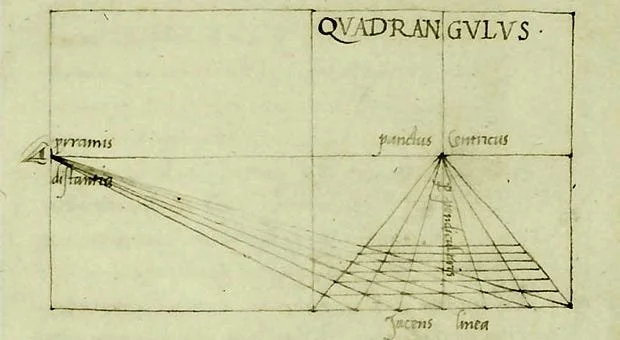
Leon Battista Alberti, from Della Pictura (1435)
In 1435, almost four decades prior to the rediscovery of Nero’s Golden House, Leon Battista Alberti’s treatise Della Pictura used mathematics to show how the human eye creates the illusions of linear perspective, including the horizon and the vanishing point (above). After 1480 the visual representation of perspective — the illusion of depth in space, on a two-dimensional surface — was matched by a conception of visualized “history” as the illusion of depth in time — specifically their location in the foreground of that pseudo-spatial depth. If this foreground is understood as the present, then we also accept that it’s in constant motion, sliding from the clarity of the foreground to the obscurity of the background, losing detail as the clock ticks, finally absorbed into the abyssal singularity of the vanishing point. On the base level of physics this is time’s arrow, Newton’s Second Law.
But culture doesn’t obey the laws of physics.
The Grotesque Animal of the Past
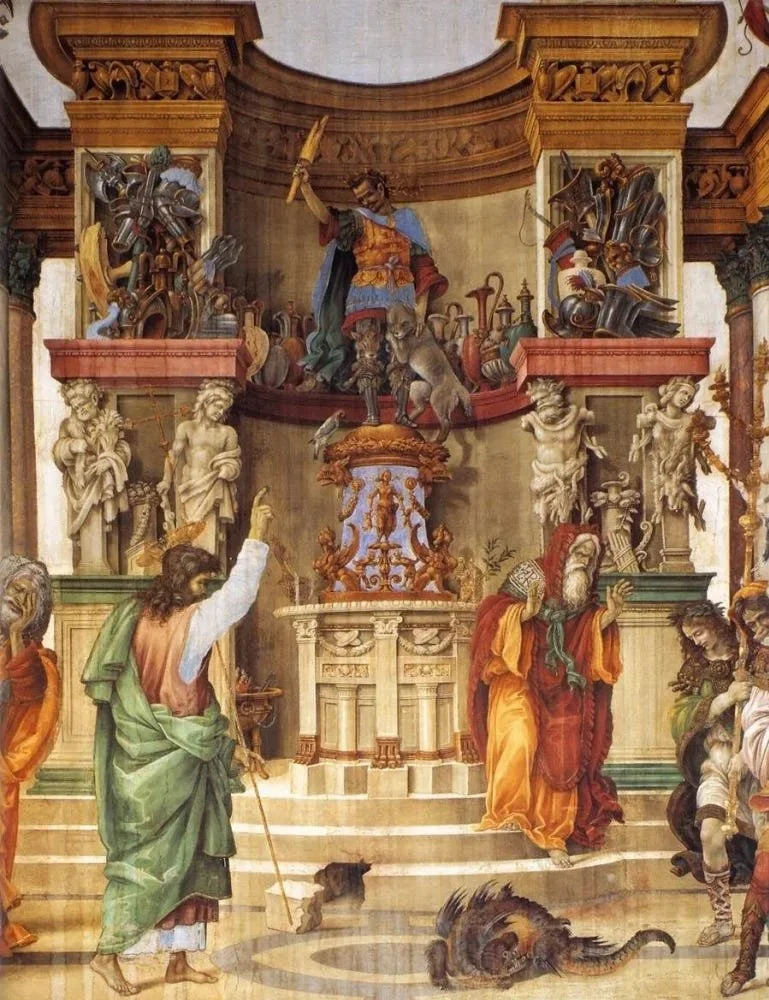
St Philip Driving the Dragon from the Temple of Hieropolis, fresco in Strozzi Chapel by Filippino Lippi, Santa Maria Novella Principal Dominican church in Florence, Italy. Created ca. 1490 CE.
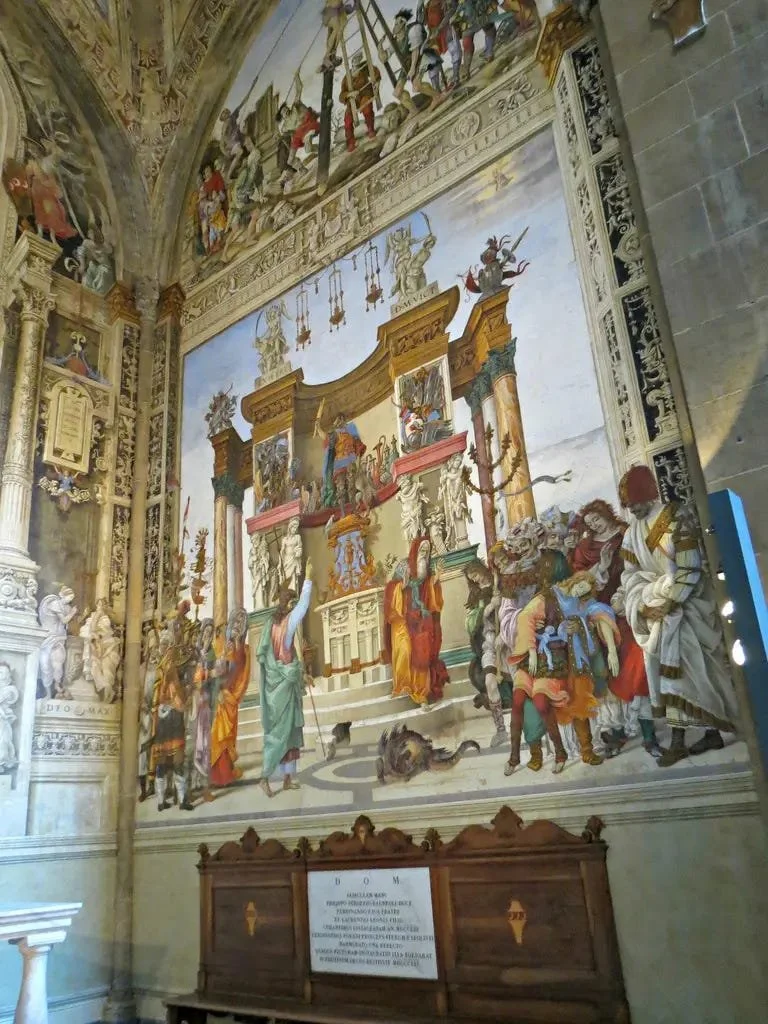
Wider view of the above work, for scale.
Filippino Lippi was one of the artists whose style was transformed by spelunking in the Domus Aurea. The world that exists within his art is suddenly sharper and brighter. Everything feels heightened and amplified; a dialectic rages between a realism of detail and an artifice of impossible colors, poses, and subjects, synthesized by the beholder into Dali-esque surrealism.
One of the first major pieces created by Lippi after his journey into the grotesque past was the fresco above. In the fresco, Philip the Apostle is in the Greco-Phrygian city of Hieropalis (where he will later be martyred, crucified upside down). He is approaching a creature on the ground, which everyone else in the images is cowering away from in terror or literal disgust — the story goes that the breath of the creature was sickening the inhabitants of the city. The image captures the moment when Philip approaches without fear, intent on casting out this malevolent force with the righteous power of Christ, literally cleansing the city and bringing it salvation in the process.
But take a look at the creature in question. What is it? It’s described as a dragon, yet it’s so strange, so stylistically jarring, so obviously grotesque in the modern sense, that “evil monster” doesn’t do it justice. Even if we take it at surface value, why is there there? Was it summoned? How did it find a home there? There are oddities that might be clues, like the piece of broken stone at the foot of the altar, which might be the kind of esoteric symbols Renaissance artists utilized to ultra-densify their work. But I think there are larger, tidal forces represented by this encounter.
The image is totally dominated by the pagan altar, in the center of which is a gold-on-blue pedestal decorated in a style straight out of the Domus Aurea. Lippi’s representation of the literal grotesque is at the visual core of this work, because in this context it represents the past — specifically the shock wave resulting from the impact between the past and the present. The counterpart to Philip in this image isn’t the “dragon” on the floor, it’s the pagan statue on the altar, its arm raised in an invocation of holy power, a gesture echoed by Philip. The statue’s arm holds a broken sword and is surrounded by armor and the trappings of war and violence; Philip, dressed plainly compared to the others, holds no weapons and approaches with humility, his face obscured by his outstretched arm. The dragon faces away from him, perhaps unable to face his purity. The loose stone near the dragon almost suggests that the dragon was birthed from the altar itself, suggesting that the believers in the pagan past have inherited only decay and pestilence masked by splendor. The splendor, however, is still there, and in the context of the artwork it’s impossible to ignore. Perhaps Lippi has mixed feelings about repudiating the pagan past? Perhaps he can reconcile the old and new, synthesize them even, in a newly-discovered-yet-still classical aesthetic — the grotesque.
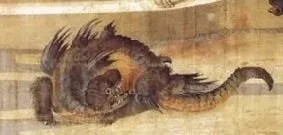
A grotesque animal.
Lippi’s fresco is an nexus of confrontations: pagan and Christian, Classic and Renaissance humanist, Lippi’s own past as an artist and his new style, all of the above and the eternally present moment of beholding by us. The historical, conceptual foreground is crowded with overlapping vertices, a vertiginous collision of perspectives, out of which chaos is born the creature that crouches and snarls at eye-height to the viewer; the animal that both is grotesque and represents the grotesque, the monster birthed from this churn of past and present, clawing its way towards us from the forbidden zone of time’s vanishing point.
The Past is a Grotesque Animal
In 2007 the band Of Montreal released their album Hissing Fauna, Are You the Destroyer? Dead center on the track listing is the hypnotic, minimalist twelve-minute long song “The Past is a Grotesque Animal.” Over the course of the song Kevin Barnes supposedly transforms into a Ziggy Stardust-like alter ego named Georgie Fruit, who performs the rest of the album (and the next two Of Montreal albums). Why would he do this? According to Rolling Stone:
DURING THE RECORDING of Of Montreal’s eighth album, Hissing Fauna, Are You The Destroyer?, Kevin Barnes was going through a difficult time. "On a creative level, my life was going great," the songwriter told Rolling Stone, "but on a personal level, it was totally falling apart." Epic 12-minute track "The Past is a Grotesque Animal" is the centerpiece and turning point of the album, on which Barnes embodies his alter ego, Georgie Fruit. "I'm not suffering from split personality or anything," he said, of the multiple personae on the record. "This just gives me an opportunity to write from a different perspective [emphasis added]."
The song starts with Barnes singing:
The past is a grotesque animal
And in its eyes you see
How completely wrong you can be
The rest of the song is a series of memories, present thoughts, impulses, second-guesses, regrets, reflections. A chord sequence repeats as a pattern in the constant musical present while, for the singer, the past and present overlap each other. But we now know: wading through the smashed-together wreckage of “before” and “now” is our very experience of the true present. All moments are intersections in time and space, all histories are imaginary histories, all imagination a merging of images and magic.
Kevin Barnes’s semi-singing style in this song is close to something called sprechstimme, literally “speak-singing,” which is close to what you’d hear in a musical, and also an art song, the kind favored by the late, great soprano Phyllis Curtin.
The Soprano’s Handwriting
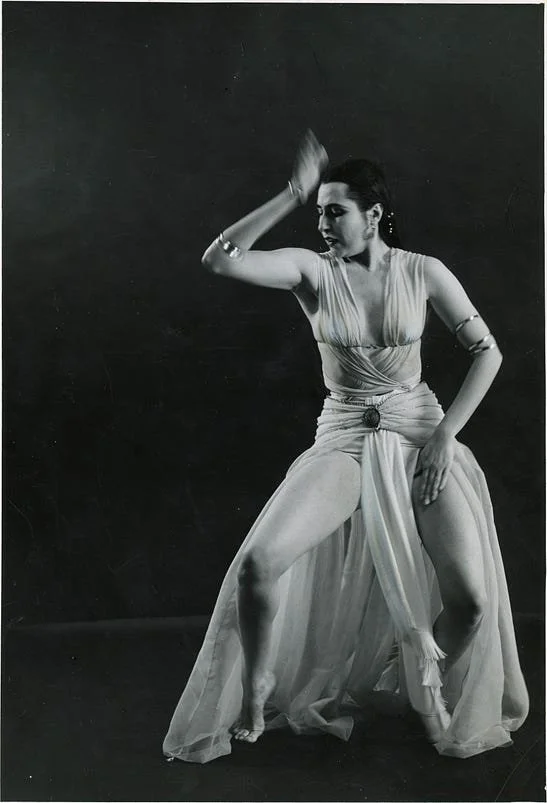
Phyllis Curtin performing as Salome in 1954.
It used to be part of my job to drive out to collectees’ homes in a rented cargo van or mini-van, usually with a partner. We would go into their garage, basement, or attic, gather up whatever it was they wanted us to have, and drive off with it back to the archives. Many collectees were cordial and welcoming and often would insist on feeding us. We were packing up their life’s work and carting it away; they were stirred them into a range of emotions: nostalgia, relief, mourning, curiosity about the the workings of the archive. Others, usually the children or grandchildren of the original collectees, made it clear we were there to clear some storage space and should get off their property as soon as possible.
In March 2004 I had to drive out to Great Barrington, Massachusetts to the home of Phyllis Curtin. Mrs. Curtin was a legendary soprano, a beloved teacher, and one of those people about whom no one can think of anything bad to say, an amazing feat in the backbiting worlds of opera and classical music. My co-driver got sick at the last minute so it was just me and a van and my printed-out MapQuest pages to take me from my apartment in Quincy, Massachusetts six hours across the entire state and six hours back again. My daughter was not quite a year old and had already decided that she despised anything that impeded her constant movement, including and especially sleep. So I was bleary when I set out around 4:00 am for the Berkshires. I exited the Mass Pike and wound my way to a plain black mailbox where I turned onto a dark brown dirt road. I found myself driving through farmland, then a short corridor of trees new with spring green, then finally a large, brown house where the road ended.
The house looked like various smaller dwellings slotted together. Behind the main house were some outbuildings that looked like small barns. In one of those barns Mrs. Curtin had stored the papers of her husband, Eugene Cook. He had been a longtime photographer for Time-Life and was, of course, a collectee. When I eventually got back to the office, a co-worker described how he had been sent out to that same property back in the 1980s to acquire the Eugene Cook collection, and how he had to wrangle hundreds and hundreds of prints, negatives, and slides out of a hayloft. He may have exaggerated a bit but it does explain the scent of straw that still clings to the photo prints.
Inside the house I was greeted warmly by Mrs. Curtin and her large dogs. She led me around the corner into an open area where a black metal music stand was stationed next to a slightly dusty grand piano. Next to this tiny rehearsal space was an alcove of shelves and cabinets; these held the scores and sheet music I had come for.
We went through the loose sheet music together — the bound scripts, she said, were pieces she wasn’t ready to part with. I was looking for pieces that had her own notes on them, as that made them unique, and thus good specimens; she was looking to weed out pieces that she never sang, as she felt they didn’t belong in her papers. She would sometimes point out individual pieces when they sparked a memory, reeling off stories about Leonard Bernstein, Virgil Thompson, and Ned Rorem, all of whom had composed songs for her to sing. She would hold a piece in front of her, sometimes softly sound a note or two, smile, and hand me the score — or it would spark nothing and she would slide it onto to the reject pile.
I was specifically chosen to be there because the people at work knew I had a “background in music,” which to them meant I could read music and recognized composers’ names. Some of them knew that I had spent a year at New England Conservatory right out of high school, where I majored in bassoon performance. What no one knew, because I didn’t tell them, was that my year trying to be a professional musician almost killed me. I wasn’t cut out for a life of nothing but constant practice, rehearsal, and competition. The stress of it, combined with my gnawing fear at finding myself utterly adrift, truly messed me up. At some point I stopped eating much, then bathing, then sleeping. Instead of practicing I would wander the streets of Boston, usually ending up in a bookstore or library until closing time (having lost track of time). I was lucky enough to still be seeing my girlfriend from high school, who was also going to college in Massachusetts and was a train ride away (we married a few years later) so we were able to support each other during that year — she had gone to a Christian college and was coming to realize that the school’s religiosity was not for her. I was also lucky enough to transfer to a different school after that year, where they assumed I would want to join the orchestra. But I never wanted to play music on a stage again, so I never have, and I probably never will.
While I was going through the scores with Mrs. Curtin I noticed some handwriting that looked different from hers on a few pieces, so I asked her who that other person was who had written on these scores. She looked confused, so I handed her an example. She laughed when she saw it. “When I was a girl growing up in West Virginia,” she said, “I wrote with my left hand. But back then you weren’t supposed to be left-handed. The teachers would hit my hand with a ruler if they caught me writing with my left. So I started writing with my right hand in front of the teachers. They thought I switched” — she chuckled — “but really I just trained myself to write equally well with both hands. When they weren’t watching I would still use my left hand. Those notations are both me, sometimes I used to switch back and forth between hands — that’s what you’re seeing.”
We were together in that windowed room, and she was in Clarksburg, West Virginia, and I was staring blankly at the wall of a basement practice room on Huntington Avenue; perhaps she was on a stage somewhere singing a song Ned Rorem wrote for her to sing, perhaps I was in Jordan Hall huffing as hard as I could into a contrabassoon playing along with Mahler’s 4th Symphony, both of us hearing music of the past, vectors of time cross-crossing next to that dusty piano and those pine cabinets. This is our experience of temporality. Not how we live it as packets of matter in the backwash of entropy, jellyfish carried on the cosmic tide of the expanding universe, but how we inhabit it as living beings with minds and memories: tracks and trajectories of our pasts, real and possible, true and imagined, psychological and historical, constantly searchlight-sweeping from background to foreground and back again. Where the lines merge they briefly constellate into shapes, creatures perhaps, animals beautiful, and ugly, in other words: grotesque.
When I had collected all the specimens I could I made to go, eager to get on the road for my six-hour return drive. But Mrs. Curtin insisted that I stay for lunch, which, after a brief and frantic scan of her pantry, ended up being Cambpell’s tomato soup for two. As we ate I told her that someone from the archive would come for the rest of her papers whenever she was ready. She leaned forward and pointed her spoon at me. “I think it should be you,” she said.
“It never was what it was”
The 1976 television series I, Claudius has an early scene set at the birthday party for the Roman Emperor Augustus in 24 BCE. One of the entertainments the Emperor has lined up is a poetic recounting the Battle of Actium by a renowned Greek orator. The quiet the hall, an unnamed usher steps up and slams his staff on the floor three times, shouting “Caesar calls for silence!”
The Greek orator is stunned. “What a voice!” he says. “Perhaps we should change places! Only the Romans can afford ushers with a voice like that. Did you have any training?”
“I was an actor, sir,” the usher replies.
“Oh, that explains it. Resting, are you?”
“No sir, I’ve given it up. Everyone’s an actor in Rome. There just isn’t enough work to go ‘round.”
“And what there is goes to friends and relatives, it’s the same everywhere.”
“The theatre isn’t what it was.”
“No. And I’ll tell you something else. It never was… what it was.”
(The scene is at 8:30 here, if you want to watch it for free.)
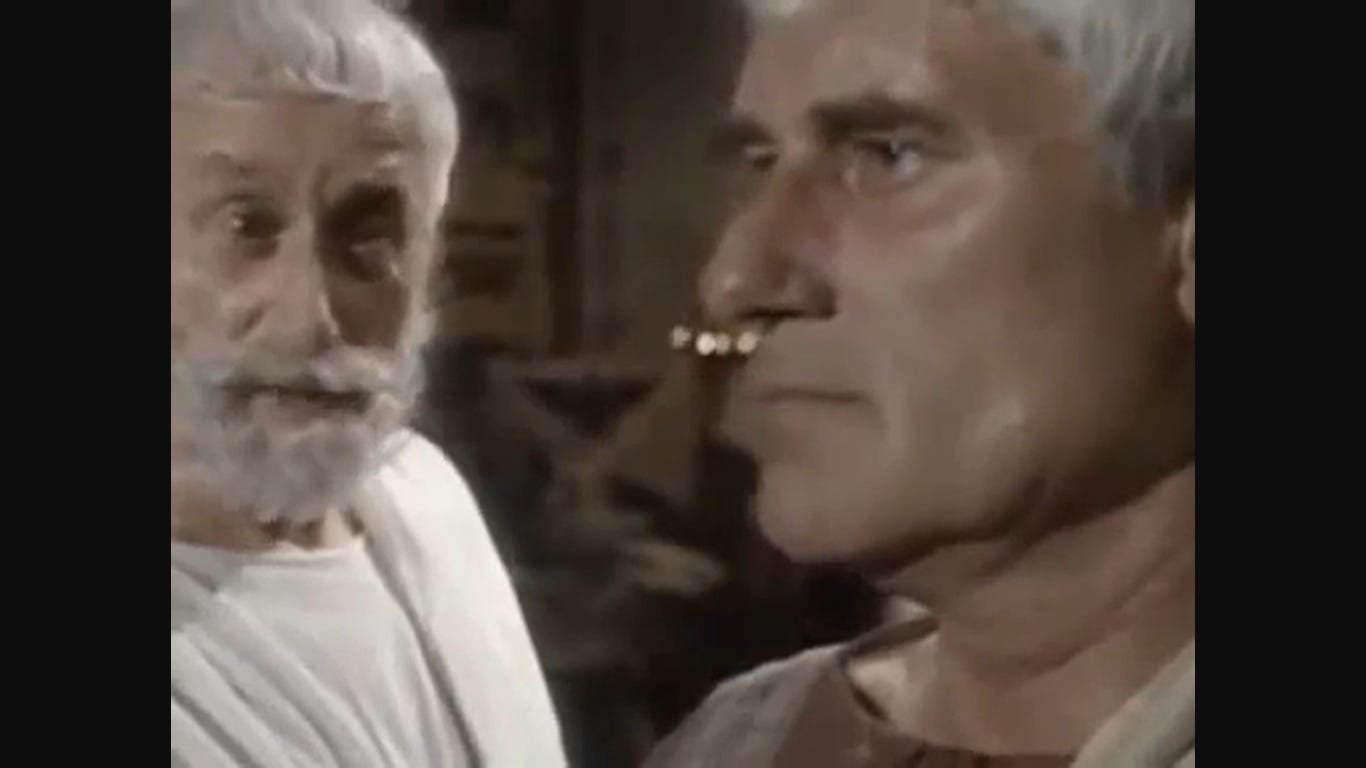
This is one of the first iterations of a motif that runs through the series: never forget you’re watching a story. The series opens with narration by Claudius late in his reign, writing his memoirs and relaying events that happened before he was born, in case it wasn’t clear that what we’re seeing lies somewhere between fact and fiction. These are British actors in the 1970s portraying fictionalized versions of (mostly) real people who lived over a thousand years before, adapted from two books by Robert Graves who picked the juiciest morsels from primary sources that were often relaying secondhand tales, gossip, and propaganda. The low-fi quality of the makeup, sets, props, and film stock has gone from merely adding camp to a serving as a stamp of analog authenticity. I rewatched the whole series in 2020, to keep my mind occupied during the long nights of the first COVID wave, which for me adds yet another layer of associated-memory onto the show’s time-onion. (Later, I listened to the I, Podius podcast, which recaps each episode — a funny concept for a show that aired about 47 years ago — and found myself once again wanting to rewatch it.)
I wonder, now, if the many original British and American viewers of I, Claudius appreciated the story about a powerful, global empire reduced to a state of moral and structural decay through the avarice, pride, and myopia of its rulers — as that was also their contemporary world? Or is that just me, projecting my own illusory vector backwards from my foreground position back towards the horizon, seeing a line where none exists? Was it never what it was?
After the Greek orator is finished, Augustus pulls him aside to thank him. “What a gift you Greeks have! Incidentally, you know — the battle, it wasn’t like that. But you described it poetically, I understand! You used poetic license. I’m used to that!” It never was what it was. All histories are imaginary histories.
Story of the EYE (I)
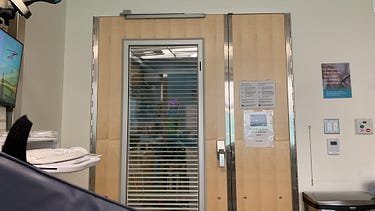
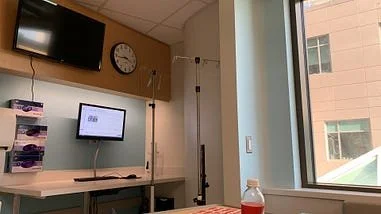
In September 2022 I spent a full week in a hospital bed in Boston. My head was wired to an EEG machine that was constantly monitored by someone I couldn’t see, though I could see my own brainwaves on a large screen on the other side of my small room. To my left was a large window displaying on a slab of roof and another tower of rooms across from mine. I could only leave my bed if the nurse was present, which meant I was prone almost the entire time. By the time I was discharged I found I had to re-learn how to walk as my legs un-stiffened and my equilibrium recalibrated to keep me standing.
A ride-share driver guided me through the afternoon traffic to my train station. The sky was gray with rain but everything pulsed with color. I could try to describe it, or you could scroll back up and imagine the esplanade along the Charles River glowing like a fresco by Filippino Lippi after he had seen the Domus Aurea. I had turned 48 years old during my hospital stay and here I was learning how to walk and how to see again.
The goal of my visit was to solve the mystery of a series of seizures I suffered over the last three years, the first of which almost killed me. I got no answers, but I did get a clue that perhaps what was happening to me was some combination of the mental and the physical. This led me to wonder if it was related to my autism, which I had been assessed for a few months prior. That in turn led me to read the book Unmasking Autism, by Devon Price. Price lays out how autistic people create “masks", i.e. personae that function to fake their way through everyday life. My persona “Ryan,” for example, is a work of art - almost a work of fiction, except so much of him was crafted by mirroring others and trying to anticipate their expectations. “Ryan” is outgoing, witty, polite, comfortable in groups, self-effacing, socially functioning. But “Ryan” is an appendage of another being, a grotesque animal without a true name but for our sake we’ll call it EYE. EYE puts on the “Ryan” mask as needed; has been doing so since EYE was a child. But after so many years of use it started to crack and peel. Like so many other things, the pandemic sped up its decay like a time-lapse film.
It took me a long time to make it through Unmasking Autism because I would read a passage like this:
Though masking is incredibly taxing and causes us a lot of existential turmoil, it’s rewarded and facilitated by neurotypical people. Masking makes Autistic people easier to “deal” with. It renders us compliant and quiet. It also traps us. Once you’ve proven yourself capable of suffering in silence, neurotypical people tend to expect you’ll be able to do it forever, no matter the cost. Being a well-behaved Autistic person puts us in a real double bind and forces many of us to keep masking for far longer (and far more pervasively) than we want to.
And this:
Therapy that is focused on battling “irrational beliefs,” such as cognitive behavioral therapy (CBT), doesn’t work as well on Autistic people as it does on neurotypicals. … One reason for that is many of the fears and inhibitions of Autistic people are often entirely reasonable, and rooted in a lifetime of painful experiences. We tend to be pretty rational people, and many of us are already inclined to analyze our thoughts and feelings very closely (sometimes excessively so). Autistics don’t need cognitive behavioral training to help us not be ruled by our emotions. In fact, most of us have been browbeaten into ignoring our feelings too much.
… and I would have to pause to take a breath or calm down. I would get deeply angry thinking about all the years I spent trying to inhabit a skin that wasn’t really mine and never could, or should, have been. I was suddenly very defensive of the young EYE who could never feel a sense of peace between the bullying, the dismissal, or the praise that backfired. I realized that I had embraced Zen Buddhism when I was 15 because I thought it would teach me ego death, since killing my sense of self felt like a way to commit virtual suicide, faking my own death to myself so that nothing could touch me. But nothing could touch “me” anyway, since EYE was inside the carapace of “Ryan,” afraid to come out. I can forgive myself, though, which makes forgiveness for anyone else irrelevant.
My anger passed through me and I was left with the resolve to let myself be changed this time. I had to stop trying to swat away those beams of time that kept trying to converge on my location, let them illuminate me and I will see with my EYE open for a change. Some of that is middle age too, of course, the perspective of knowing that there’s more years behind me than in front of me. But like we said, we experience time all together, always in the foreground. Everything (everywhere?) all at once.
Story of the EYE (II)
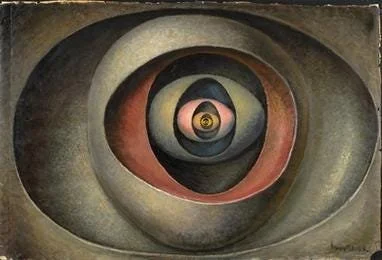
Eye in the Egg [Silm Munas], by Ülo Sooster.
In “The Past is a Grotesque Animal,” Kevin Barnes/Georgie Fruit sings:
I fell in love with the first cute girl that I met
Who could appreciate Georges Bataille
Standing at Swedish festival
Discussing "Story of the Eye"
I discovered an English translation of Bataille’s Story of the Eye (L'histoire de l'œil) when I was 17, purely by chance at the public library in the town where I grew up. (It was this edition; in part I was taken by the cover, which freaked me out.) At first glance it looked like a long, disturbing series of viscerally disgusting sexual fantasies, but there was something in its relentless description of bodily functions that made me wonder if I was falling into a trap by reading it all too literally. I re-read it and sure enough without the shock factor, actual themes emerged from the viscera. It never was what it was, it was something more.
An early motif is the character Simone’s obsession with eggs. This comes back at the end of the book, when she is transfixed by the face of a dead priest (which the main characters have killed) when a fly briefly lands on his open, lifeless eyeball. Then there’s this brief moment (translated from the French by Joachim Neugroschel):
She [Simone] made me come over to the corpse: she knelt down and completely opened the eye that the fly had perched on.
“Do you see the eye [l’oeil]?” she asked me.
“Well?”
“It’s an egg [l'oeuf],” she concluded in all simplicity.
There’s something symbolically wonderful and physically gross about the idea of an eye, or an EYE, being both an organ of observation and generation. Another grotesque combination! Perhaps the EYE has seen enough, has incubated for long enough, perhaps something will yet claw its way free. The past is a grotesque animal, and in its EYE you see how completely wrong you could be. But then again, all histories, including the history of the EYE, are imaginary histories. If it never was what it was, who knows what it will possibly be?