
"A Victory for White Life," pt. 2
How Republicans fused anti-abortion with the Great Replacement
Note: this was originally posted on my Substack on July 4, 2022. I deleted that Substack a couple years ago and I’m reposting these here so they don’t get lost.
Hope is not optimism, which expects things to turn out well, but something rooted in the conviction that there is good worth working for. — Seamus Heaney
Evangelical Christians in America stayed mostly on the sidelines of electoral politics since the repeal of Prohibition. What brought them off the bench was the end of segregation.
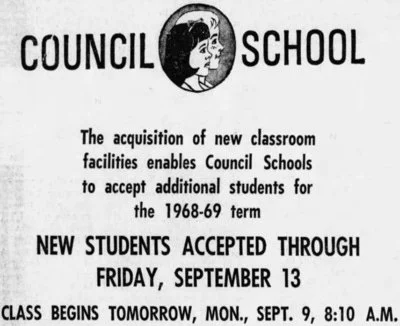
A 1968 advertisement for segregated private schools operated by the Citizens' Councils; caption via Wikipedia.
In the wake of Brown v. Board of Education, white evangelical parents fled from public schools into segregation academies — private whites-only schools run by evangelical leaders in Virginia, Arkansas, Mississippi, Alabama, and elsewhere. Running a school was expensive, so the administrators relied on the academies’ tax-exempt status as religious schools to cover their costs. Several Black parents in Holmes County, Mississippi successfully sued, meaning that as of 1971 any organization engaging in racial discrimination could legally be a charitable institution and thus has no right to claim exemption from taxes. White evangelicals had tried and failed (and have mostly succeeded ever since) to carve out a whites-only, government-free enclave within American society; the idea of joining an integrated, egalitarian nation horrified them and mobilized them into action. Jerry Falwell, the head of a segregation academy in Lynchburg, Virginia, seized the moment to become the public face of the new politicized evangelical churches.
The 1973 Roe v. Wade decision was the tipping point. Before Roe, conservative and evangelical Christian churches hadn’t taken much interest in abortion. But by 1976 they had become uneasy at the increase in the rate of abortions. To describe what happened next, I’ll quote historian Paul Boyer:
In the wake of Roe, many evangelical Protestants overcame their suspicions of Rome to unite with Catholics in opposition. (Protestants and Catholics had earlier found common ground, of course, in a shared anti-Communism.) The Catholic-evangelical rapprochement represents a crucial development in the post-1970 reorientation of American religion. … Waning denominational loyalties and the emergence of special-interest lobbies, plus Pope John XXIII’s liberalizing innovations, encouraged a new ecumenism built around shared cultural values and objectives. This, in turn, eroded anti-Catholic prejudices dating to the earliest English settlements in North America and later reinforced by heavy Catholic immigration. … Doctrinal differences persisted after 1970s, and evangelical and Pentecostal proselytizing among Hispanic Catholics continued to irritate Catholic leaders. But overall, evangelical-Catholic relations improved dramatically after 1970.¹
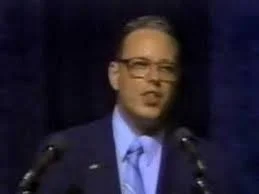
Paul Weyrich
This was good timing for right-wing activist Paul Weyrich. Now that the white evangelicals were off the bench, he was looking for an issue he could use to harness their potential voting power. Past conservatives had tried anti-Communism, but this was the pre-Reagan détente era; they tried economic issues, but it was still the tail end of the post-war boom. Even basic racism was no longer the go-to issue for grassroots evangelicals. They shifted instead to “cultural” issues, like government overreach (i.e., the IRS) and changing gender roles. But to the conservatives’ frustration it was Jimmy Carter of all politicians who had success with evangelical voters.
In 1978 Weyrich finally figured out the magic issue that would bring evangelicals to the Republican party: abortion. Weyrich connected with right-wing activists and leaders like Jerry Falwell to make overturning Roe a core value for evangelicals. When Falwell formed the Moral Majority in 1979, it gave the Republican party a solid base of right-wing, white evangelical voters. They turned decisively against Carter towards Reagan and never looked back. It also had the effect of locking the Republican party into a peculiar position. Conservative Catholics and evangelicals expected the Republican party to keep their anti-abortion ideology as a core doctrine in order to maintain their loyalty, despite its unpopularity. Opposition to abortion continued to decline over time — it was commonly accepted that an American woman had the rights of privacy and sovereignty over her body. Fanatical campaigns like the 1991 “Summer of Mercy” by the anti-abortion extremists of Operation Rescue did nothing but drive anti-abortionists further out of the mainstream. Adding to that trend was anti-abortion terrorism in the 1990s — like John Salvi’s attack on a clinic in Massachusetts; the assassination of George Tiller; and the clinic bombings by Eric Robert Rudolph.

Anti-abortion terrorist Rachelle “Shelley” Shannon in 1993 after shooting George Tiller; Tiller survived but was killed in 2008 by Scott Roeder.
The opposition to Roe became smaller but more concentrated and partisan, especially as the Republican party itself receded into a electoral minority (just barely). The narrow seizing of the Presidency in 2000 via Bush v. Gore taught the Republicans they could continue their grip on power even when out-voted as long as they manipulated the process. The ability of the Republican leadership to paralyze Congress and thwart the Obama administration confirmed their new model of purely partisan governance.
Their goal was no longer policy but power. Every American political institution, from state legislatures and circuit courts to Congress and the Supreme Court, was fair game to be dismantled and sold off to wealthy donors, mega-rich families, foreign lobbyists, and business trade associations. The success of the Tea Party movement in unseating established GOP leaders convinced the party leaders that their survival meant never getting outflanked on the right again.
By the 2010s the party was in a feedback loop. They wanted to keep their evangelical base, maintain control despite their shrinking demographic, and pursue their grandiose goal of permanently cementing their power via gerrymandering, the filibuster, and capturing the judiciary. To do all this they had to keep moving rightwards (taking the “centrist” Democrats with them) until there where was nowhere left to go within the boundaries of the existing Republican Party coalition. The only group left was the true fringe, the outsiders on the margins — Christian nationalists, hard-core libertarians, Internet cults, fascist militias. Anyone who could keep these groups engaged and energized would be the future face of the Republicans.

Donald Trump in 2019. Credit: Evan Vucci/AP
Before 2015, Donald Trump’s pointless Presidential campaigns combined massive egotism, shameless advertising for the Trump brand, and the paranoid insistence that Barack Obama was a Kenyan Muslim radical. But when Trump gained some traction the second time around he was suddenly the obvious choice to represent the party and what it stood for — inflicting suffering on the party’s enemies and designated targets, the kind of cruelty and revenge Trump had embraced from an early age. Republican donors and their politicians who ran the party thought they could use Trump as a tool to continue going as they had been. It didn’t work out that way.
It was supposed to be a two-pronged strategy. From the bottom up, Trump’s faux-populism would keep the remaining constituency engaged, using, among other things, the old anti-immigration race panic of the Great Replacement. From the top down, wealthy evangelicals and Leonard Leo-approved judges would focus on eliminating women’s rights, keeping with their almost-50-year-old goal.
Trump immediately went off the rails. Over the course of his 2015-2016 campaign, it became obvious to both parties that the GOP wasn’t using Trump as a tool, he was absorbing it instead. An ecosystem of mania and extremism took over the entire enterprise. Trump was no longer the face of the party’s future, he was the party’s future. It happened so quickly that most Republican Americans don’t actually know what their own party believes anymore.
The Great Replacement was part of that future. It had always been part of the party’s anti-immigration policy. After Trump was elected, his first wave of advisors included Steve Bannon, proudly open racist and right-wing ideologue; and Steven Miller, who openly embraced xenophobia and white nationalism. The influence of Trump, his family, and his enablers within the party continued to grow; the national conservative media, disciplined and trained to support the party leaders, couldn’t contradict Trump and his bigotry even if it wanted to.
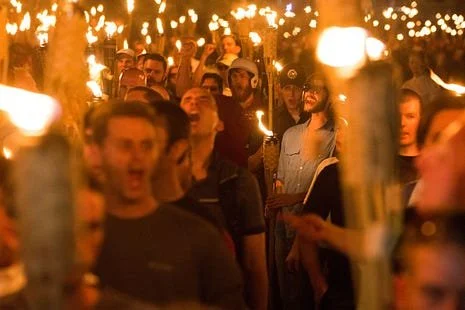
Unite the Right. Credit: Zach D. Roberts/NurPhoto
The ascendance of the Great Replacement in the modern GOP was completed in August 2017 at the “Unite the Right” rally in Charlottesville, Virginia. On the night of August 11, a torch-wielding mob chanted the phrase “you will not replace us!” which was a popular fascist slogan at that time. This quickly morphed into “Jews will not replace us!” echoing the earliest versions of the Great Replacement. When Trump refused to clearly comment them it was a signal of things to come. The party and its acolytes had already assimilated law enforcement with the emergence of Blue Lives Matter police cadres after the Ferguson protests in 2014. By 2017 it was clear there was a permeable membrane between police and vigilantes. To the party faithful this is how it should be; this alliance is vital to protecting party members from both an oppressive federal government and imaginary hordes of criminals, migrants, and degenerates. In a tradition going back to pre-Civil War slave revolts, white citizens imagined they and their property were constantly under an imaginary threat and thus perpetually justified in preemptive violence.
COVID-19 accelerated everything. The new party faithful had two responses: xenophobic violence (against Asians and immigrants) and paranoid delusions. How could the party do otherwise? But the refusal of the true believers to adhere to basic health protocols managed to shrink the overall party demographic even further, by how much is not yet known. It was so bad that despite the still-large number of party voters and the huge asymmetrical advantages rural, conservative states enjoy in the electoral college, Trump lost in 2020.
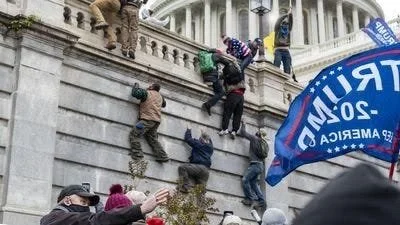
Photo: Blink O’faneye/Flickr
The party had no more right-wing constituencies to capture. It could expand by winning over some newly conservative voters, but that might take years and might just replace the aging party members. Efforts to recruit younger voters mostly resulted in more extremists joining the party, as they were the only young people interested. The only thing to left to do: make it as difficult as possible for anyone not in the party to vote, organize, protest, or participate in politics at all.
It was an old Jim Crow-era strategy of violence and intimidation — approved by parents, pastors and politicians, enforced by cops, judges, and jailers. It was kicked off by the mob attack on Congress on January 6, 2021. Trump intended to stage a coup that day, using the mob as his weapon. Even though that failed, the attack itself was successful in the historic feat of occupying and sacking the Capitol building. It inaugurated a nationwide campaign of terror and violence that hasn’t stopped since, coordinated by the party’s media apparatus, political leadership, funders, and armed militant wing. There are excellent accounts of the present state of the party but they usually try to suggest, or hope, that the party will come to its senses. In retrospect, however, the status quo reached in 2020 looks inevitable. [Editorial note from 2026: and of course Trump recaptured the White House anyway and went on to be one of the most unpopular Presidents in American history.]
Where was the Democratic Party? To quote Nikhil Pal Singh:
In the face of this challenge, it is difficult to judge the Democratic Party as anything more than a feckless, mildly recalcitrant partner. Over the past 40 years, it has alternatively sought to ratify, in gentler tones, GOP-driven projects and demands to lower corporate taxes, get tough on crime, end welfare as we know it, expand the ambit of deportation and sustain open-ended military authorisations. It has sought to placate vulnerable constituents with forms of symbolic recognition and modest regulatory action, often undergirded by weak executive authority and moral sentiment. It is the undeniably saner and more constructive of the two electoral options Americans are forced to choose between. But it also operates an effective pincer movement against alternatives further to the left that seek to transform skewed imbalances in the power of capital and labour, police authority and public safety. When constituents choose to fight, for example, against police abuse, or for labour rights, Democrats are missing in action, or else warning against unpopular opinions that will awaken the monster on the right. Forever counselling that we choose the lesser evil, they have instead grown habituated to living with the fox inside the chicken coop.
That finally brings us to the end of Roe.
Samuel Alito, Amy Coney Barrett, John Roberts, Clarence Thomas, Neil Gorsuch and Brett Kavanaugh committed a monstrous act of violence against American women and their families. In the context of 2022 that act has to be seen as part of the ongoing Republican campaign of psychological and actual warfare. It’s also meant to reverse to the Great Replacement, alongside all the mass killings inspired by that old race panic. Post-Roe America is a joint white evangelical/right-wing Catholic eugenics project. White women are forced to carry their children to term while the “unfit” are excised from the nation. “A victory for white life.”

Danillo Sena. Credit: Nashoba Valley Voice
A couple years ago, a stranger knocked on our door. He told us his name was Danillo Sena. He was running for a seat in the Massachusetts House of Representatives and was canvassing the neighborhood. This was during the 2020 Presidential race and our north-central Mass. town was upholstered with Trump flags. Danillo saw our pride flag draped over our porch rail so he felt comfortable paying us a visit.. He was running for the seat against a local Republican woman who happened to be the realtor who sold us our house. Danillo told us he was born in Brazil in the 1980s; now he was living in Acton. As we talked it occurred to me that I’d never had an American politician in my kitchen and probably never will again. He was proudly progressive and clearly excited to be running in the hopes of making a difference to his community. We wished him the best but he didn’t need it — he won the election against the realtor by about 2,800 votes. The realtor only won her own hometown, which happens to by the town I live in. Even she had to admit that he “ran a good campaign and is a very nice young man.” He won his next election too. It felt different that the usual liberal talk of how great voting is, and how the idea of voting itself will save us. This time it wasn’t a lesser evil, we were affirmatively voting for someone we liked and agreed with. It had been a long time.
Does it mean anything that a young progressive Brazilian immigrant can beat the odds in 2020 and 2021? I choose to believe it does and I want to to believe that too. Everything that led to the criminalization of abortion might have building for 40 years but that also means it’s in the past. The future is people like Danillo Sena. It’s the fact that almost 1 out of 6 young people identify as LGBTQ+. It’s the unbelievable return of unions to the United States. It’s Americans realizing their government has no use for them so they will take care of themselves instead. Stirrings of suspicion about law enforcement, the widespread realization the US government could be more supportive any time it wanted to, real proof that it doesn’t just feel like everything has gotten worse over time, it truly has, at a time when most of the world’s wealth is passed around between the same few individuals. In themselves these aren’t necessarily inspiring, but they might be if they wake up the non-conservative masses to the truth that things don’t have to be this way. Not to mention: it’s not 1973. There are organizations and networks in place to get people what they need, sometimes out of sight because if the cops could find them they would crush them. It’s not the kind of activity that needs celebrities, or charity balls, or Democratic party co-optation. They need money, and resources, and protection, and time to grow. Sometimes you burrow down and gather and wait until the time is right to surface again. Maybe once the shellshock and numbness of the last two years have worn off, maybe long after that. Evil isn’t the only force in the world that can execute a 40-year plan.
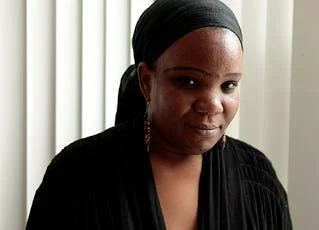
Miriame Kaba. Credit: Terrence Antonio James/Chicago Tribune
There’s a well-known quote by the activist Miriame Kaba: '“hope is a discipline.” In January 2018 she explained where that came from in a conversation with Brian Sonenstein and Kim Wilson on the Toward Freedom podcast:
The idea of hope being a discipline is something I heard from a nun many years ago who was talking about it in conjunction with making wire we were of the world and in the world. … The hope she was talking about was this grounded hope that was practiced every day, that people actually practiced all the time. … That speaks to me as a philosophy of living, that hope is a discipline and we have to practice it every single day. Because in the world which we live in, it’s easy to feel a sense of hopelessness, that everything is all bad all the time, that there is nothing going to change ever, that people are evil and bad at the bottom. … I choose to think in a different way and I choose to act in a different way. … Hope is really believing in spite of the evidence and watching the evidence change. … I believe ultimately that we’re going to win, because I believe there are more people who want justice, real justice, than there are those who are working against that.
Footnote (1): Paul Boyer, “The Evangelical Resurgence in 1970s American Protestantism,” in Rightward Bound: Making America Conservative in the 1970s, ed. Bruce J. Shulman and Julian E. Zelizer (Harvard University Press: Cambridge, Mass., 2008).