Gallery of the Body
Spirits, golems, robots, and cyborgs
Note: this was originally posted to my Substack on Aug 5, 2022. I deleted that Substack a couple years ago and I’m posting these here so they don’t get lost.
Divine Bodies: Spirits
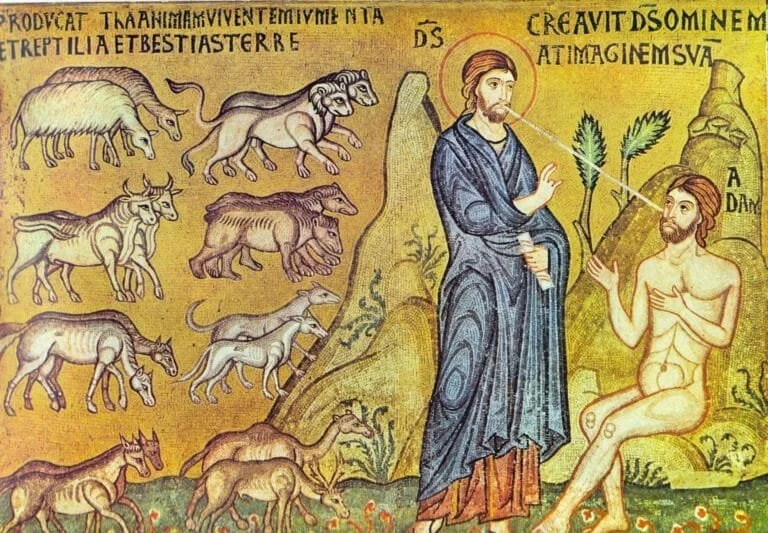
It is said that when the Creator was done fashioning a clay vessel in its own image it breathed into it the spirit of life; and the vessel in turn breathed its first breath into the body of the Creator. Their mutual breathing formed a shared circle of the spirit, suspended between the two. This shape is the realm of the human, a sphere in which the circumference is nowhere and the center is everywhere. This is the intimacy of our universe. It opens and closes, expands and contracts, to the rhythm of our spirits.
Two years ago a seizure bloomed into me without warning. My mind flickered out of existence for several minutes. Then there were serious people hovering over me asking me “who are you” and “do you know where you are” which was ironic because these were precisely the questions I wanted ask them. I was brought to the hospital and because it was the early days of the pandemic — it would be months before a vaccine was even tested — all the doctors and nurses were wrapped in plastic and protected by clear face shields. All of us wore masks the whole time. When I tested negative for COVID (which meant waiting for lab results) we could all, so to speak, breath easy.
We all know COVID spreads through infected air — it’s a literal sickness of spirit, a corruption of respiration. Instead of COVID I had contracted a metaphorical illness of spirit, a malaise of the mind. My neurologist told me that three seizures in a row meant I had epilepsy. I would have to take medication to control it, which meant I couldn’t drink alcohol anymore. By state law, I couldn’t drive. I had to stay off ladders and other places where I might fall. For a few weeks I thought the seizures, or spells, or episodes, had run their course. I was barely past the starting gun.
I wanted to believe that the problem was some flaw in my brain that we could locate, diagnose, and repair. The trouble was, the CT scans and the MRI and the three-day ambulatory EEG (where I was constantly on video) all showed the same result: nothing. There was nothing wrong with my brain. The seizures continued.
The brain is an organ among other organs (see below) but the spirit itself, that which thinks and laughs and makes art about our organs and seizures and breathing, is ensouled matter, something adjacent to the brain but not identical with it. If my brain-organ was untouched, perhaps the actual malady had all along been incubating in my spirit-body until it was finally ready to hatch.
Vital Bodies: Golems
Many and long were the conversations between Lord Byron and Shelley, to which I was a devout but nearly silent listener. During one of these, various philosophical doctrines were discussed, and among others the nature of the principle of life, and whether there was any probability of its ever being discovered and communicated. They talked of the experiments of Dr. Darwin, (I speak not of what the Doctor really did, or said that he did, but, as more to my purpose, of what was then spoken of as having been done by him,) who preserved a piece of vermicelli in a glass case, till by some extraordinary means it began to move with voluntary motion. Not thus, after all, would life be given. Perhaps a corpse would be re-animated; galvanism had given token of such things: perhaps the component parts of a creature might be manufactured, brought together, and endued with vital warmth. — Mary Shelley, preface to Frankenstein (1831)
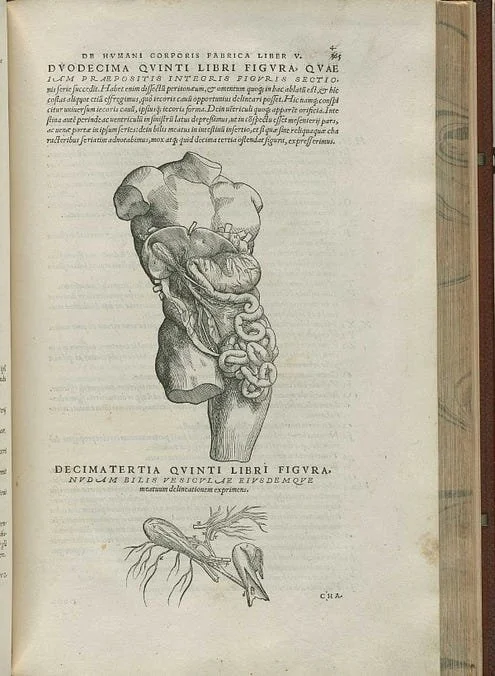
After my first couple seizures the medical doctors I was working with were convinced I was having a heart problem. Diagnosing illness is a puzzle designed to test pattern recognition, and heart problems matched the pattern: some family history, middle age, not obviously fit, sedentary job. Just to make sure, I had to pass some tests, and here is where the doctors began to lose their patience with me. I tested my stamina on a treadmill, which only demonstrated my ability to perspire. I was injected with warm dye and scanned by a large computer. My chest was injected with bubbles. An ultrasound tech (who happened to be my neighbor) sent sound waves into my neck and commented that I had “lovely carotids.” Finally I wore a machine on a sash which recorded every twitch of my heart for weeks. In the end it was nice to know my vascular system was doing fine, but that was all I knew.
The human body is an awe inspiring evolutionary result of a process that tends to keep reinventing the crab. It’s also a fussy assembly of individual organs and systems which often as not wears out, malfunctions, or self-destructs. Any particular organ might one day decide out of the blue that is has simply had enough of cleaning up booze or dissolving cheese. A bird’s egg, on the other hand, is a superior biological design. Instead of ambiguously-shaped, porous, rubbery skin, the egg has the bold clarity of a hard shell. Instead of a parliament of organs, the egg is a tidy pocket of liquid surrounded by a satisfying edible sac of more liquid. It’s true the egg is brittle; it can’t survive a sharp enough impact; but then again that’s true for all of us.
The human body is a single body made of smaller bodies, individual parts fused together and electrified to life like Frankenstein’s monster: a kind of golem. The most famous golem is the golem of Prague, a creature made of stuck-together chunks of clay and brought to life by the great Rabbi Loew. The clay was animated when a slip of paper containing a mystical phrase was placed in the golem’s mouth; when the paper was removed the golem returned to quiet matter. A human body is a golem of flesh and blood, parts grouped together with the mystical paper held in our mouth, paper which could be easily snatched away.
If you doubt that we are vital pieces functioning as a whole: In 2016 a biological research study showed that about half of our body is made up of human cells and the other half is made up of trillions of non-human microorganisms. Some are bacteria, some are archaea (primitive bacteria without even a nucleus), some are fungi. A human body needs this microbiome to survive because even on the cellular level our golem-body is a living quilt. And of course we have ample room to weave in coronaviruses.
Material Bodies: Robots
All unintellectual labour, all monotonous, dull labour, all labour that deals with dreadful things, and involves unpleasant conditions, must be done by machinery. Machinery must work for us in coal mines, and do all sanitary services, and be the stoker of steamers, and clean the streets, and run messages on wet days, and do anything that is tedious or distressing. At present machinery competes against man. Under proper conditions machinery will serve man. There is no doubt at all that this is the future of machinery, and just as trees grow while the country gentleman is asleep, so while Humanity will be amusing itself, or enjoying cultivated leisure – which, and not labour, is the aim of man – or making beautiful things, or reading beautiful things, or simply contemplating the world with admiration and delight, machinery will be doing all the necessary and unpleasant work. - Oscar Wilde, The Soul of Man Under Socialism (1891)
If you spend any time at all in hospitals you’ll observe the frictionless interface of flesh, plastic, and metal. From the first hand-axe to now human technology was designed for our bodies; medical technology is marvelously manufactured to be our bodies. As I watched nurse after nurse prick me with IV needles it occurred to me that the IV tube wasn’t just connecting to my veins, it was itself a vein. My technological body is a modular, hybrid body. The only part that can’t be modified and swapped out is my brain, which happens to be the piece that is the whole problem.
Our terms for this problem are all founded on the concept of ability: disabled, differently abled, able-bodied. The question is: “able to what?” and the answer is “to perform work.” Almost all of American life is defined by our relationship to our labor; health is no exception. In our society we use “health” to measure our (literal) fitness for work — we work to get wages so that we can afford to optimize our health and feel good so that we can perform better, more efficient work. This is what corporate “wellness” is about. If this sounds sophomoric consider how we talk about disabled, fat, and neurodivergent people. They are “unhealthy,” so they must have made bad choices somewhere (especially regarding diet and exercise); otherwise they would be fit and well and not dependent on the labor of the healthy ones for support.
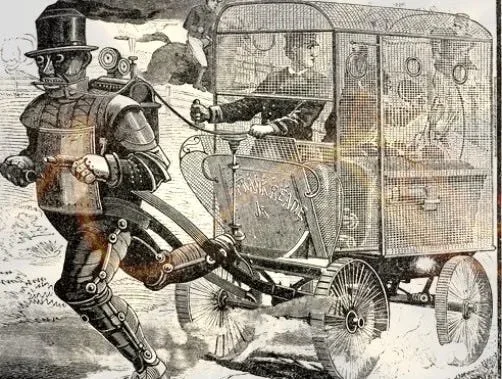
The English word robot comes from the Russian word robot or roboti (робот, роботы), which literally means work. The healthy American laboring body, the robot-body, is a sleek technological thinking/working machine that looks properly maintained. It is also designed to be a killing machine depending on the programming. The American robot-body is hard and strong and merciless, but like that brittle eggshell it’s also prone to fracture.
COVID caused a total breakdown at the US robot factory. Millions of Americans’ bodies stopped working properly. It might sound like a dumb metaphor but there are so many thousands who, regardless of politics, believe they are healthy because they deserve to be. To them COVID was a plot to poison them, or harm their children, or subvert their right to force the lesser robots into servitude. As one popular trope has it, only the unhealthy would die, and it was because of their “comorbidities.” If their robot bodies did need a tune-up they would only do it using the tools of their choice, not the ones for the unhealthy masses. Meanwhile the leaders who could have shut everything down for repairs lost their nerve and just couldn’t do it. A million-plus deaths later, the bodies that remain have to keep the engines running.
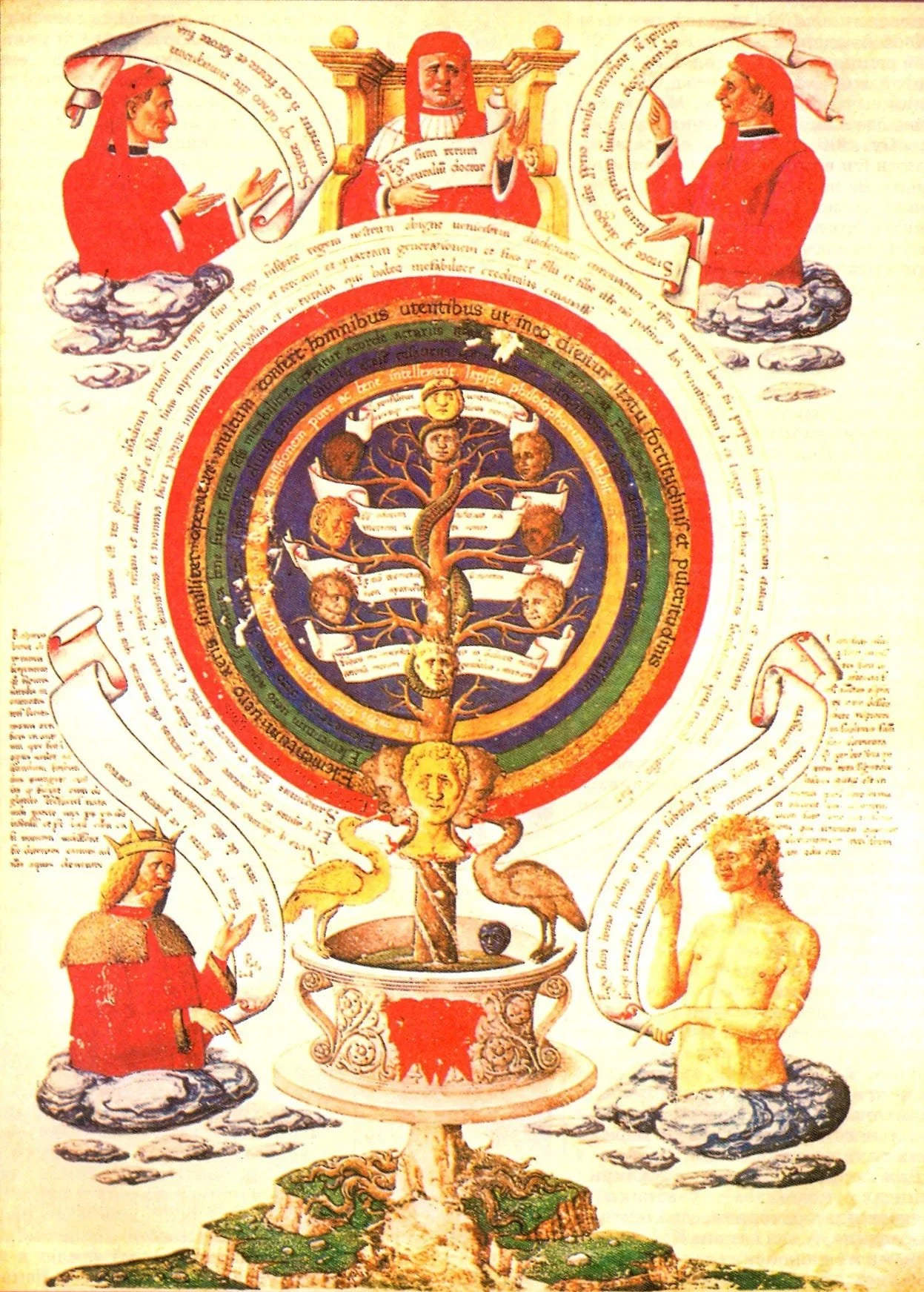
Ecological Bodies: Cyborgs
Selves, as opposed to snowflakes, can learn by experience, which is another way of saying that … they can grow. And this, in turn, is another way of saying that selves think. Such thinking need not happen in the time scale we chauvinistically call real time. It need not happen, that is, within the life of a single skin-bound organism. Biological lineages also think. They too, over the generations, can grow to learn by experience about the world around them, and as such they too demonstrate “scientific intelligence.” In sum … it makes sense to treat both lives and thoughts as “living thoughts.” — Eduardo Kohn, How Forests Think (2013)
I still don’t know exactly what causes my seizures, or even if they are truly epileptic seizures or some other kind of seizures. I don’t have enough information, which is really the heart of my whole problem. Every human body is full of information, like I saw at the hospital — everything about a body can be translated into information so it can be weighed and measured. As far as the physical universe is concerned, energy is information (just different types, like gravity, magnetic energy, photons, etc.) and matter is just temporarily condensed information. Corporeal bodies like ours aren’t just sources of information, they are information, just like everything else. On the other hand, just because that’s true doesn’t mean all the information has been decoded or even discovered yet.
When people use the term “cyber” they usually mean humans that have merged with technology and/or machines, but we covered that already. The ancient Greek word kybernetes (κυβερνήτης) is where the prefix “cyber-” comes from. The word means pilot, helmsman, or governor (it’s a cognate of the Latin word gubernare, as in gubernatorial). It was first used in our modern sense by Norbert Wiener; he meant it to describe a kind of information flow where (for example) the “pilot” would be send out information about where the ship should go, then would receive constant feedback about how the course was changing, and so constantly adapted and corrected. Information, the feedback and response, is the essence of cybernetics. If we follow this metaphor through it would be easy to assert that a human body is an information system — a flesh/bone golem-body; a social/laboring robot-body; and a cyborg-body giving information feedback to the governing spirit-body, who continuously guides the whole. I think it’s more complicated than that. I have to go beyond human bodies to explain why.
The Earth is full of living information systems that run without a pilot. Superorganisms like ant colonies, beehives, and coral; slime molds and fungi; whole forests that communicate among the trees with the wood wide web. These are all cybernetic organic systems — cyborgs — that run on the principle of self-organizing systems. These are assemblages of bodies containing bodies containing bodies; bodies all the way down to the most basic unit of organic information, DNA; and bodies up to the scale of the biosphere. In this way every living body is its own mortal ecosystem, entangled and nested within a fractally complex network of other mortal ecosystems. These ecosystems process information; they think; they know things. But for us to know what they know, we would have to understand what it’s like to be a coral reef or a rain forest, meaning we would have to actually be them. The best we can do is imagine what that would be like from a primate perspective… not really the same thing. There’s a long, long tradition in human religion of a holy person who transcends the limitations of the physical world and travels beyond into the ethereal realm of the soul and spirit. What if instead one were not to transcend beyond the ecological body, but into it? What would we learn? At that point what would knowledge itself even be?
I comprehend my own body as a convocation of four distinct, adjacent, overlapping bodies: the mind, the flesh, the social, the cybernetic. A seizure disrupts this already-unstable nexus and messes it all up. Whatever the cause, the effect is real. COVID also disrupted all our super-imposed bodies, in millions of individuals and on the scale of our entire social structure. It’s common for Americans to talk now of COVID in the past tense. Even if were true that COVID had mostly disappeared from the US population — which it definitely hasn’t — it’s been a massive seizure striking the entire country. What will it take for America’s body to reintegrate itself? COVID will be part of the US ecology-body from now on. Viruses, like any other biological lineage, can learn, and adapt, and remember. What do you think COVID has learned? What does it know about you, and me, and our world?
Bodily Remains
"History" is both a human storytelling practice and that set of remainders from the past that we turn into stories. Conventionally, historians look only at human remainders, such as archives and diaries, but there is no reason not to spread our attention to the tracks and traces of nonhumans, as these contribute to our common landscapes. Such tracks and traces speak to cross-species entanglements in contingency and conjuncture, the components of ‘historical’ time. To participate in such entanglement, one does not have to make history in just one way. Whether or not other organisms ‘tell stories,’ they contribute to the overlapping tracks and traces that we grasp as history. History, then, is the record of many trajectories of world making, human and not human. — Anna Lowenhaupt Tsing, The Mushroom at the End of the World (2015)
Shards Become Jewels
Note: this was originally published on my Substack on July 10, 2022. I deleted that Substack a couple years ago and I’m reposting these here so they don’t get lost.

The Greenway in Boston.
Recently we drove to Boston and stayed at a downtown hotel for a couple nights. The city is only two hours away but like everybody else we don’t have much money; we sometimes visit but we never stay overnight. Unlike my wife and I, the children have never lived in the city so we did the things tourists do. We hiked the hills of the old North End to see the relics of the War for Independence, shopped at the Haymarket bazaar, strolled through Quincy Market in the center of Boston. A couple weeks after our visit a fascist gang called Patriot Prayer marched proudly and unopposed through the same plaza. Like the tour guides dressed in Revolutionary War costumes they were keeping alive the old spirit of that revolt, the war of the elites in the tax-hating North allied with the wealthy slave-owners in the South. We Americans want so badly to forget that spirit to be innocent lovers of freedom. These new suburban tourists parade their malice through our streets masked like the Klan and armored like toy soldiers, to remind us we still are in the United States, still on contested ground.
We took a crowded morning ferry across Boston Harbor to visit Georges Island. Ringing the center is Fort Warren, a crumbling granite hulk gleaming and looming in the sunlight. Built to defend the harbor it quickly became that most American of institutions, a prison; it housed defeated Confederate soldiers who passed their time shut in bricked rooms or sweating on the shadeless lawn of the parade ground.
Now that it stands empty it resembles nothing so much as a giant forlorn sculpture. Bereft of purpose it retired into that afterlife we call history.

Fort Warren.
My favorite thing about Georges Island is the seaglass. The rough pebbled shore is sprinkled with glass of every color and form you could think of, along with chunks of old porcelain and chunks of brick all smooth-polished by harbor water, salt, and island breezes. Remnants of cargo lost at sea or thrown overboard, wholes shattered into pieces like the millions of rounded stones clattering in the surf. Bent to the forces of nature, which are truthfully the forces of time. Glass as sand furnaced into molded vessels then shattered; shattered like great mountains risen from the crust cracked into pocketfuls of skipping stones. The pieces have formed their own wholes now. However much they break the pieces multiply into new units of being.

Pieces harvested from the island shore.
The seaglass is beautiful garbage, Fort Warren is historic garbage, cast-offs treasured for their uselessness. Marcel Duchamp’s urinal art piece captures this perfectly; to this day it enrages consumers who want their garbage to know its place.
Looking out at the colorful hulls skimming the waves I contemplate my own place now. My oldest child is an adult now, leaving for college soon, with the other two soon to follow. I used to think my role was to be a talented and brilliant youth. When that illusion burned away I decided my role was to be a leader in my profession, being an archivist; that aspiration drained away when I struck middle age having contributed exactly nothing of value to anyone in my field. The one aspiration that has, I think, panned out was my deep desire to be a just and loving father and spouse.
Now I see the trick parenting always held up its sleeve: the better you perform your parental role the faster you hurry yourself into obsolescence. Children have to shatter their old lives to grow up into their own wholes. The forces of nature, which are truthfully the forces of time. My wife and I hold to each other; we can already feel ourselves being washed and salted and drifting towards unfamiliar shores.
Of course we fear the future, how could we not? The biosphere shuffles towards mass extinction. The corridors of power are split, fanatical cruelty to the right, feckless avarice to the left. Americans are numb to our own pain, resigned to our commissions of victims in waiting. I don’t want my daughter to have any part of this world. But she yearns for it. She wants to work to make things better somehow. How does this beautiful person share the same species as the fascist bullies of Patriot Prayer? But my wife and I know her well enough to believe she can do it. The pride, the faith, the trust in her makes it all the more bittersweet.

LOVE IS CALLING.
During our trip to Boston we visited the Institute for Contemporary Art. The main exhibit right now is a piece by Japanese artist Yayoi Kusama titled LOVE IS CALLING. You enter a medium-sized room completely paneled by mirrors. Glowing, polka-dotted, inflatable tendrils reach up through the ceiling and floor. Kusama’s voice is there too, reciting a tender love poem in Japanese. Is there a single word in any language that capture it? Disorientation, amusement, recognition, melancholy, wonderment? If there is such a word I wish knew it. I think I would be using a lot from now on.

The Greenway in Boston.
You have a few minutes in the LOVE IS CALLING room, then you have to go so the next group can come in. You come out into the gallery, then you exit through the gift shop, you make your way outside and back to the train and back home, and it’s all a little different than before, changed somehow by what you’ve seen and where you’ve been. Things age, they break, the shards become jewels. It’s the forces of nature, which are, truthfully, the forces of time.
"A Victory for White Life," pt. 2
How Republicans fused anti-abortion with the Great Replacement
Note: this was originally posted on my Substack on July 4, 2022. I deleted that Substack a couple years ago and I’m reposting these here so they don’t get lost.
Hope is not optimism, which expects things to turn out well, but something rooted in the conviction that there is good worth working for. — Seamus Heaney
Evangelical Christians in America stayed mostly on the sidelines of electoral politics since the repeal of Prohibition. What brought them off the bench was the end of segregation.

A 1968 advertisement for segregated private schools operated by the Citizens' Councils; caption via Wikipedia.
In the wake of Brown v. Board of Education, white evangelical parents fled from public schools into segregation academies — private whites-only schools run by evangelical leaders in Virginia, Arkansas, Mississippi, Alabama, and elsewhere. Running a school was expensive, so the administrators relied on the academies’ tax-exempt status as religious schools to cover their costs. Several Black parents in Holmes County, Mississippi successfully sued, meaning that as of 1971 any organization engaging in racial discrimination could legally be a charitable institution and thus has no right to claim exemption from taxes. White evangelicals had tried and failed (and have mostly succeeded ever since) to carve out a whites-only, government-free enclave within American society; the idea of joining an integrated, egalitarian nation horrified them and mobilized them into action. Jerry Falwell, the head of a segregation academy in Lynchburg, Virginia, seized the moment to become the public face of the new politicized evangelical churches.
The 1973 Roe v. Wade decision was the tipping point. Before Roe, conservative and evangelical Christian churches hadn’t taken much interest in abortion. But by 1976 they had become uneasy at the increase in the rate of abortions. To describe what happened next, I’ll quote historian Paul Boyer:
In the wake of Roe, many evangelical Protestants overcame their suspicions of Rome to unite with Catholics in opposition. (Protestants and Catholics had earlier found common ground, of course, in a shared anti-Communism.) The Catholic-evangelical rapprochement represents a crucial development in the post-1970 reorientation of American religion. … Waning denominational loyalties and the emergence of special-interest lobbies, plus Pope John XXIII’s liberalizing innovations, encouraged a new ecumenism built around shared cultural values and objectives. This, in turn, eroded anti-Catholic prejudices dating to the earliest English settlements in North America and later reinforced by heavy Catholic immigration. … Doctrinal differences persisted after 1970s, and evangelical and Pentecostal proselytizing among Hispanic Catholics continued to irritate Catholic leaders. But overall, evangelical-Catholic relations improved dramatically after 1970.¹

Paul Weyrich
This was good timing for right-wing activist Paul Weyrich. Now that the white evangelicals were off the bench, he was looking for an issue he could use to harness their potential voting power. Past conservatives had tried anti-Communism, but this was the pre-Reagan détente era; they tried economic issues, but it was still the tail end of the post-war boom. Even basic racism was no longer the go-to issue for grassroots evangelicals. They shifted instead to “cultural” issues, like government overreach (i.e., the IRS) and changing gender roles. But to the conservatives’ frustration it was Jimmy Carter of all politicians who had success with evangelical voters.
In 1978 Weyrich finally figured out the magic issue that would bring evangelicals to the Republican party: abortion. Weyrich connected with right-wing activists and leaders like Jerry Falwell to make overturning Roe a core value for evangelicals. When Falwell formed the Moral Majority in 1979, it gave the Republican party a solid base of right-wing, white evangelical voters. They turned decisively against Carter towards Reagan and never looked back. It also had the effect of locking the Republican party into a peculiar position. Conservative Catholics and evangelicals expected the Republican party to keep their anti-abortion ideology as a core doctrine in order to maintain their loyalty, despite its unpopularity. Opposition to abortion continued to decline over time — it was commonly accepted that an American woman had the rights of privacy and sovereignty over her body. Fanatical campaigns like the 1991 “Summer of Mercy” by the anti-abortion extremists of Operation Rescue did nothing but drive anti-abortionists further out of the mainstream. Adding to that trend was anti-abortion terrorism in the 1990s — like John Salvi’s attack on a clinic in Massachusetts; the assassination of George Tiller; and the clinic bombings by Eric Robert Rudolph.

Anti-abortion terrorist Rachelle “Shelley” Shannon in 1993 after shooting George Tiller; Tiller survived but was killed in 2008 by Scott Roeder.
The opposition to Roe became smaller but more concentrated and partisan, especially as the Republican party itself receded into a electoral minority (just barely). The narrow seizing of the Presidency in 2000 via Bush v. Gore taught the Republicans they could continue their grip on power even when out-voted as long as they manipulated the process. The ability of the Republican leadership to paralyze Congress and thwart the Obama administration confirmed their new model of purely partisan governance.
Their goal was no longer policy but power. Every American political institution, from state legislatures and circuit courts to Congress and the Supreme Court, was fair game to be dismantled and sold off to wealthy donors, mega-rich families, foreign lobbyists, and business trade associations. The success of the Tea Party movement in unseating established GOP leaders convinced the party leaders that their survival meant never getting outflanked on the right again.
By the 2010s the party was in a feedback loop. They wanted to keep their evangelical base, maintain control despite their shrinking demographic, and pursue their grandiose goal of permanently cementing their power via gerrymandering, the filibuster, and capturing the judiciary. To do all this they had to keep moving rightwards (taking the “centrist” Democrats with them) until there where was nowhere left to go within the boundaries of the existing Republican Party coalition. The only group left was the true fringe, the outsiders on the margins — Christian nationalists, hard-core libertarians, Internet cults, fascist militias. Anyone who could keep these groups engaged and energized would be the future face of the Republicans.

Donald Trump in 2019. Credit: Evan Vucci/AP
Before 2015, Donald Trump’s pointless Presidential campaigns combined massive egotism, shameless advertising for the Trump brand, and the paranoid insistence that Barack Obama was a Kenyan Muslim radical. But when Trump gained some traction the second time around he was suddenly the obvious choice to represent the party and what it stood for — inflicting suffering on the party’s enemies and designated targets, the kind of cruelty and revenge Trump had embraced from an early age. Republican donors and their politicians who ran the party thought they could use Trump as a tool to continue going as they had been. It didn’t work out that way.
It was supposed to be a two-pronged strategy. From the bottom up, Trump’s faux-populism would keep the remaining constituency engaged, using, among other things, the old anti-immigration race panic of the Great Replacement. From the top down, wealthy evangelicals and Leonard Leo-approved judges would focus on eliminating women’s rights, keeping with their almost-50-year-old goal.
Trump immediately went off the rails. Over the course of his 2015-2016 campaign, it became obvious to both parties that the GOP wasn’t using Trump as a tool, he was absorbing it instead. An ecosystem of mania and extremism took over the entire enterprise. Trump was no longer the face of the party’s future, he was the party’s future. It happened so quickly that most Republican Americans don’t actually know what their own party believes anymore.
The Great Replacement was part of that future. It had always been part of the party’s anti-immigration policy. After Trump was elected, his first wave of advisors included Steve Bannon, proudly open racist and right-wing ideologue; and Steven Miller, who openly embraced xenophobia and white nationalism. The influence of Trump, his family, and his enablers within the party continued to grow; the national conservative media, disciplined and trained to support the party leaders, couldn’t contradict Trump and his bigotry even if it wanted to.
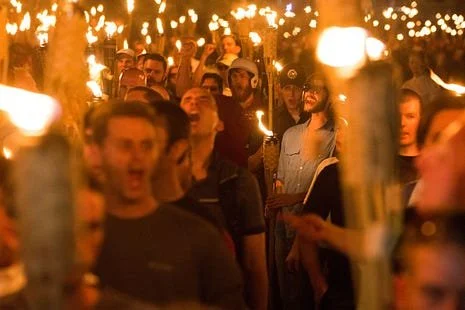
Unite the Right. Credit: Zach D. Roberts/NurPhoto
The ascendance of the Great Replacement in the modern GOP was completed in August 2017 at the “Unite the Right” rally in Charlottesville, Virginia. On the night of August 11, a torch-wielding mob chanted the phrase “you will not replace us!” which was a popular fascist slogan at that time. This quickly morphed into “Jews will not replace us!” echoing the earliest versions of the Great Replacement. When Trump refused to clearly comment them it was a signal of things to come. The party and its acolytes had already assimilated law enforcement with the emergence of Blue Lives Matter police cadres after the Ferguson protests in 2014. By 2017 it was clear there was a permeable membrane between police and vigilantes. To the party faithful this is how it should be; this alliance is vital to protecting party members from both an oppressive federal government and imaginary hordes of criminals, migrants, and degenerates. In a tradition going back to pre-Civil War slave revolts, white citizens imagined they and their property were constantly under an imaginary threat and thus perpetually justified in preemptive violence.
COVID-19 accelerated everything. The new party faithful had two responses: xenophobic violence (against Asians and immigrants) and paranoid delusions. How could the party do otherwise? But the refusal of the true believers to adhere to basic health protocols managed to shrink the overall party demographic even further, by how much is not yet known. It was so bad that despite the still-large number of party voters and the huge asymmetrical advantages rural, conservative states enjoy in the electoral college, Trump lost in 2020.

Photo: Blink O’faneye/Flickr
The party had no more right-wing constituencies to capture. It could expand by winning over some newly conservative voters, but that might take years and might just replace the aging party members. Efforts to recruit younger voters mostly resulted in more extremists joining the party, as they were the only young people interested. The only thing to left to do: make it as difficult as possible for anyone not in the party to vote, organize, protest, or participate in politics at all.
It was an old Jim Crow-era strategy of violence and intimidation — approved by parents, pastors and politicians, enforced by cops, judges, and jailers. It was kicked off by the mob attack on Congress on January 6, 2021. Trump intended to stage a coup that day, using the mob as his weapon. Even though that failed, the attack itself was successful in the historic feat of occupying and sacking the Capitol building. It inaugurated a nationwide campaign of terror and violence that hasn’t stopped since, coordinated by the party’s media apparatus, political leadership, funders, and armed militant wing. There are excellent accounts of the present state of the party but they usually try to suggest, or hope, that the party will come to its senses. In retrospect, however, the status quo reached in 2020 looks inevitable. [Editorial note from 2026: and of course Trump recaptured the White House anyway and went on to be one of the most unpopular Presidents in American history.]
Where was the Democratic Party? To quote Nikhil Pal Singh:
In the face of this challenge, it is difficult to judge the Democratic Party as anything more than a feckless, mildly recalcitrant partner. Over the past 40 years, it has alternatively sought to ratify, in gentler tones, GOP-driven projects and demands to lower corporate taxes, get tough on crime, end welfare as we know it, expand the ambit of deportation and sustain open-ended military authorisations. It has sought to placate vulnerable constituents with forms of symbolic recognition and modest regulatory action, often undergirded by weak executive authority and moral sentiment. It is the undeniably saner and more constructive of the two electoral options Americans are forced to choose between. But it also operates an effective pincer movement against alternatives further to the left that seek to transform skewed imbalances in the power of capital and labour, police authority and public safety. When constituents choose to fight, for example, against police abuse, or for labour rights, Democrats are missing in action, or else warning against unpopular opinions that will awaken the monster on the right. Forever counselling that we choose the lesser evil, they have instead grown habituated to living with the fox inside the chicken coop.
That finally brings us to the end of Roe.
Samuel Alito, Amy Coney Barrett, John Roberts, Clarence Thomas, Neil Gorsuch and Brett Kavanaugh committed a monstrous act of violence against American women and their families. In the context of 2022 that act has to be seen as part of the ongoing Republican campaign of psychological and actual warfare. It’s also meant to reverse to the Great Replacement, alongside all the mass killings inspired by that old race panic. Post-Roe America is a joint white evangelical/right-wing Catholic eugenics project. White women are forced to carry their children to term while the “unfit” are excised from the nation. “A victory for white life.”

Danillo Sena. Credit: Nashoba Valley Voice
A couple years ago, a stranger knocked on our door. He told us his name was Danillo Sena. He was running for a seat in the Massachusetts House of Representatives and was canvassing the neighborhood. This was during the 2020 Presidential race and our north-central Mass. town was upholstered with Trump flags. Danillo saw our pride flag draped over our porch rail so he felt comfortable paying us a visit.. He was running for the seat against a local Republican woman who happened to be the realtor who sold us our house. Danillo told us he was born in Brazil in the 1980s; now he was living in Acton. As we talked it occurred to me that I’d never had an American politician in my kitchen and probably never will again. He was proudly progressive and clearly excited to be running in the hopes of making a difference to his community. We wished him the best but he didn’t need it — he won the election against the realtor by about 2,800 votes. The realtor only won her own hometown, which happens to by the town I live in. Even she had to admit that he “ran a good campaign and is a very nice young man.” He won his next election too. It felt different that the usual liberal talk of how great voting is, and how the idea of voting itself will save us. This time it wasn’t a lesser evil, we were affirmatively voting for someone we liked and agreed with. It had been a long time.
Does it mean anything that a young progressive Brazilian immigrant can beat the odds in 2020 and 2021? I choose to believe it does and I want to to believe that too. Everything that led to the criminalization of abortion might have building for 40 years but that also means it’s in the past. The future is people like Danillo Sena. It’s the fact that almost 1 out of 6 young people identify as LGBTQ+. It’s the unbelievable return of unions to the United States. It’s Americans realizing their government has no use for them so they will take care of themselves instead. Stirrings of suspicion about law enforcement, the widespread realization the US government could be more supportive any time it wanted to, real proof that it doesn’t just feel like everything has gotten worse over time, it truly has, at a time when most of the world’s wealth is passed around between the same few individuals. In themselves these aren’t necessarily inspiring, but they might be if they wake up the non-conservative masses to the truth that things don’t have to be this way. Not to mention: it’s not 1973. There are organizations and networks in place to get people what they need, sometimes out of sight because if the cops could find them they would crush them. It’s not the kind of activity that needs celebrities, or charity balls, or Democratic party co-optation. They need money, and resources, and protection, and time to grow. Sometimes you burrow down and gather and wait until the time is right to surface again. Maybe once the shellshock and numbness of the last two years have worn off, maybe long after that. Evil isn’t the only force in the world that can execute a 40-year plan.
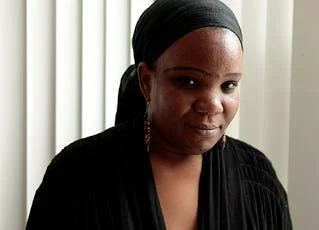
Miriame Kaba. Credit: Terrence Antonio James/Chicago Tribune
There’s a well-known quote by the activist Miriame Kaba: '“hope is a discipline.” In January 2018 she explained where that came from in a conversation with Brian Sonenstein and Kim Wilson on the Toward Freedom podcast:
The idea of hope being a discipline is something I heard from a nun many years ago who was talking about it in conjunction with making wire we were of the world and in the world. … The hope she was talking about was this grounded hope that was practiced every day, that people actually practiced all the time. … That speaks to me as a philosophy of living, that hope is a discipline and we have to practice it every single day. Because in the world which we live in, it’s easy to feel a sense of hopelessness, that everything is all bad all the time, that there is nothing going to change ever, that people are evil and bad at the bottom. … I choose to think in a different way and I choose to act in a different way. … Hope is really believing in spite of the evidence and watching the evidence change. … I believe ultimately that we’re going to win, because I believe there are more people who want justice, real justice, than there are those who are working against that.
Footnote (1): Paul Boyer, “The Evangelical Resurgence in 1970s American Protestantism,” in Rightward Bound: Making America Conservative in the 1970s, ed. Bruce J. Shulman and Julian E. Zelizer (Harvard University Press: Cambridge, Mass., 2008).
"A Victory for White Life," pt. 1
Dobbs and the Great Replacement ideology
Note: this was originally posted on my Substack on June 30, 2022. I deleted that Substack a couple years ago and I’m reposting these here so they don’t get lost.
Now that the US Supreme Court has stripped women of their constitutional right to privacy and autonomy over their own bodies, anti-abortionists are taking a victory lap to gloat and celebrate their triumph over 50% of the US population. Among the festivities was a old-fashioned Trump rally June 25. These kind of right-wing entertainments have become normalized in 2020s America so mass media was set to ignore it — until a proclamation from Republican Rep. Mary Miller from Illinois gave away the game. “President Trump, on behalf of all the MAGA patriots in America, I want to thank you for the historic victory for white life in the Supreme Court yesterday.” Her spokesman Isaiah Wartman tried to walk back her comments by saying that (a) it was “a mix-up of words” and (b) she is the grandparents of several non-white grandchildren, which apparently gives her a pass. (Isaiah Wartman is not just a right-wing mouthpiece who works has also worked for Marjorie Taylor Greene, he has multiple PACs of his own in Georgia.) But when Wartman claims that Miller had a “mix-up” he is admitting that she had a Freudian slip; she said what she really wanted to say whether she consciously intended to or not. Of course she might have just been voicing her true opinion, which happens to be the same as the neo-Nazi motto of the 14 words. From the ADL:
"14 Words" is a reference to the most popular white supremacist slogan in the world: "We must secure the existence of our people and a future for white children." The slogan was coined by David Lane, a member of the white supremacist terrorist group known as The Order (Lane died in prison in 2007). The term reflects the primary white supremacist worldview in the late 20th and early 21st centuries: that unless immediate action is taken, the white race is doomed to extinction by an alleged "rising tide of color" purportedly controlled and manipulated by Jews.
This is the core of “Great Replacement,” the aspect of the white supremacist ideology that worries about the white “race” going extinct as a result of low white birth rates, high non-white birth rates, and immigration into those bastions of whiteness Europe and North America; thus it’s been a core belief in right-wing racist thought for generations in Europe and the US. It’s become especially popular among mass killers all over the world in the last few years, from Brenton Tarrant to Payton Gendron. (Not that anti-abortionists have any problem with violence.)
Mass media in 2022 has cringed over the movement of the Great Replacement panic from the militia fringe to the mainstream via Tucker Carlson, but a panic over whites losing their unique racial power and identity has been part of American politics for hundreds of years — the entire immigration policy of the US was founded on it. Mary Miller’s public declaration is perfectly in line with this history. But to fully understand the ramifications of Miller’s specific words we have to connect the dots between two different lines of racist thought: eugenics and the misogyny that expresses itself as anti-abortionism.
Anti-abortion extremists have long been fond of saying that birth control (including abortion) is equivalent to a policy of eugenics against Black children. It’s one of the arguments undergirding Clarence’s Thomas’s legal reasoning in Dobbs. When Clarence Thomas linked abortion with eugenics in 2019, he was, as usual, making up a historical precedent in an attempt to inject the barest tinge of tradition into his obsession with stripping Americans of their rights. His ahistorical linkage of eugenics and abortion appeared again in the decision making women second-class American citizens. So there’s at least a fifty percent chance Thomas actually believes it.
Even though Thomas gets his history wrong — his decisions are the raw exercise of unchecked power anyway, so he doesn’t care about historical fidelity — a link between the concept of eugenics and the promoters of white race panic was forged in the 1970s. The Great Replacement is that link.
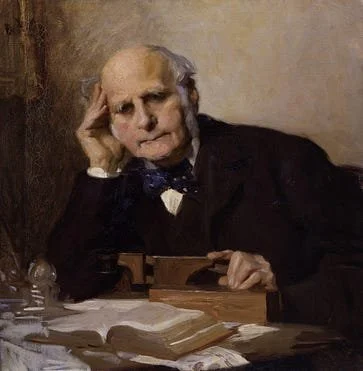
Francis Galton
The story begins with Francis Galton. Galton was born in 1822 in Birmingham, England. For the sake of space I’m going to gloss over Galton’s early years as a child prodigy and world traveler. When Galton finally settled back in England, he found his true calling: science and invention.
Galton was obsessed with numbers and counting — his personal motto was “whenever you can, count” — which led him to make great advances in statistics, where he invented concepts like the median and standard deviation. This in turn led him to advances and inventions in several other fields, including: meteorology, where he create the first weather map; forensics, where he separated fingerprints into six major types; perception, where he invented the Galton Whistle to test hearing, which became the first dog whistle; psychology, where he pioneered the use of questionnaires to gather data on large numbers of subjects; and various others, including a study on how to make the perfect cup of tea. But among these innovations, Galton’s real legacy would be in a field he personally created and named: eugenics.
Galton’s life was changed when his cousin, Charles Darwin, had his book The Origin of Species published in 1859. Galton was obsessed with the book, especially the section that dealt with the breeding of animals. Darwin only hints at using his theories to study variations in homo sapiens, so Galton decided he would go down that path himself. He was determined to unlock the secrets of human heredity by analyzing traits like height, fingerprints, facial features, and, crucially, mental characteristics like intelligence, which Galton assumed was inherited.
Since Gregor Mendel’s research was still unknown, Galton had to rely on gathering large amounts of data from a wide range of subjects, a project well-suited to his innovative statistical techniques and questionnaires. Using a technique he called “historiometry,” Galton analyzed numerous biographies of prominent men — judges, statesmen, scholars, premiers, scientists, military commanders, writers, and artists. He quantified this biographical information and converted it into tables and charts. Galton also looked closely at the families of these men, to see if they too had eminent relatives and if so, where their rise to eminence began.
Overall he analyzed 300 families and about 1000 individuals in total. He found that the “eminence” dropped off a bit for each preceding generation, and for the distance from the person in question; for example, cousins were less eminent than brothers. This pattern confirmed for Galton that genius was an inherited trait that accumulated over time. He published his findings in an 1869 book, Hereditary Genius. To say that this book doesn’t withstand modern scrutiny is putting it mildly. And despite the influence of Darwin, whose theories laid waste to centuries of “race science,” Galton recreates the old racial hierarchy inherited from physical anthropology by suggesting that the “negro race” is two levels of intelligence below the Anglo-Saxon race.
What made Hereditary Genius a landmark work was Galton’s suggestion that humans could use the inheritance of genius to actively direct the course of their evolution.
I propose to show in this book that a man's natural abilities are derived by inheritance, under exactly the same limitations as are the form and physical features of the whole organic world. Consequently, as it is easy, notwithstanding those limitations, to obtain by careful selection a permanent breed of dogs or horses gifted with peculiar powers of running, or of doing anything else, so it would be quite practicable to produce a highly-gifted race of men by judicious marriages during several consecutive generations. I shall show that social agencies of an ordinary character, whose influences are little suspected, are at this moment working towards the degradation of human nature, and that others are working towards its improvement. I conclude that each generation has enormous power over the natural gifts of those that follow, and maintain that it is a duty we owe to humanity to investigate the range of that power, and to exercise it in a way that, without being unwise towards ourselves, shall be most advantageous to future inhabitants of the earth.
Galton goes further and suggests that it will be necessary for the more advanced races like the Anglo-Saxons to consciously evolve in order to adapt to their own civilization, otherwise they are be in danger of dying out. Galton is especially worried that white families are delaying marriage to later and later ages and thus having fewer children.
The effect of this, he writes,
would be such as to cause the race of the prudent [i.e., those having fewer children] to fall, after a few centuries, into an almost incredible inferiority of numbers to that of the imprudent, and it is therefore calculated to bring utter ruin upon the breed of any country where the doctrine prevailed. I protest against the abler races being encouraged to withdraw in this way from the struggle for existence. It may seem monstrous that the weak should be crowded out by the strong, but it is still more monstrous that the races best fitted to play their part on the stage of life, should be crowded out by the incompetent, the ailing, and the desponding.
I’m quoting so much from Hereditary Genius because this is ground zero for Great Replacement rhetoric.
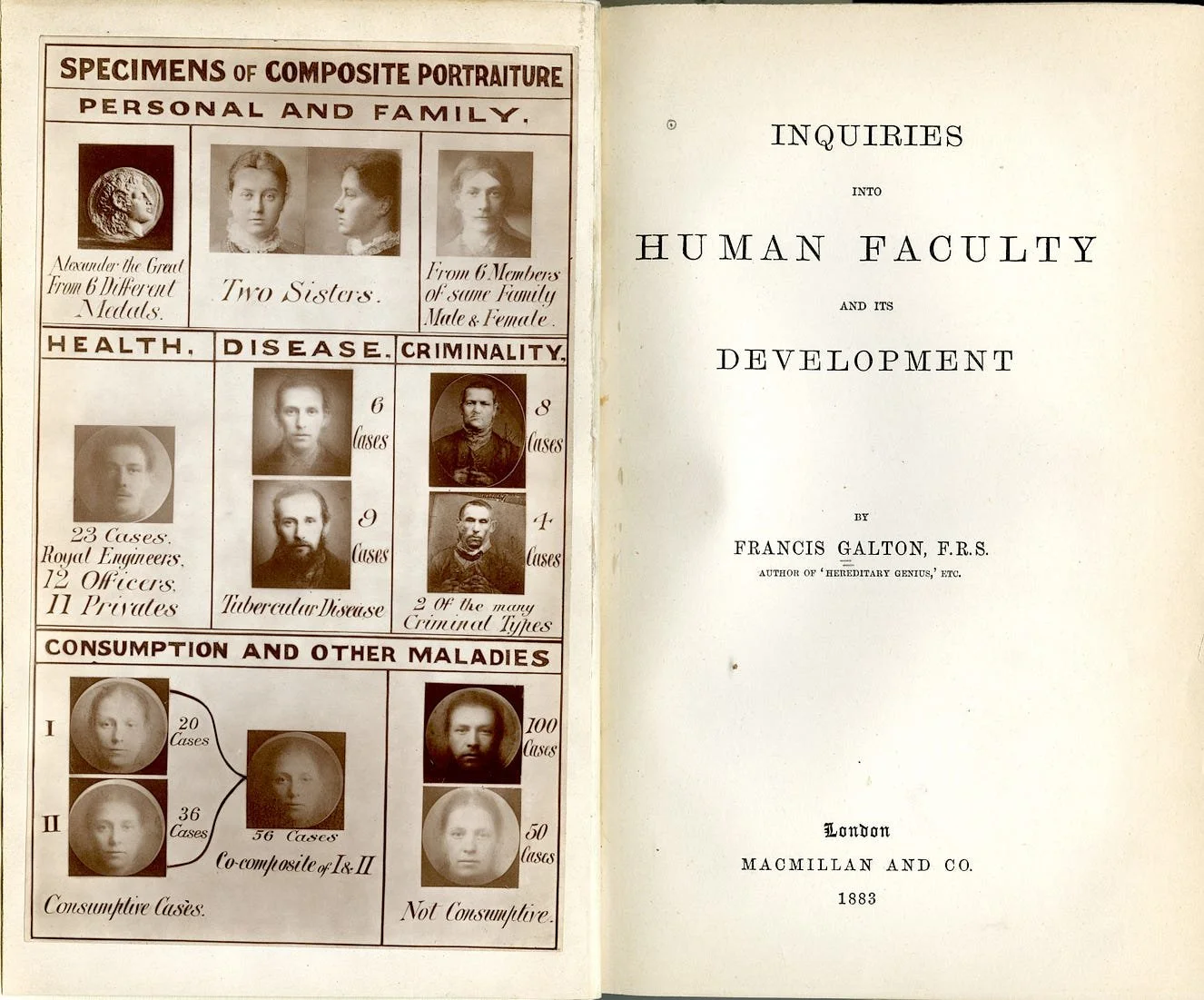
Inquiries into Human Faculty and Development, 1883
Galton’s contemporaries were skeptical. Hereditary Genius scrambles together complex mathematics and statistics with blanket assumptions and wild guesses. But Charles Darwin, at least, was impressed; in his book The Descent of Man he wrote: “We now know, through the admirable labours of Mr. Galton, that genius . . . tends to be inherited.” In his follow up book, Inquiries into Human Faculty and its Development (1883), Galton invents the term “eugenics” to describe this active improvement of humanity through selective breeding. A new pseudo-science, racialism wrapped in the trappings and rhetoric of rigorous science, was born. To understand how “white families should have more children” became the Great Replacement, we need to look at the work of a German doctor named Alfred Ploetz.
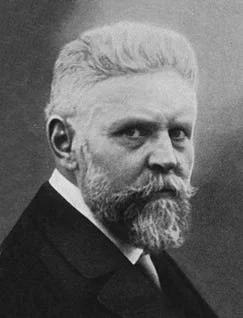
Alfred Ploetz
Alfred Ploetz was born in Germany in 1860. I’ll have to pass over his early years as well, though I will mention that he became committed to racist eugenics in his 20s and became a medical doctor at the age of 30.
While Francis Galton was receiving accolades for his eugenic ideas in Britain, Ploetz was quietly reshaping the future of eugenics with his 1895 book The Efficiency of Our Race and Protection of the Weak. Galton wanted governments and nations to encourage the best families to have more children; Ploetz emphasized the importance of preventing so-called degenerates from breeding. Marriages and children, he wrote, should only be allowed by society and the state. For the sake of the nation the sick, the weak, the disabled, twins, and those whose parents were too old or too young should be, in Ploetz’s words, “eliminated.” Ploetz’s ideas were the logical end point of Galton’s eugenics. Whereas Galton was content to rhapsodize about a better world through elites having large families, Ploetz’s racist eugenics was how Galton’s ideas were put into practice.v1895 was also the year that Ploetz created the term Rassenhygiene, “race hygiene,” to describe his approach. It was a term that would stick as he found that the German-British-American science axis was a receptive audience for his ideas.

Grundlinien einer Rassen-Hygiene, 1895
On June 22, 1905, Ploetz founded the German Society for Racial Hygiene with only 31 members, but two years later it had grown to the point where it renamed itself the International Society for Racial Hygiene. Its goal, according to Ploetz, was "for society to return to a healthy and blooming, strong and beautiful life.” The Society received strong support from the German imperial government, and their ideas began to take root elsewhere, as similar societies formed in the United States, Sweden, the Netherlands, and Britain. The United States was especially interested in applying “race hygiene” to a specific problem: immigration.
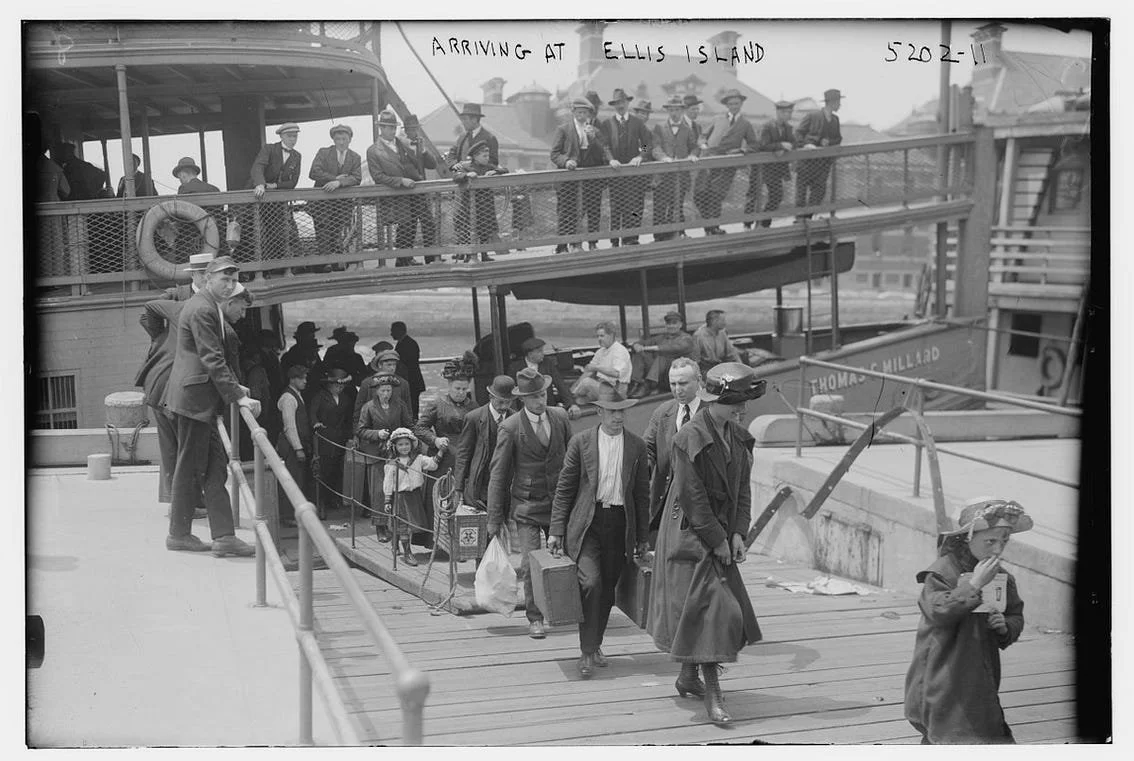
Between 1870 and 1900, twelve million immigrants settled in the United States. It was the largest influx of immigrants in US history to that point. They were mostly from Germany, England, Ireland, Scandinavia, and China, the latter of whom had already been coming in large numbers to work on massive railroad projects in the Western US. 70 percent of these 12 million immigrants came through New York City, and if they didn’t settle there, they usually traveled to other urban centers like Chicago or Philadelphia to look for work.
These new arrivals were treated badly. The public and private sectors discriminated against them, which in turn kept them in a state of economic insecurity at best and hunger and poverty at worst. They were thus stereotyped as dirty, lazy and stupid, which encouraged discrimination against them, forming a feedback loop of bigotry. “Anglo-Saxon” white Americans were deeply anxious that their bloodlines would be diluted and eventually erased completely by the sheer numbers of these physically diseased and inferior specimens, especially those from Italy, Greece, Spain, or Central Europe. This centuries-old anxiety about vice and degeneracy as a moral and physical contagion could now be validated by the discourse of science and medicine, via the scientific literature and professional associations devoted to eugenics.
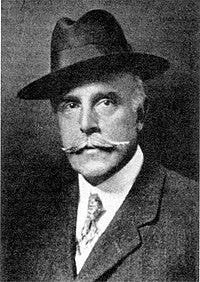
Madison Grant
White American anxiety over immigration was the perfect moment for Madison Grant. His book The Passing of the Great Race was published in 1916. It was the most popular and influential book on race science before World War I. It was the first true expression of Great Replacement rhetoric, with Adolph Hitler admired Grant’s work though he preferred the term Aryan to Nordic. In 1930s Hitler wrote Grant a fan letter where he called The Passing of the Great Race “his Bible.”
Madison Grant brought the eliminationist racism at the root of Ploetz’s eugenics to the forefront of American discourse. In Grant’s 1916 version, the superior Nordic race is under threat by immigrants from southern and eastern Europe. “A rigid system of selection,” he writes, “through the elimination of those who are weak or unfit – in other words, social failures, would solve the whole question in one hundred years, as well as enable us to get rid of the undesirables who crowd our jails, hospitals, and insane asylums.” He thought that “unfavorable” races should be segregated into ghettos, overseen by public health officers given absolute power. This would prevent the superior Nordic race from committing “race suicide” by marrying and having children with inferior races.
At the very time The Passing of the Great Race was published, the supposedly superior white Europeans were slaughtering each other by the hundreds of thousands. The Great War interrupted the German side of the eugenics axis, but in the United States, the war would be the final piece that transformed the US into a full-fledged eugenicist republic.
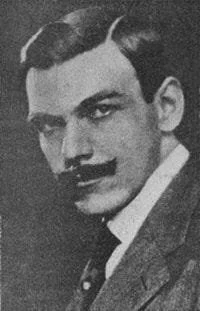
Lothrop Stoddard
In the aftermath of the Great War, a wave of xenophobia swept across Europe and America. A wave of violent racism directed against African-Americans, Jews, and ethnic minorities swept the country; late winter through early autumn of 1919 came to be known as the Red Summer because so many hundreds of black Americans were attacked, lynched, or murdered across the US by rioting white Americans. It was also the first Red Scare, when Americans became paranoid about the influence of Bolshevism and Anarchism infiltrating the US — not only through Jewish and Italian immigrants but also African-American labor organizers and civil rights leaders. The Klu Klux Klan had been re-founded in 1915 and now its numbers swelled. Perhaps the most prominent member of this new Klan was Madison Grant’s protégé, Lothrop Stoddard.
Stoddard’s 1920 book The Rising Tide of Color Against White World-Supremacy made Grant’s racist theories of the white civilization against non-white barbarism even more popular. Stoddard’s book The Rising Tide of Color Against White World-Supremacy But things had changed in just the four years since The Passing of the Great Race —whereas Grant was concerned with the Nordic race diluting its purity by mixing with those from the Mediterranean or Russia, Stoddard focused his racist ire on black Americans and the poor.
Stoddard was also a member of the American Eugenics Society. Founded in 1923, it was mostly made up of 28 state committees that used state fairs to popularize the concepts and practice of eugenics. In addition to these efforts, the AES also lobbied for the wider use of intelligence tests on students and immigrants to the US. But at this point the lobbying was almost unnecessary, as the US government had was determined to restrict immigration to almost nothing, thanks to the work of American psychologist Robert Yerkes.
The Great Replacement paranoia was now codified into federal government policy over immigration and sterilization (since the Buck v. Bell case), the latter of which is a huge topic I can’t cover here. To understand how this all connected with the backlash to Roe v. Wade, we have to fast forward to the 1970s. I’ll cover that and more in part 2.
WE SHALL BE CRIMINALS
How to Survive in America
Note: this was originally posted on my Substack back on May 27, 2022. I deleted that Substack a couple years ago and I’m posting these here so they won’t be lost.
WE SHALL BE CRIMINALS because the law has declared that we are one angry cop, one medical bill, one wellness check, one housing shortage, one traffic stop, one power outage, one biased judge, one fascist vigilante, one border checkpoint, one polluted river, one pregnancy, one viral infection, one drone strike away from death; because the law believes with all its heart that these deaths are right and just; because the law has made our identities, our everyday actions, and our existence criminal;
WE SHALL BE CRIMINALS because shoplifting is a crime but wage theft is legal; because being unhoused is a crime but evicting people to build empty luxury apartments is legal; because you or I not paying our taxes is a crime but when the wealthiest people in history ignore or evade their taxes it is legal; because resisting arrest is a crime but elected politicians overthrowing the government is legal; because manslaughter is a crime but 1 million Americans dead from COVID is legal;
WE SHALL BE CRIMINALS because we will reclaim our right over own bodies; because getting an abortion makes us criminals; because transitioning makes us and our families criminals; because using our preferred pronouns makes us criminals; because being a woman means the law will not protect you from harassment, violence, and terror; because being disabled makes us disposable; because being a minor gives one no standing or protection before the law;
WE SHALL BE CRIMINALS because criminals are not satisfied with Facebook posts and human resources seminars and Instagram posts and book clubs and tweets and diversity, equity, and inclusion initiatives and YouTube videos and cable television interviews and Twitch streams and corporate logos and political speeches and thoughts and prayers;
WE SHALL BE CRIMINALS because Metacomet and Nat Turner and Tecumseh and John Brown and Harriet Tubman and Ellen and William Craft and Henry “Box” Brown and Sojourner Truth and Frederick Douglass and William Lloyd Garrison and Ida B. Wells and Alice Paul and Eugene Debs and Emma Goldman and Big Bill Haywood and Rosa Parks and Diane Nash and A.J. Muste and John Lewis and Anne Braden and Bayard Rustin and Martin Luther King, Jr. and Fannie Lou Hamer and Malcolm X and Kwame Ture and Leonard Peltier and Fred Hampton and Dolores Huerta and Susan Rosenberg and Rasmieh Yousef Odeh and Chelsea Manning and the Standing Rock Sioux Tribe and a thousand others were criminals;
WE SHALL BE CRIMINALS because people who are not rich or not white or don’t speak perfect English who try to enter the United States are ignored for years; because people to try to cross America’s imaginary border without waiting for years are labeled illegals by the law and stripped of their human rights; because the illegals have their children taken from them; because the children of the illegals are housed in camps where they are starved, abused and drugged; because the illegals are hunted, captured, jailed, and deported, no matter how long they have lived in the United States; because the the law has decided the illegals can be cheated, exploited, and killed at work with no consequences;
WE SHALL BE CRIMINALS because our geography is sculpted by the law; because the law is founded in private property and the law determines what counts as private property; because littering is a crime but polluting waterways and oceans is ignored; because when a corporation breaks the law on a massive scale and pays a fine as a result, the corporation considers it a cost of doing business;
WE SHALL BE CRIMINALS because Americans cherish catching criminals using forensic science like pattern matching evidence, DNA analysis, hair analysis, firearm analysis, shoe print analysis, tire track analysis, handwriting analysis, bite mark analysis, line-ups, breathalyzer tests, psychological profiles, and lie detector tests, even though there is no proof that these methods are reliable, useful, or honest; because it is legal for the law to lie to you; because it is legal for the law to pressure you to confess to a crime you did not commit; because innocent prisoners are not allowed to show proof of their innocence or that their lawyers were incompetent;
WE SHALL BE CRIMINALS because the law in America gets qualified immunity; because the law shoots an average of 1,000 people every year; because the law has filled the jails to overflowing; because the law sees mass shootings coming a mile away does nothing to stop them; because the law forms gangs within their own ranks; because the law plants evidence; because the law gets the vast amounts of money shoveled into its budget while vital social programs disappear; because the law embezzles public money and seizes assets; because the law kills 3 times as many black Americans that any other racial group; because the law in America in known around the world for being arbitrary and brutal;
WE SHALL BE CRIMINALS because there are more people incarcerated in the United States than anywhere else in the world; because the law allows us no alternative; because we break the law by talking about breaking the law; under the law there is nothing to do, nowhere to go, and no one to be that will not be against the law; because criminals will be brave in America; criminals will thrive in America, criminals will survive in America.