Archives and the Fruits of Crime
Short stories about malfeasances of memory
Note: this was originally posted on my Substack on September 9, 2022. I deleted that Substack a couple years ago and I’m reposting these so they don’t get lost.
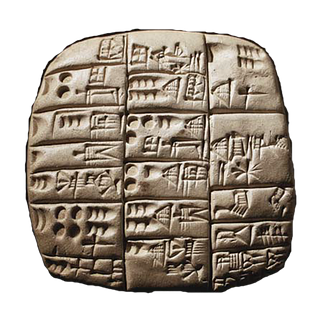
Ancient Sumerian clay tablet. The earliest of these were created about 3200 BCE. The vast majority of them are financial records. So many were created that about half a million to two million have survived to the present, though only about 10,000 have been translated.
Stairway to Heaven
From 2011 to 2019 I taught a class called Introduction to Archival Management and Services (i.e. Archives 101) at the Simmons University College of Organizational, Computational, and Information Sciences. Most of my job was trying to keep the exhausted grad students alert from 6:00 to 9:00 PM once a week. The capstone assignment was the “Process Yourself Project.” Each student chose material that they created or owned; this was their collection. The had to take these items and write a finding aid for it — an overall description that a hypothetical patron would use to access their collection. It was a way for them to show their ability to appraise, organize, and describe documents and artifacts from their own life history. Usually archivists never meet the donors of any given collection; in this case the student was the donor. For some students the experience of going back over the traces of their lives was profound — they were mostly in their in their 20s, used to facing forward not looking backwards.
I was flexible about what constituted a “collection,” as long as they could write a finding aid and provide context I would accept it. One student wrote a whole finding aid about his Magic: the Gathering card collection. Another student asked if she could catalog her father’s collection of Led Zeppelin vinyl record albums. Her father had recently died and the two of them had been re-connecting the last couple years, bonding over his favorite music. Make sure to give the context, I said. Give the release years, catalog numbers, etc., but let people understand why this collection exists, what it means to you. Make them comprehend how these songs are the sounds of your memories.
Bring it On Home
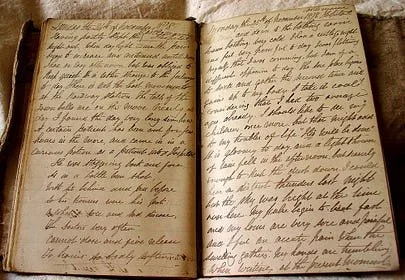
One of 25 diaries of Joseph Jenkins (1818-1898), a Welsh farm laborer who immigrated to Canada, then returned to Wales. His writings, in English and Welsh, include both his poetry and his detailed everyday observations. Original at State Library of Victoria, Canada.
At the repository where I work most of the collections are based around individuals, what we call “personal papers.” Archival repositories in general are built to house institutional records and want little to do with personal papers. The problem with personal papers: archives use standardized language to describe their material the way libraries do. But applying a set of standard bibliographic categories to a bound volume — a tidy packet of information — is one thing. Any given letter might touch on numerous different subjects; what is it “about”? A diary might include observations about the weather, important appointments, pressed flowers, quotes from other writers, or all or none of those.
Cataloging always conceals as much as it reveals. This slipperiness is a problem for the students and historians who try to study material culture and, in the words of E.P. Thompson, “history from below.” Letters, diaries, mementos, and other “non-records” are exactly what these scholars are looking for, but because they’re difficult to describe they’re difficult to find. Everybody wants archivists to digitize as much as possible of this kind of material because in theory it’s easier to access. But that doesn’t solve the description problem, and it often makes it worse. “Digitizing personal papers” usually means disaggregating material that has been physically grouped together — often by the creator and/or donor, so that the arrangement itself can be significant context — into numerous discrete digital objects, each of which each needs a base level of decent-quality descriptive metadata in order to be discoverable by online search and browse functions. The limited access of personal papers isn’t just analog vs. digital, it’s the limits of descriptive language and even language in general.
In My Time of Dying
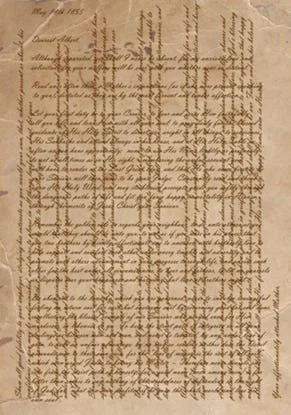
An example of cross-writing from the mid-19th century. This was done to save on the cost of paper and postage.
Archivists who work with the collections of individual people are professional hauntologists. We deal in traces left behind by people who mostly never imagined the surviving evidence of their existence would be boxed, cataloged, and curated. Personal papers can include quotidian objects everyone accumulates: diaries, journals, photo albums, letters, postcards, souvenirs, children’s drawings, maybe a pocket watch, some clothing, family Bibles, mementos and “ephemera.” One of our collections includes two bullets (possibly) dug out from the corpse of a soldier killed in World War I, kept by his grieving mother. Inhabiting this residue is like looking into a little abandoned room. Processing a whole collection can feel like temporarily possessing someone else’s body.
Institutional records on the other hand are selectively chosen and carefully pruned by archivists and records managers. “Personal” records, i.e. anything created by an individual for their own private use, are weeded out as much as possible. It’s not always an easy call to make but the policies and procedures for stewarding these records are standardized and comprehensive. Trouble creeps in when you can’t distinguish between personal and institutional records — when a person is the institution — like the Executive Office of the President.
Houses of the Holy
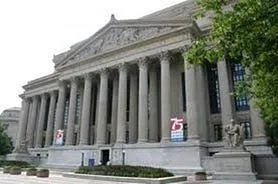
National Archives and Records Administration, Washington DC. NARA was created by FDR in 1934, expanded under the General Services Administration in 1949, and became its own agency in 1984.
Most US Presidents since Franklin D. Roosevelt have donated their papers to the US in the form of Presidential Libraries, a system started when FDR donated his records in 1939. Every President from Hoover through Obama has their own Presidential Library. Most Americans think that (a) this donation is compulsory; (b) the libraries are, for the most part, politically neutral, designed to teach history, not propaganda. Neither of these are true.
Prior to the Presidential Records Act of 1978, all Presidential records were legally the private property of that President. FDR could have kept his papers to himself, but he decided to donate them to the National Archives and Records Administration. This set a public precedent for the next few Presidents, though privately they more or less hated it.
This gentleperson’s agreement was torched by Richard M. Nixon. On his way out the door from his resignation in disgrace he decided he would use his papers’ status as his personal property to keep them for himself and mostly destroy them. Congressional legislators realized they had no way to stop him so they hurriedly passed the Presidential Recordings and Materials Preservation Act of 1974, which only applies to Nixon’s papers. The PRA was broader, converting all Presidential records from public to private and ensuring at least some public access to inactive records using the 1966 Freedom of Information Act (with the usual nine exceptions). The specific procedure for transferring the records wasn’t fully codified until 1989 by Reagan administration. George W. Bush’s administration struck this down in November 2001 and replaced it with an order locking down both Presidential and Vice Presidential records, in line with their general disdain for public access. Obama reverted the PRA back to the Reagan guidelines in 2009, which meant material that had been declassified under Reagan and re-classified under W was again declassified.
Presidential papers might be public records but Presidential Libraries aren’t public institutions. When Truman decided to follow FDR’s example with his own papers, his administration created a system whereby private endowments front the money for the library building while civil servants preserve, catalog, and administer access to the actual records. The exhibits are also determined by the private foundations, which by definition are set up by supporters of the various Presidents. This leads to some straight-up propaganda like the “Decision Points Theater” exhibit in the George W. Bush library. The exhibit gives you various Presidential choices to make and shows you the potential consequences of your decision, along with what GWB actually did; if you decide that going to war in Iraq was the wrong choice, the exhibit responds with “sorry, wrong answer! Try again!” So you can imagine the bullshit that will fill the Trump Presidential Library.
(As a side note, trying to get access to the records of the Office of Presidential Libraries is practically impossible, despite those records being public. The OPL didn’t want their records subject to NARA’s retention schedule, so they just stopped sending them to NARA circa 1964. That puts them in the category of “operational” records and thus unavailable to the public.)
Trampled Under Foot
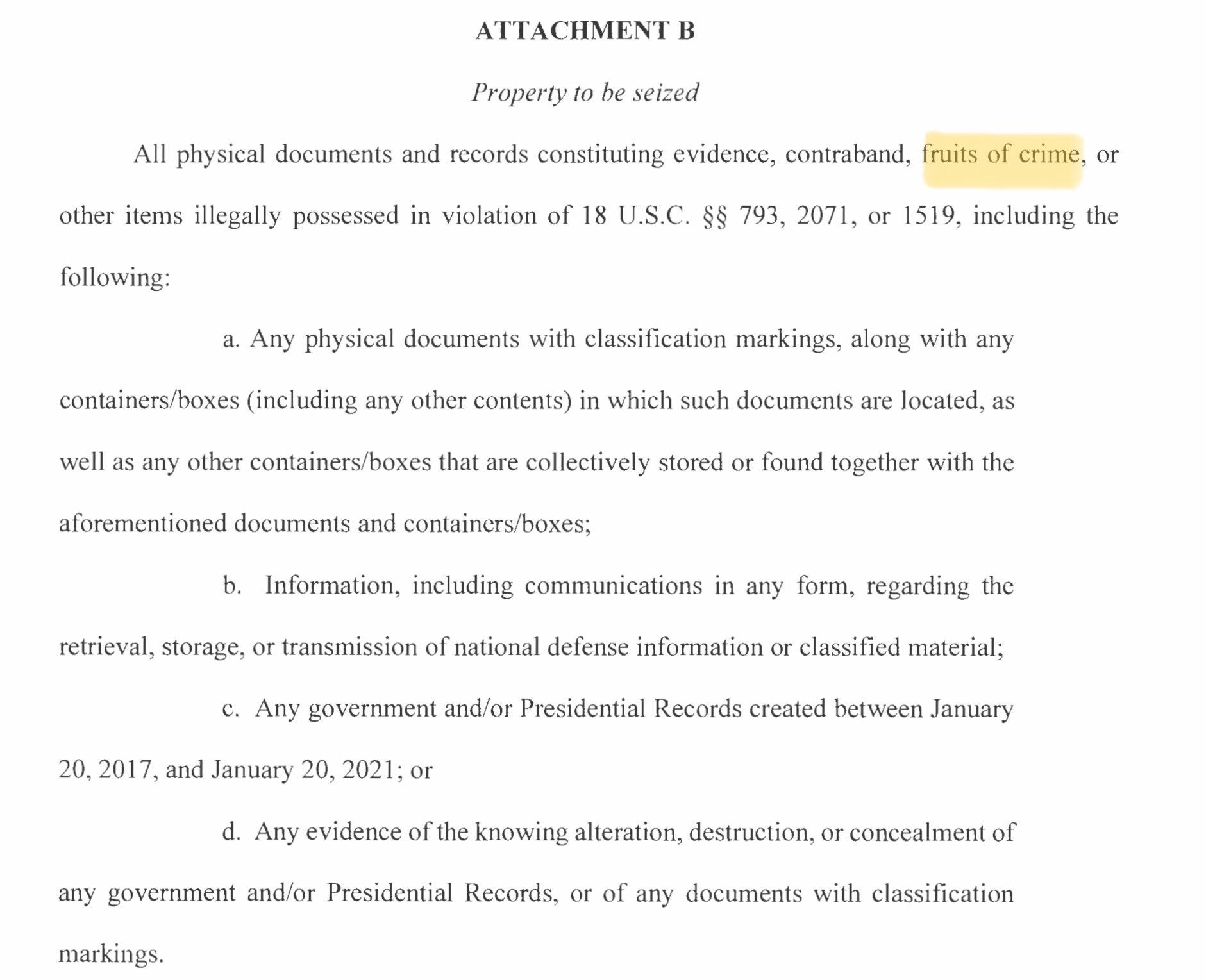
FBI search warrant for Mar-a-Lago, August 11, 2022.
What makes Trump’s attitude towards his Presidential records is, as usual, his brazen honesty about the fact that the American Chief Executive is bound by no rules. When he was done reading a memo, a letter, or anything else, he would rip it up and throw it on the floor or sometimes in the trash. We now know he would flush papers down the toilet, despite his lies to the contrary. This was obviously against the PRA but to say that Trump didn’t give a damn is an understatement.
His aides are always happy to enable Trump so they scooped up his refuse and sent it to NARA, where it was the thankless job of two NARA records management analysts, Soloman Lartey and Reginald Young, Jr., to literally Scotch tape the fragments back together so they could be filed. In Spring 2018 they were both fired without warning; maybe Trump or his people realized what they were doing they told NARA’s head of human resources to get rid of them. But maybe they were just victims of the 2018 purge of civil servants by Trump.
Good Times, Bad Times
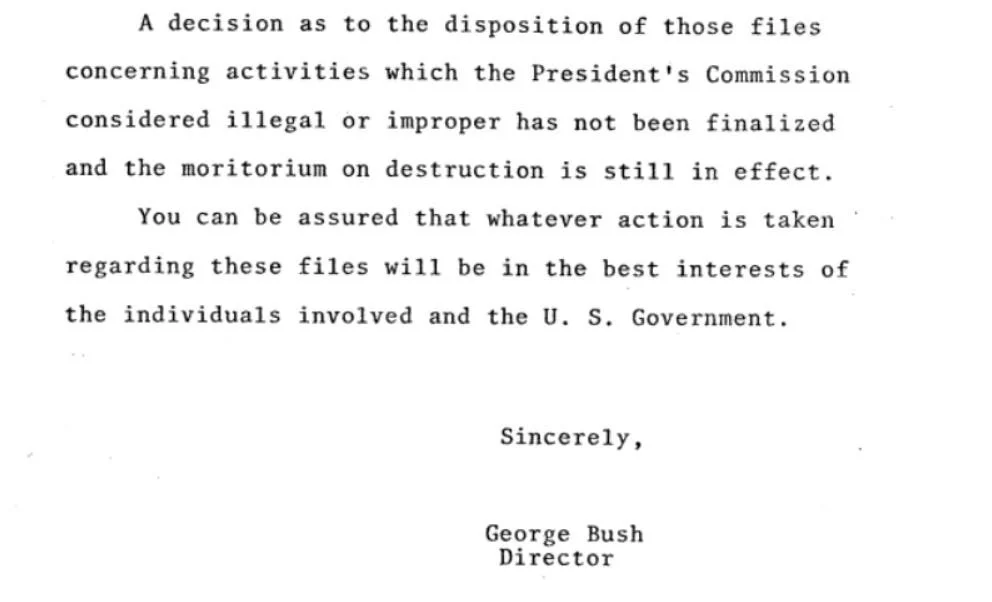
Draft memo by CIA Director George H.W. Bush, 1976. Bush was responding to Bella Abzug’s concern about the CIA purging its records. The Agency rewrote this to say the CIA would act ““in accordance with Presidential directives and as permitted by law” but this memo reflects their actual proprietary stance towards their own records.
Trump isn’t the first President to bury or destroy his own records. It’s common knowledge by now that Warren G. Harding was a sex maniac; his family managed to keep Harding’s letters to one of his mistresses under seal for as long as they could. When Republicans howled over Hillary Clinton’s private email server during her run, Democrats retorted that nobody in the GOP cared when George W. Bush’s staff deleted about 22 million emails instead of sending them to NARA. When NARA’s security office told Dick Cheney to hand over his Vice Presidential records, Cheney ignored them, then decided it would be simpler to abolish the security office. In 2003, Sandy Berger, a National Security Adviser under the Clinton Administration, stuffed a bunch of classified documents into his clothes and walked out of the NARA facility with them.
Then there’s the garden-variety restriction and/or destruction of records by various US government bodies. For example: soon after it came out that the CIA were running secret prisons in Eastern Europe, they destroyed ninety videotapes of their officers torturing captives. Bush’s White House Counsel Gina Haspel ordered their destruction; in 2018 she was named director of the CIA and retired comfortably in 2021.
Candy Store Rock
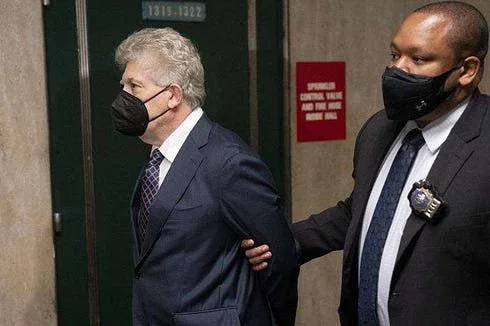
Book and manuscript dealer Glenn Horowitz being led into court, July 2022. Creator: Gabriella Bass | Credit: Gabriella Bass for NY Post.
Apart from the officially sanctioned crimes against archives, there’s an economy of rare books and manuscripts that operates in the shadows: purchases from dealers who don’t ask many questions about provenance by wealthy private collectors building their treasure hoards. (In this shadow economy museums are in a class by themselves since so much of their holdings are stolen.) In this grey zone, forgeries and fraud are rampant. Phil Collins, an obsessive collector of material about Texas and The Alamo, was probably conned into purchasing large amounts of forgeries from a historian and an antiquities dealer working together. Mark Hoffman made a whole career out of forging documents about the LDS Church. Even the venerable auction houses Christie’s and Sotheby’s colluded to artificially inflate market prices — since the value of any given book or manuscript, as with any other commodity, is only worth as much as the most someone is willing to pay for it.
There’s a long list of thieves that have stolen from NARA. Maps are particularly valuable to collectors, so thieves like Gilbert Bland and Edward Forbes Smiley III are the reason many private map collections exist. Barry Landau stole thousands of Presidential documents and artifacts partly for the money and partly for his love of collecting. The FBI created the Art Crime Team in 2005 because of the high level of international theft. The FBI steps in if: the material is over 100 years old and valued over $5,000; or under 100 years old and valued over $100,000. They also maintain a National Stolen Art File of items valued over $2,000, but of course these are only the items they know about.
In addition to this dark economy, there’s an open, legal economy of papers and archives. A donor can get their collection appraised at a certain value, donate that material to a repository as a gift, and take a tax deduction for the amount on the appraisal. The only catch is you can’t donate your own personal papers this way and the repository can’t hire the appraiser. If you’re a private collector with some valuable material, you can use this system to create your own tax loophole — just keep donating highly-appraised material every year and watch your taxable income go down. If you don’t care about the tax implications and you want to give your own papers to an archive — but not for free — you can sell them to the highest bidder. The record for sales is currently the University of Tulsa buying Bob Dylan’s papers for between $15 to $20 million (George Kaiser and his Kaiser Family Foundation chipped in a large amount of that). On the other side, if an archive is willing to pay top dollar it can engage in multi-million dollar buying sprees for major collections, like Thomas Staley did to get the Harry Ransom Center at the University of Texas at Austin some of the most prestigious archival collections in the world.
Brokering these deals snags a nice payday for the middleman. If they do it right, they quietly build up a reputation with the right people while mostly keeping their own name out of the news; discretion is extremely important to private collectors and large institutions alike. If they get too cocky or greedy, they can end up in jail like Glenn Horowitz, dealer to the gentry of the super-rich. Trying to convince Don Henley to buy his own stolen documents from you is a bold move! So is claiming that you got them as a present from Glenn Frey, who happens to be dead!
There’s yet another economy of archival information and cultural heritage, a more recent development that operates on a giant scale. These are companies like Clarivate, Adam Matthew Digital, and Ancestry.com. Clarivate and Adam Matthew repackage digitized material and sell those packages as proprietary products, such as educational resources or databases of newspapers and other periodicals. In the case of Clarivate, they own the rights to their databases, so if you want your library users to have access to their digital material prepare to subscribe to their services. They don’t say how much they charge, but in 2021 they made hundreds of millions of dollars. Ancestry.com is notorious for putting public records like death indexes and genealogical records behind a paywall. In order for these companies to exist you need low-wage labor to digitize the material, loopholes in intellectual property that allow for proprietary platforms to do mass distribution, and the Internet. One insidious development of this economy is the recent emergence of marginalized groups finding their own records secured behind paywalls and trademarks so these companies can claim to be more diverse.
Immigrant Song
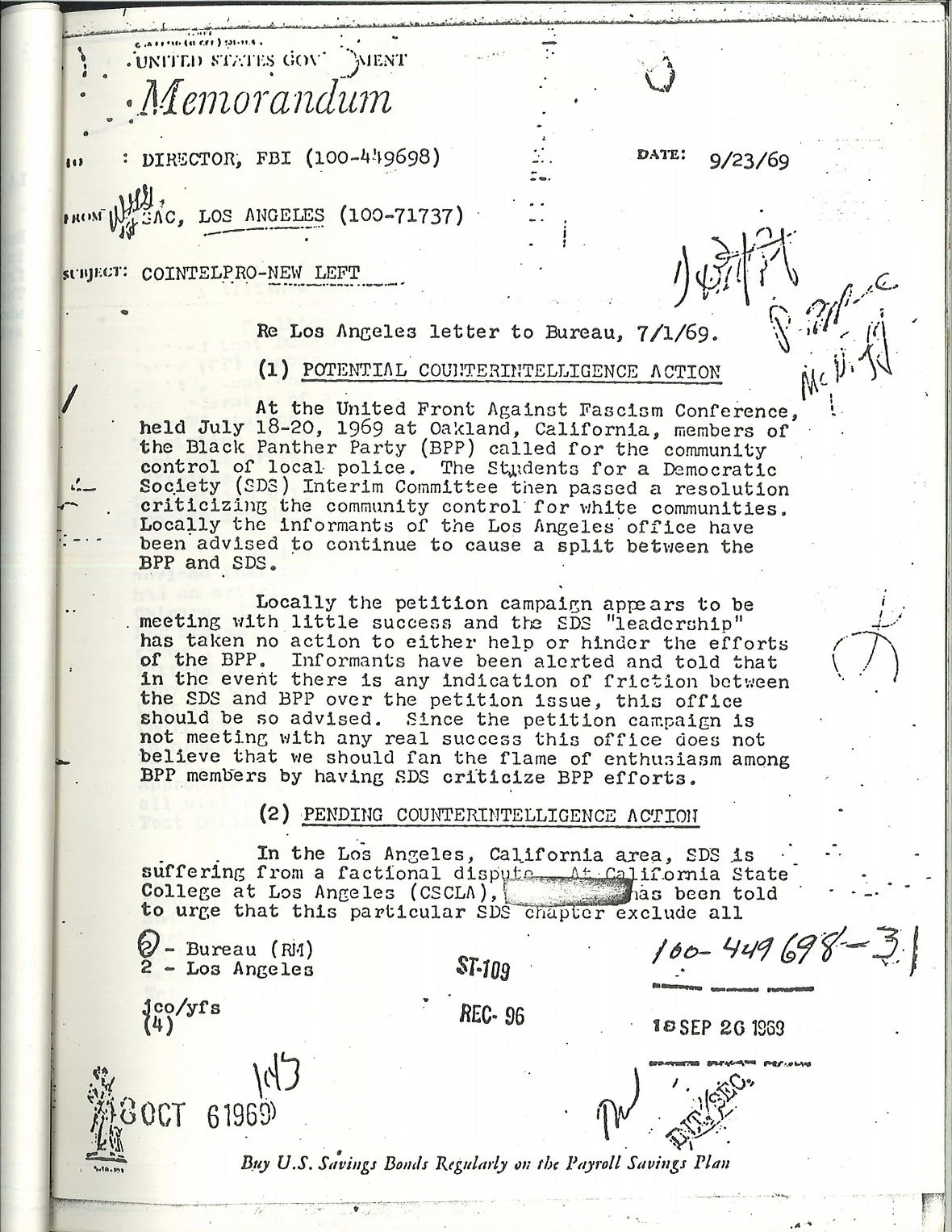
Memo from the FBI, part of the COINTELPRO operation, to informants instigating a split between the Black Panther Party and the Students for a Democratic Society, September 23, 1969.
The truly dark economy of records has almost nothing to do with money. Instead it deals in social control and naked power. Official bureaucratic records have been used to discipline and punish various groups for centuries, with archives playing their role to preserve these weaponized records.
The aftermath of World War II gave rise to a giant international legal structure designed to control large displaced populations trying to move between national borders, especially those trying to enter Western Europe or North America. This system merged organically with a growing public-private surveillance apparatus that ballooned after 9/11 and hasn’t stopped expanding. Archives and archival theory play crucial roles in the maintenance of this American bureaucratic panopticon.
Internally, one of the largest archives of domestic surveillance is the archive of the Federal Bureau of Investigation at NARA. The FBI even has a searchable website of publicly available records, selected from the hundreds of boxes of records. But the FBI’s most valuable, though unintentional, contribution to American history are its COINTELPRO files. Their carefully documented hounding of various groups and public figures makes for a trove of primary sources, as long as you keep in mind that much of the information comes from unreliable informants — usually criminals — and disgruntled agents. Also disturbing is the fact that many subjects of the FBI’s attention have no idea that a file on them exists, nor is there a way for them to get the Bureau to seal or purge their file.
Just as sinister are the records kept, or not kept, by US Customs and Border Patrol. CBS of course has a long tradition of records as a way to keep out refugees, asylum seekers, or anyone else they want, often brutally and sometimes in open defiance of the US government.
Archivist Anne J. Gilliland sums it up this way:
Those who have never undergone the profoundly destabilizing experience of migration, especially as a result of forced displacement, may not have had to think very much or very often about how or why or even where records are kept or adjudicated or how they might have a crucial effect on their own lives and wellbeing or those of family members or loved ones who are with or are separated from them. They may not have experienced linguistic or procedural confusion, literary challenges, dread or even flashbacks when confronted with having to fill in an official form. they may not have experienced similar affect when having to write a letter to an official agency in the country of settlement, whose bureaucratic processes may be steeped in different language and cultural norms, or even to an agency in the country from which they fled; when having to interact with a document that is replete with the language, script, and symbolism of those who oppressed them; or when they are required or challenged to produce identity documentation. … Archival theory insists upon the arrangement and description of records in accordance with the authority, agent or function (“provenance”) responsible for their creation and accumulation and thus emphasizes and reinforces not only the categorizations but also the power of the agency or state.
When it comes to the CBP’s own records, they are eager to destroy them and/or shield them from NARA and automatically destroy them.
What Is and What Should Never Be
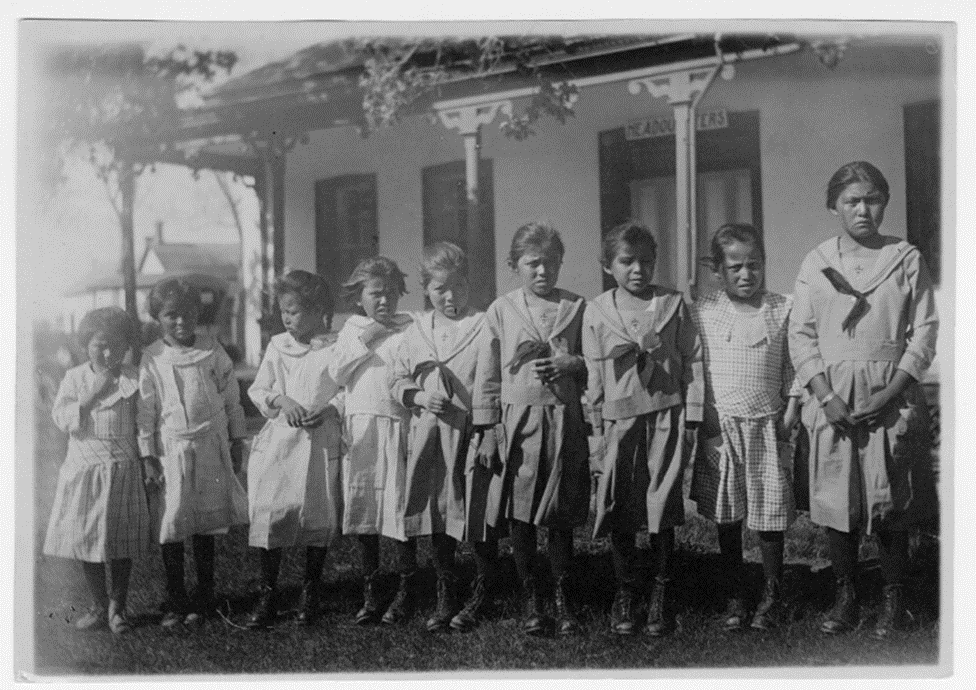
“First girl attendants on the day they were received after having been ‘changed,’” June 19, 1923; Records of the Bureau of Indian Affairs, National Archives.
There are archives that are victims of crimes, there are archives that perpetrate crimes, and there are archives which exist because of crimes.
The history of the US, like the history of most Great Powers, contains a long chain of atrocities going back to America’s origins as a nation founded on enslavement. Some of these atrocities and injustices, like the American Indian Treaties, have reams of documentation, with others, like records regarding slave ships, are relatively rare. Even when records do exist, like the thousands of documents generated by centuries of American slavery, the people who are the subject of those records remain hard to grasp because of the bureaucratic and archival insistence on making surnames and birth dates markers of identity. Speaking of which, white Americans love researching their genealogy — especially using Ancestry.com and DNA sampling — in part because having an immigrant-based identity allows them to slip out of their complicity with white supremacy when it’s convenient for them. On the other hand, white supremacists are obsessed with using genetic ancestry tests to prove their whiteness without a doubt — which doesn’t work because whiteness is a social category, not a biological one. Meanwhile Ancestry.com’s services makes it almost impossible to find out if one’s ancestors owned slaves or were involved in the slave trade.
Some archives of atrocities are hidden in plain sight. When historian James Jones was researching the Tuskegee Syphilis Study for his book Bad Blood, he happened to discover US government records about the Tuskegee study at NARA while researching a different topic altogether. This was in 1969; “needless to say,” he wrote, “I did not know that the experiment was still going on.” In another case of human experimentation, the papers of John C. Cutler were processed and described at the University of Pittsburgh and restricted until after shortly after his death. Cutler was one of the lead doctors conducting the Guatemala syphilis experiments; his papers consisted of government records (which he stole) about the US Public Health Service intentionally infecting prisoners, soldiers, and asylum inmates with the disease in order to see how it would spread through the general population. Other collections document the Japanese-American internment camps operating during World War II and the Indian Boarding Schools, though the latter collections are full of gaps and lost records.
The issue of Black historical archives captured by predominantly white institutions would double the size of this piece, so I’ll have to you give a quote from the incredible Dorothy Berry, the Digital Curator for the Smithsonian National Museum of African American History and Culture:
Academics continuously loosen the concept of the archives in vigorous debate and flowery speech, while hundreds of linear feet of Black history are stacked in secure shelving, unbeknownst and inaccessible to implicated communities. “Why do we even have this?” is a recurring question whispered across institutions as complex histories of provenance and acquisitions lead to single box collections with titles like “Miscellaneous Slavery Documents,” a collection of Freedman’s Bureau papers and Bills of Sale I recently encountered. In the face of this guilt-inducing backlog, special collections have turned towards digitization as a solution, prioritizing getting images of Black people online and hoping that will be enough. I’ve commiserated with colleagues about demands to streamline digitization with the feeling that getting things online will increase access- even without full description or detailed metadata, the things that guide digital discovery. Digital collection development has been presented as a liberatory access provider, with the idea that reparative access is primarily a workflow adjustment.
There is an idea born equally from the enormous backlogs of patron requests and from idealism. If everything is digitized, regardless of metadata or image quality, the resulting hoard would solve a host of issues. Researcher discomfort in dealing with racially insensitive reading room staff? Solved. Physical awareness of marginalized status being the only Black person in the building? Solved. Criticisms that existing digital collections are too White? Immediately solved, with references. No longer would there need to be as heavy a focus on the White-supremacy inflected structures of archival repositories- those issues can be fixed in their own time, and researchers can safely access content at home. … Institutional possessors of primarily Black collections obfuscate access through rules and roadblocks of their own design.
If this subject interests you, you should absolutely read her entire essay.
Dazed and Confused
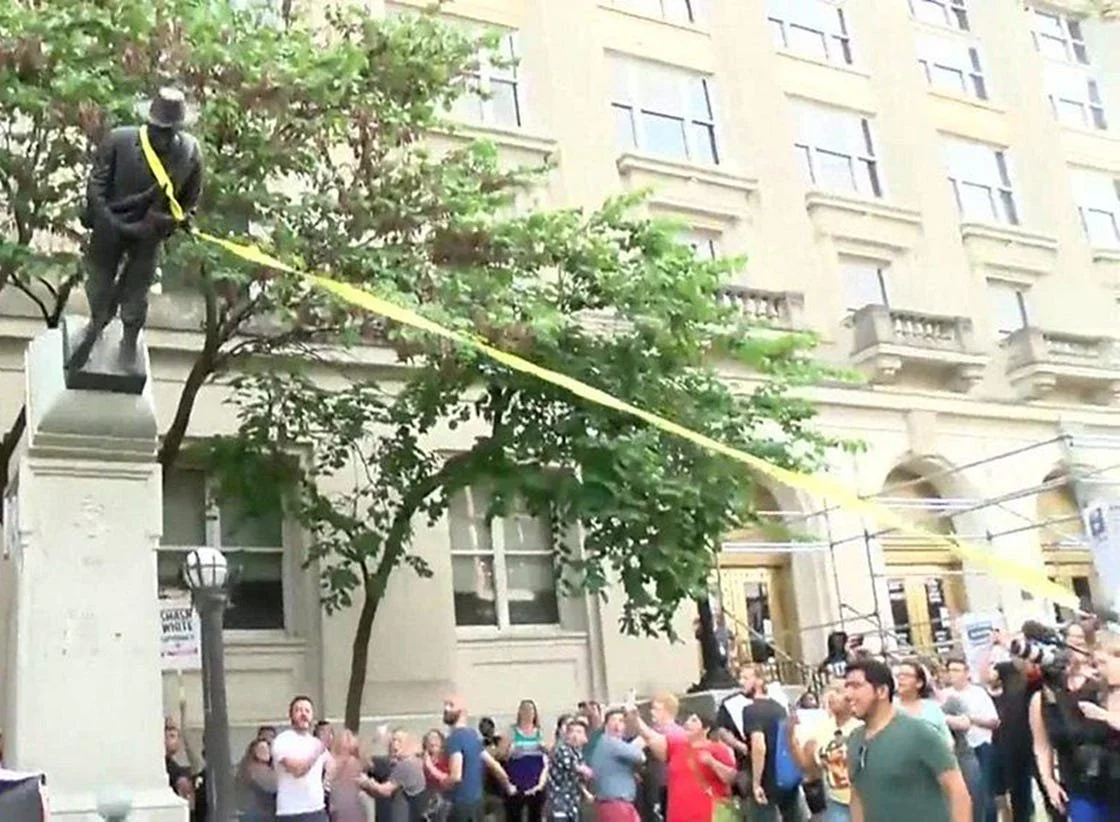
“Silent Sam” pro-slavery statue toppled in Chapel Hill, North Carolina, August 15, 2017.
The atrocity archives create headaches for the academic institutions that house them, especially because so many American institutions of higher learning were either funded by blood money, built on stolen land, or both. Perusing their own university archives too closely would force an unwelcome reckoning with their own legacy. Universities hate being caught between the modern forces of capital and their original charter to create knowledge and further social mobility. On the other hand, they also hate institutional self-critique that might drive away potential big donors and alumni boosters.
University archives tend to embarrass higher-ed institutions founded on white supremacy. The Julian Shakespeare Carr Papers, Southern Historical Collection, The Wilson Library, University of North Carolina at Chapel Hill contain the text of his speech at the unveiling and dedication of the confederate monument “Silent Sam,” placed on the UNC campus by the Daughters of the Confederacy, on June 2, 1913. The loquacious speech praised the Confederacy to the heavens. Then there was this passage:
I trust I may be pardoned for one allusion, howbeit it is rather personal. One hundred yards from where we stand, less than ninety days perhaps after my return from Appomattox, I horse-whipped a negro wench until her skirts hung in shreds, because upon the streets of this quiet village she had publicly insulted and maligned a Southern lady, and then rushed for protection to these University buildings where was stationed a garrison of 100 Federal soldiers. I performed the pleasing duty in the immediate presence of the entire garrison, and for thirty nights afterwards slept with a double-barrel shot gun under my head.
When this came to light in 2017 the students were so disgusted they tore down the Silent Sam statue itself shortly afterwards. The Carr Papers, as noted above, are part of the Southern Historical Collection, a renowned archival resource collected and maintained by avowed white supremacist J.G. de Roulhac Hamilton. Hamilton has a campus building named in his honor, though that may soon change. Changing a building’s name is a welcome gesture but it also happens to be good PR. Harvard University’s public apology and promise of reparations might be genuine and is admirable. It also poses no reputational risk to Harvard, unlike, say, an examination of their current relationships with war criminals.
Some schools lost large portions of their research collections after the passage of the 1990 Native American Graves Protection and Repatriation Act (NAGPRA), which requires any institution that receives federal funding to return “cultural items” like “human remains, funerary objects, sacred objects, and objects of cultural patrimony” to their rightful indigenous owners. In response, some university archives and museums decided to simply hand-wave NAGPRA away. Other schools have ghoulishly held on to human remains in their archives. Some of these collections are remnants of “race science” and physical anthropology, like the Morton Collection of a thousand human skulls. Then there are the stolen bones of two children killed in the 1985 MOVE bombing in Philadelphia, used as teaching materials.
Gallows Pole
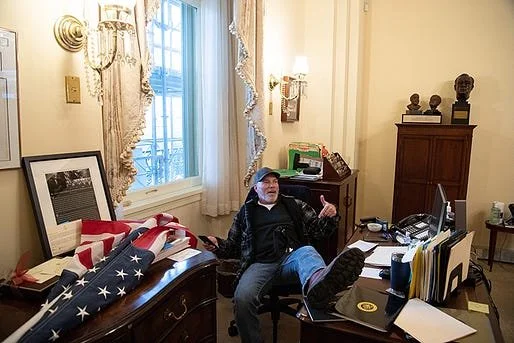
Richard Barnett in the office of Congressional House Speaker Nancy Pelosi with his boot on some government records, January 6, 2021. He later bragged about stealing mail from the office. Creator: Saul Loeb | Credit: AFP via Getty Images.
Trump understands that being in trouble is a fake idea. People who get mad about rule-breaking can’t understand why Trump keeps getting away with everything. He’ll get away with this too. There is almost no one on Earth, especially no one in America, willing to even try to impose rules on the President of the US, much less when it comes to respect for proper government documentation procedure. He’ll get away with selling the details of Israel’s nuclear program to Saudi Arabia (which is likely what he did) because he broke a rule and no one can or will do anything about it. From an archives point of view, though, it’s a perfect scandal. It combines the scramble of personal and Presidential papers; disdain for the PRA; historical documents as fungible commodities; destruction of public records; the archives of the national security state; and institutions embarrassed by the content of their own collections.
The people who aren’t getting away with it are the rioters who wrecked the Capitol building in 2021. They were such good archivists, proudly documenting their crimes for posterity, in real time. Another archive of crime, created by criminals, to document the greatest crime of their lives. [Editorial correction from 2026: for the most part they did actually get away with it.]
Night Flight
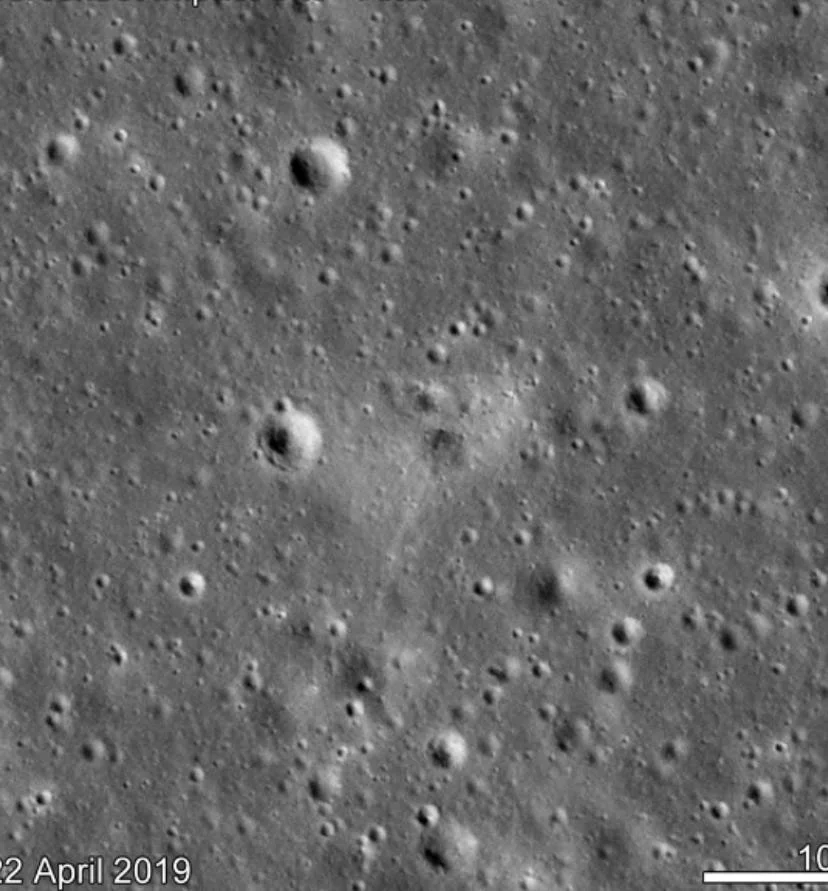
Photograph of the crash site (the black smudge in the center) of the SpaceIL Beresheet rocket, April 2019.
In 2018, SpaceX successfully launched their Falcon Heavy rocket into space. The rocket needed a test payload, so in a monument to Elon Musk’s pathological ego they used the first Tesla Roadster his company ever sold. SpaceX dumped the car into an orbit around the sun, theoretically to travel through space for millions of years. Tucked in the glove compartment of the Roadster is a high-tech optical disk loaded with a digital copy of Isaac Asimov’s Foundation trilogy. Will some far-future civilization be using CD-ROMs? Regardless, four years into it’s 30-million-year journey the Roadster is falling apart, so at some point the disk will either fall into the sun or fly off into the void.
The Asimov disk is a creation of the Arch Mission Foundation, a futurist-utopian project of Nova Spivack who is fixated on the idea of creating multiple “archives” of all human knowledge and shooting them into space. In 2019, Spivack funded his own moon shot, using a SpaceIL Beresheet lunar lander built by Israel Aerospace Industries. The rocket would be the first private spacecraft to land on the lunar surface, and its payload would be “Billion Year Archive,” aka the Lunar Library (tm). Unlike the Asimov disk, the BYA uses analog technology — high-res, nano-scale images engraved onto 25 micron-thick layers of nickel, viewable through a microscope with 1000x magnification. Layers 1 through 4 hold 60,000 images of book pages, looking something like an old microfiche loaded with thousands of novels, textbooks, Wikipedia (in English), hair follicles and blood samples from Spivack and few other people (to include human DNA), and weirdest of all a few thousand dehydrated tardigrades. To be useful, future humans would have to (1) somehow rebuild civilization after the coming climate collapse (2) find and process the massive amounts of fossil fuel needed to shoot a manned rocket to the moon, and (3) find the disk — because right before it was supposed to land on the lunar surface Beresheet crashed. Spivack is positive that the disk somehow survived and has planned to deliver a second installment of the Lunar Library (tm) as a hitchhiker on the Astrobotic Peregrine Mission One lander in 2022.
The Song Remains the Same
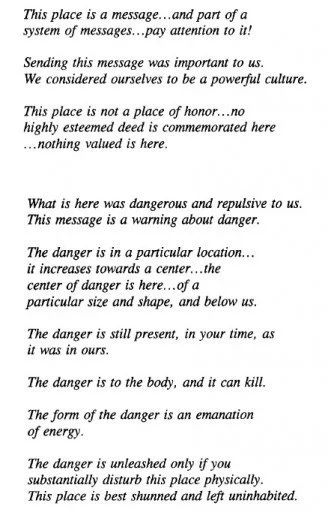
Version of the textual warning at the Yucca Mountain nuclear waste facility, part of a design to keep visitors away for the next 10,000 years. For context, 10,000 years ago Homo sapiens was just starting to learn agriculture.
Shooting these info-disks into space feels like a tacit admission that Homo sapiens’ time on Earth is drawing to a close and we need to leave a suicide note behind. It’s also part of a long tradition of wealthy and powerful men leaving monuments to themselves intended to keep their fame alive for all future generations. The survival of the monuments testifies to the superiority of analog records over digital technology.
That brings me back where I started: the Sumerian clay tablets and the personal papers. People in the Internet age have a general anxiety about the records of our recent history becoming inaccessible or just disappearing. They’re not wrong! Digital records sacrifice longevity for portability. But archivists understand that all memory is mortal and what’s remembered is defined by what's forgotten. It’s an accident that thousands of Sumerian contracts, jokes, and squabbles can still be read centuries later while the original footage of the 1969 moon landing was almost lost forever. Time isn’t selective in how it winnows. Archivists like me are the janitors of history, sweeping up what remains, cleaning things up as best we can, doing it again, and again, and again.