Under an Evil Hand, Part 2
The Salem Witch Trials begin, King Philip's War, and the original Satanic Panic of the 1980s-1995.
Note: this was originally posted to my Substack on September 29, 2022. I deleted my Substack a couple years ago and I’m posting these pieces here so they don’t get lost.
Fear in Salem Village
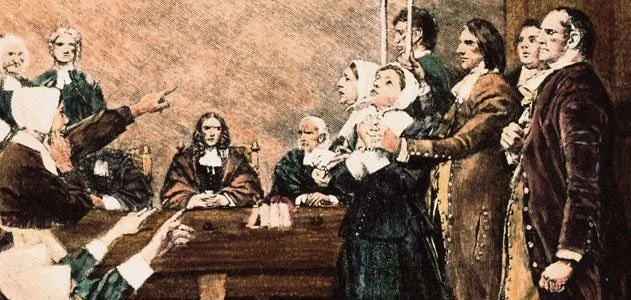
On March 1, 1692, the Magistrates John Hathorne and Jonathan Corwin began interrogating the accused witches, starting with Sarah Good. The interrogations took place in public at the Salem Village meetinghouse, with most of the Villagers in attendance along with the four accused.
Going by an old Massachusetts law defining a witch as one who “hath or consulteth with a familiar spirit,” Hathorne asked Sarah Good: “What evil spirit have you familiarity with?” “None,” she replied. “Have you made no contract with the devil? “No.” “Why do you hurt these children?” Sarah Good continued to insist that she was innocent.
Finally Hathorne turned to the four girls, the accusers, who were seated together. Look at Sarah Good, Hathorne said to them, and see if she was the person who hurt you. Yes, they said, it was her, as they fell into tormented fits. It wasn’t me, Sarah Good cried in fear and anger, it must be Sarah Osborne, she’s the one attacking those girls. The transcripts indicate that Sarah Good was by turns enraged and sarcastic in her responses; but now even her own husband, William, wondered about her innocence.
Sarah Osborne was next. She was asked the same questions, and gave the same responses. She was told that Sarah Good had accused her of tormenting the children. “I do not know,” she said, but “that the devil goes about in my likeness to do any hurt.” Hathorne asked the four afflicted girls asked to look at Sarah Osborne, and again they screamed and cried out. Then suddenly some of the Villagers spoke up. Someone noted that she hadn’t been attending church lately. Someone else said that Sarah Osborne had once seen a thing that looked like an Indian, all black, that had grabbed her by the neck; or maybe Sarah had dreamt it?
Finally it was Tituba’s turn to be interrogated by the Magistrates, who didn’t know that Samuel Parrish had beaten her until she agreed to confess to being a witch. The devil, she said, had appeared to her and commanded her to serve him; she tried to resist, but he sent his emissaries to frighten her into doing his will. She had seen Sarah Good and Sarah Osborne hurt the children, along with the specters of two other women, and a man from Boston. Sarah Good had a familiar, a yellow bird that sucked blood from between her fingers. Sarah Osborne had two familiars, a thing with a head like a woman with two legs and wings, and a short, hairy creature that walked like a man.
The girls listened to Tituba’s confession in silence. When she finished they once again cried out in torment; Betty Hubbard had “an extreme fit”. They all agreed that Sarah Good was guilty; Tituba complained that Sarah Good and Sarah Osborne were attacking her at that very moment, preventing her from saying anything more.
That night, Sarah Good was jailed at the house of the constable. Betty Hubbard was recuperating at the house of her master, the doctor William Griggs, when she cried out in fear; she saw Sarah Good’s apparition standing on a table staring at her. A local man named Samuel Sibley who had been watching over Betty, rushed in to help. He saw nothing, but he struck out with his staff at the space above the table where Betty said she saw Sarah Good’s spectral form. That same night some Villagers saw Sarah Good lurking in Salem Village, free from her captivity. They told the constable but he found Sarah still locked up in his house; the constable’s wife, however, noticed that Sarah’s arm was bloody, in the same spot, it occurred to her, where the specter of Sarah Good had been struck by the staff of Samuel Sibley at the house of William Griggs earlier that night.
Over the next few days the Magistrates interrogated Tituba in jail. She said she had given in to the Devil and signed his book with a mark in her blood to join his legion; then the Devil showed her the marks of Sarah Good and Sarah Osborne. There were nine signatures in all. Word of this reached the Villagers and there was no doubt: the Devil had come to Salem Village, and he was there to do the Devil’s work. And they wondered: who else among them had signed the Devil’s book?
Death in Massachusetts
If the Pequot War was a crisis for the English Puritans, King Philip’s War was a catastrophe.
The war was started by the Wampanoag chief Meatcom, the second son of Massasoit. Massasoit had good relations with the Pilgrims (the English settlers who arrived on the Mayflower) and in those better days Metacom had adopted the English name “Philip”. But those days were long gone by the time Metacom became chief in 1662.
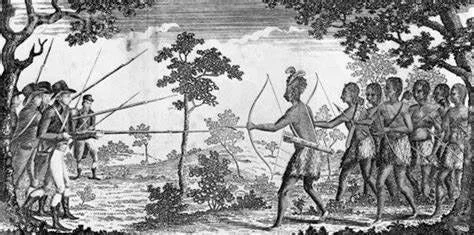
The Europeans kept settling on indigenous lands, leading to a constant state of tension. The spark was struck in 1675, when three Wampanoags killed an Indian who had converted to Christianity; in response, officials in Plymouth Colony captured the three men and hung them. This incident prompted the Wampanoags and other tribes to form an alliance to push back against the European invaders. Metacom’s forces attacked, raided, and ambushed the colonists again and again, while the colonists fought back just as violently.
In December, Metacom moved north and set up his winter camp in New York, where he hoped to enlist the aid of the Mohawk against the colonists. But the Mohawk had refused to help. Then, in February 1676, the Mohawk ambushed 500 of Metacomet’s warriors and killed most of them. It was the beginning of the end. Metacomet withdrew back to New England to continue his war into the spring of 1676, but even though his warriors could infiltrate deep into Colonial territory -- assaulting Plymouth Colony, burning Providence to the ground – it was too late for the Wampanoags to annihilate the English. It had always been too late. Smallpox, typhoid, measles, and spotted fever brought by the earliest European settlers decades earlier had wiped out most of the Algonquian population, so that by 1676 there were only about 2,500 warriors in Metacomet’s forces, compared to about 16,000 colonial militia.
By July 1676 Metacomet’s coalition was breaking up and hi allies were leaving him. He knew the war was lost, so he went back to where it began, hiding out in the Assowamset Swamp south of Providence. On August 12, he was tracked down by colonial rangers and shot by a Christianized Indian named John Alderman, who later received Metacomet’s severed hand as a trophy. Metacomet’s corpse was drawn and quartered; his limbs were hung in trees to rot. His severed head was mounted on a pike at the entrance to Plymouth where it was prominently displayed for more than twenty years. His widow and child were captured and enslaved.
The fighting continued in northern New England for two more years, ending in 1678. By the end of the war more than half of the towns in the New England Confederation had been attacked; twelve were completely wiped out. The colonists were literally decimated – one tenth of all men available for military service had been killed. The colonial economy almost collapsed. Even if the English crown had been interested in aiding its colonial subjects, they were an ocean away.
The colonies managed to survive and rebuild on their own. The brutality of King Philip’s War had changed them. They had been through terrible suffering, and inflicted horrible suffering in return; the violence marked them as a separate people, still English, still subjects of the Crown, but with a new identity just beginning to take hold. And there were still violent incidents between the colonists and the Native peoples. Tensions between New France (now Canada) and the English settlers in the 1680s led to open warfare between the French and their Wabanaki allies and the English and their Iriquois allies in 1690. Again, whole towns were destroyed and hundreds killed. The district of Maine was almost emptied of English settlers as they fled deeper south into Massachusetts to escape the attacks. On January 25, 1692, hundreds of Penobscot Wabanakis raided the town of York in the district of Maine. They destroyed the town, killed about 100 colonists, and captured at least eighty, who were forced to walk to New France where they were ransomed. The attack stunned the New England colonists, who called it the Candlemas Massacre.
A week earlier, Abigail Williams and Betty Parris had fallen into fits at the house of Samuel Parrish.
Satan in America
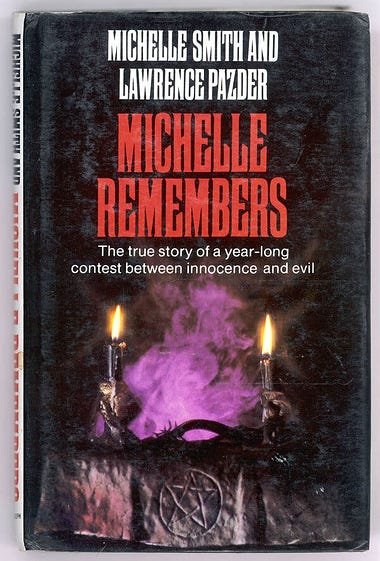
The book Michelle Remembers was published in 1980. It was co-written by Michelle Proby under the pen name Michelle Smith, along with her psychiatrist, Lawrence Pazder, whom she later married. It was framed as Smith’s autobiography, but it really consisted of Smith’s tales of horrific physical abuse at the age of five at the hands of a satanic cult based in Victoria, British Columbia, Canada, between 1954 and 1955. Smith had repressed these memories, but Lawrence Pazder extracted her stories in the course of 600 hours of hypnosis over 14 months, during which they also became romantically involved. The final memory was of an 81-day-long ritual that summoned the devil himself; Jesus and the Virgin Mary appeared in person to stop it, and the Archangel Michael removed Michelle’s physical scars - received over the previous year – and blocked her own memories of what she had suffered, explaining why she had not recalled it earlier.
The book garnered national press coverage and sold well. The term “ritual abuse,” coined in the book, entered the popular discourse, and Pazder became a recognized authority in the new field of Satanic ritual abuse investigation. Pazder and others promoted the idea that this Satanic ritual abuse was the work of a worldwide conspiracy of evil abusers; the fact that there was never any evidence to support this claim simply showed how powerful and far-reaching the conspiracy was.
A fear of an evil network of child abusers took root in the American suburbs of the early 1980s, which were designed to be racially, politically, and culturally homogenous – they were overwhelmingly white, conservative, and Christian. At the same time, new laws mandating the reporting of child abuse had begun to show just how widespread child abuse was in these communities. Rather than confront the awful reality - that the abusers were the husbands, male relatives, teachers, coaches, pastors, and youth leaders whom parents had trusted with their children – the parents preferred to blame an evil conspiracy working in the shadows. Not only did this play into the natural fear that parents have for their children’s safety, it dovetailed with a rising tide of fundamentalist and Evangelical Christianity that preached warnings of widespread demonic and Satanic influence in the government and popular culture.
A turning point came in 1983, when Peggy McMartin and Ray Buckey were charged with ritually abusing the children at their preschool. Despite the lack of evidence, the intense media coverage, and the ensuing public fear, triggered a wave of accusations against over a hundred preschools across the US. In 1987, the journalist Geraldo Rivera devoted an episode of his popular television show to Satanic ritual abuse, claiming that there were “over one million Satanists … linked in a highly organized, secretive network.” People like Lawrence Pazder and other self-appointed experts traveled the country making numerous presentations to church groups, law enforcement officers, parents groups, and psychology conferences; they often used the Geraldo Rivera episode in the course of their talk. This triggered a large movement among police, social workers, therapists, and clinicians to investigate claims of Satanic ritual abuse. In 1989, Oprah Winfrey interviewed Michelle Smith and Lawrence Pazder on her popular talk show; Sally Jesse Raphael did two programs on the topic.
But the actual evidence of Satanic ritual abuse never appeared, despite hundreds of investigations. The McMartin case resulted in no convictions after a three-year trial. The book Michelle Remembers was discredited when it was found that many of the things Michelle Smith described in the book either didn’t happen or couldn’t have happened. By the early 1990s the public had begun to turn skeptical. A 1992 report by an FBI agent found no credible evidence for a single case of ritual abuse. In 1994, the National Center on Child Abuse and Neglect, under the federal Department of Health and Human Services, released a report also finding no evidence of ritual abuse. Psychologists and other mental health workers who studied the ritual abuse cases found that the methods used by forensic investigators to elicit stories of abuse from the children were suggestive at best and coercive at worst.
In 1995, HBO aired the film Indictment: The McMartin Trial, portraying the McMartins as victims of overreaching prosecutors and media hype. The popularity of the film signaled the shift towards skepticism in the general public towards ritual abuse claims. By 2000, most prosecutors no longer took these claims seriously. Lawrence Pazder died in 2004, shortly after it came to light that all along there had been, in plain sight, an actual wide-ranging network of serial child abusers protected by powerful individuals and secretive institution — not based in Satanism, but in the Catholic Church and various Protestant denominations.
To be continued in Part 3.