Under an Evil Hand, Part 3
The Salem Witch trials escalate; power and politics in the Massachusetts Bay Colony; and the first flying saucer sighting.
Note: this was originally posted to my Substack on October 6, 2022. I deleted that Substack a couple years ago and am posting these again so they don’t get lost.
Devil’s Dominion
Early March 1692 saw more victims of witchcraft appear: Ann Putnam, Jr., Mercy Lewis, Mary Walcott, and Mary Warren were all affected.
The next woman labeled a witch was a woman who lived on the outskirts of the Village: Martha Corey, the third wife of 80-year-old Giles Corey. She was currently a member of the church in good standing, but many years earlier she had borne a child out of wedlock to a father who wasn’t white.
On March 12, Martha Corey visited the Putnam family. 12 year old Ann Putnam Jr. suddenly went into fits as she saw a vision of Martha roasting a man alive on a spit. Mercy Lewis, who was also visiting the Putnam house, began having fits. A few days later Ann Putnam, Sr. said she was being attacked by Martha Corey’s specter — Martha wanted Ann to add her name to the Devil’s book and join his legions.
The next day, two men from the village complained to the Magistrates about Martha Corey; on March 21 she was examined before the congregation. During the questioning, Abigail Williams cried out there was “a black man whispering in her ear,” by which she meant an Indian man. 17-year-old accuser Mary Walcott claimed to see him as well. Magistrate Hathorne demanded that Martha Corey tell them what the black man was saying. Martha, of course, said she didn’t hear anything. The girls went into fits; Corey, flustered, bit her lip, and the accusing girls said they were being bitten; she moved her hands nervously and the girls said they were being pinched; one of the girls hit Corey on the head with her shoe and all the girls wildly stamped their feet. Finally Hathorne had to end the examination and ordered Corey jailed in Salem Town.
The next day, Ann Putnam Sr. was visited by the specter of Rebecca Nurse, a respected seventy-year-old member of the Salem Town church who had a longstanding legal dispute with the Putnam family. A group of villagers confronted Rebecca at her home. She was completely baffled at being among the accused. Two of the Putnams filed a formal complaint against her for having afflicted Ann Putnam Sr. and Abigail Williams, their complaint including an accusation against 12-year-old Dorcas Good, the daughter of Sarah Good. Both Rebecca Nurse and Dorcas Good were arrested and held at the inn.
On March 24 they were brought before the Magistrates and the congregation. Dorcas Good, clearly terrified by the entire proceeding, quickly confessed. Rebecca Nurse, however, refused to confess, and like Martha Corey her movements were mimicked by the girls and met with cries of pain from the accusers. This time people in the audience, ostensibly there to observe, joined in the cries of pain. At one point Ann Putnam Sr. went limp and couldn’t move; her husband had to carry her out of the meeting house. Next accused was Elizabeth Proctor, the wife of John Proctor, who had loudly proclaimed his disbelief in witches and witchcraft. Their servant, Mary Warren, had become one of the accusers. Sarah Cloyce, the sister of Rebecca Nurse, was also accused of being a witch, after trying to defend her sister against that same charge.
The seriousness of the situation had finally become apparent to the local authorities. On April 11, Sarah Cloyce and Elizabeth Proctor were taken to Salem Town to be examined before Deputy Governor Thomas Danforth and members of the Governor’s Council. During the examination, Abigail Williams and Ann Putnam Jr. went into severe fits, they saw Elizabeth Proctor’s specter on the ceiling, they accused John Proctor of being a witch, then all the girls fell into chaos. Sarah Cloyce and the Proctors were jailed in Salem Town. Rebecca Nurse, Martha Corey, and Dorcas Good were all sent to prison in Boston.
At this point, Mary Warren, who had originally accused Elizabeth Proctor of witchcraft, suddenly changed her story. She admitted she had been lying and said the other accusers were lying too. As a result, she was — not surprisingly — accused of being a witch all along.
It seemed all of New England was under attack by witches. Reports of witchcraft attacks came from Malden, Stamford, and elsewhere, the accusers claiming there were many witches working together across the country. In Salem, meanwhile, on April 13 Ann Putnam Jr. accused Martha Corey’s husband Giles Corey of witchcraft. Then 14 year old Abigail Hobbs was accused by Ann Putnam Jr., Mary Walcott, and Mercy Lewis. The more Villagers were accused, the larger the coven seemed to grow.
On April 19, when Bridget Bishop, Giles Corey, Mary Warren, and Abigail Hobbs were examined, Abigail did something no one, including her accusers, expected: she confessed to practicing witchcraft. She had seen the devil once “at the Eastward at Casco Bay,” the site of one of the worst raids inflicted on the colonists by the Wabanakis. And three or four years ago Abigail said she had met Satan in the woods near Falmouth — another target of the Wabanakis — and made a covenant with him.
The accusers watched in silence. Some observers noted that the girls were as stunned as anyone to hear what Abigail was saying. Shortly afterwards, Mary Warren, under pressure from the court, the afflicted, and the audience, reversed herself again and rejoined the ranks of the accusers. The congregants of Salem Village and Salem Town were shaken yet again: not only could anyone, including respected members of the church and community leaders, be a witch in disguise, those witches might be working in secret on behalf of the devil’s minions, their adversaries the Wabanakis.
The next night, Ann Putnam Jr. was visited by the apparition of a former minister in Salem and in Maine named George Burroughs. The specter of George Burroughs described the terrible acts of witchcraft he had committed, including using his magic against the soldiers in Maine that had been fighting the Wabanakis. The morning after that, Abigail Williams also saw an apparition of Burroughs, this time on the road to a tavern; he then appeared again, inside the tavern. Both times the specters implied that George Burroughs, a man of authority, was the hidden leader of the witches assaulting New England. Soon after these visions of Burroughs, the other afflicted girls all saw visions and were attacked by specters. The number of accusations and imprisonments increased dramatically.
Colonial Chaos
The governance of the Massachusetts Bay Colony was in dispute from the very founding of the colony in 1628.
The Massachusetts Bay Company was chartered by the crown of England to colonize North American territory claimed by the English. In Massachusetts Bay especially the English population were almost all Puritans, with the government dominated by a small group of solidly Puritan leaders. In 1630 a group of emigrants bought all the Massachusetts Bay Company’s stock and brought the original charter to America, which meant that neither the Crown nor Parliament could any longer exert much direct influence on the colony.
The first meeting of the colony’s General Court was in October 1630. Fatefully, only eight freemen were present at the meeting. These men declared themselves the first Council of Assistants, and quickly decided that contrary to the original colonial charter they alone should elect the colony’s governor and deputy governor. In 1631 another one hundred sixteen freemen joined the General Court, but the Council of Assistants kept the power to govern for themselves. They also decided that the only men qualified to vote were men who had passed the religious examinations to become an official member of one of the colony’s Puritan churches. Dissent, especially religious dissent, was not tolerated. Anglicans, Quakers, Baptists, and others were routinely jailed or expelled from Massachusetts Bay.
This power structure fractured when the colonial government and the towns started to rancorously argue over tax collection. The General Court ordered each town to send two representatives, called deputies, to the Court, where they would settle any taxation disputes. After three years of this, the deputies, for various reasons, came to question the authority vested in the Court and the Council. The deputies demanded to examine the original colonial charter, which the Council of Assistants had literally kept hidden and inaccessible. When the deputies finally saw the charter for themselves, they realized that all freemen of the colony, not just church members, were supposed to be included in the General Court — which was meant to be the actual governing body of the colony, not the self-appointed Council of Assistants.
The deputies wanted the original charter put into action, but Governor John Winthrop pointed out that the recent influx of freemen into the colony would make for a General Court so large as to be unworkable. As a compromise, the General Court would be made up of the two deputies elected by each town. It was the very first step towards representative democracy in the colonies.
The first code of laws was formally adopted in 1641, the Massachusetts Body of Liberties, a mix of 100 civil and criminal laws mostly based on Biblical principles. It included provisions like equal protection and double jeopardy next to the criminalization of smoking tobacco, non-religious dancing, sleeping in church, and playing cards.
The governance of the colony was upended yet again the following year with the outbreak of the English Civil War. Emigration to the colony slowed, then virtually stopped. Not only did the population stop growing, it shrank as many men returned to England to fight, almost all on the side of Parliament and Oliver Cromwell’s Roundheads. When King Charles II was restored to the throne in 1660, this made for rather tense relations between crown and colony. Massachusetts Bay resisted English efforts to allow Anglican churches in their territory; to forbid the persecution of Quakers; to restrict their commerce to trade with England alone; and general efforts by the crown to rule the colonies more directly.
In the aftermath of King Philip’s War, the resiliency of the colonies inspired the King and his ministers to make the colonies official English provinces. The original colonial charter was revoked in 1684, and in 1686 the Massachusetts Bay province became part of the Dominion of New England under King James II, administered by the King’s chosen Governor, Edmund Andros. After the Glorious Revolution ended with the overthrow of James II in 1688, Andros, who was unpopular with the locals – and an Anglican to boot – was overthrown by a well-organized but bloodless insurrection in Boston in April 1689, a few months before Salem Village formally organized its first official church.
The Massachusetts colonial government was yet again re-established, but it no longer had a valid charter. Some dissenters from the old Puritan order refused to return to that old charter-based form of rule and protested in various ways, including not paying taxes. Without an organized governing body, settlements like Salem Village and even Salem Town were thrown into legal limbo. The litigious Puritans, notorious for constantly suing each other, couldn’t get their disputes settled. Instead, as 1692 began, resentments and recriminations were left to linger and fester between the Salem families.
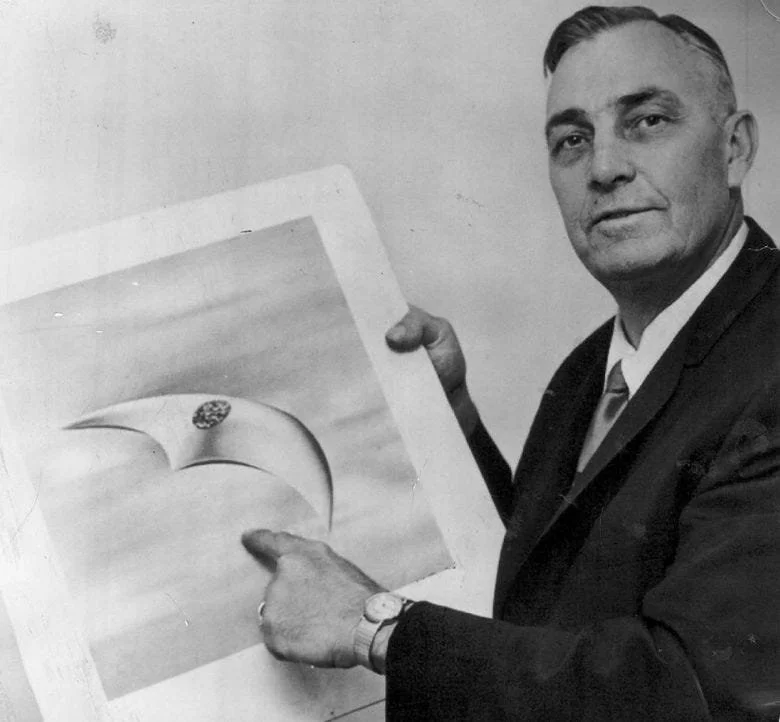
Kenneth Arnold in 1966, pointing to a drawing portraying the flying craft he saw in 1947.
Echelon Ascending
On June 24, 1947, an amateur pilot from Idaho named Kenneth Arnold was flying his small plane over Mineral, Washington. He was looking around near Mount Rainier on his way to an air show in Oregon — a Marine Corps transport plane had crashed in the area, and he was hoping to find the wreckage and claim the $5,000 reward.
Suddenly Arnold saw a flash of bright blue-ish light. He looked around for the other plane that the flash must have come from, but there was only a non-flashing DC-4 about 15 miles away. Then the light came back, this time flashing rapidly. Arnold saw nine bright objects flying in an “echelon formation,” moving in perfect unison, “like the tail of a Chinese kite.” And they were fast: it took the objects a minute and 42 seconds to travel between Mount Rainer and Mount Adams, which meant they were traveling roughly at 1700 miles per hour, three times faster than any other aircraft at that time. It occurred to Arnold that it didn’t seem like anyone was piloting them, and an “eerie feeling” came over him as he watched.
He landed an hour later, at 4:00 pm, at an air strip in Yakima, Washington. He told the staff about his strange experience, then refueled and continued on to Pendleton, Oregon. One of those air strip staffers called someone in Pendleton, and word of Arnold’s encounter started to spread. The next day, June 25, Arnold talked to a reporter at the East Oregonian paper in Pendleton, describing the movements of the strange objects. He didn’t mention it to the newspaper reporters, but he had begun to think of the objects as some kind of living organism, not flying machines at all. They flew, he said, “like a saucer if you skip it across the water.” The reporters who interviewed him were impressed by the fact that Arnold didn’t seem to be embellishing his story, let alone making it up — he was definitely a credible witness.
As the story was picked up by other newspapers and re-reported, Arnold’s description of the objects flying “like a saucer” was mutated into the description “flying saucer.” Once those reports were published, it didn’t take long for more reports of flying saucers, or unidentified flying objects, to appear. In 1947 alone, there were over 850 reports of flying saucers, from almost every state in the US and some from Canada. On July 4, a United Airlines flight crew saw another group of nine UFOs over Idaho, the first major sighting after Arnold’s.
Four days after that, a press release was sent out by the 509th Operations Group of the Eighth Air Force. The press release said that the group had recovered a craft that had crashed on a ranch in Roswell, New Mexico, a craft that was a “flying disk.” The Commanding General of the Eighth Air Force later issued a statement contradicting the earlier press release; he claimed that what crashed in Roswell was just an experimental weather balloon…
Disoriented by nuclear-age technology, frightened by the bomb, deep in Cold War fear of both the Russian government and their own leaders, the American public started seeing UFOs with alarming regularity. The US Air Force instituted Project Sign to investigate these reports, followed by Project Grudge in 1949 and Project Blue Book in 1952. By that time, UFOs had become a trope in American books, movies and television, as well as an entire new mythology built around flying saucers, with associated public speakers, writers, promoters, reporters, and true believers. Project Blue Book collected and analyzed over twelve thousand six hundred reports of UFO sightings; in most cases, they found that the sightings could be explained as natural phenomena, conventional aircraft, or, in many cases, CIA reconnaissance aircraft, especially the U-2 and A-12 planes, which flew above 60,000 feet, well above the 10 to 20,000 feet of commercial airliners in the 1950s.
Even after this analysis, however, there were still a small percentage of UFO reports that remained unexplained. But since there was never any evidence of these being extraterrestrial vehicles, let alone a threat to national security, the project was shut down at the end of 1969. As of now, the US military uses the Unidentified Aerial Phenomena Task Force, which mostly studies the many strange encounters of Navy pilots from the last 20 years. Their research and findings are so classified few Americans know the task force even exists, let alone its findings. This is mostly because the scant footage and other evidence suggests these sightings can mostly be explained away as high-tech unmanned drones or other craft. On the other hand, there have been confirmed sightings, Navy personnel took two videos years apart, on opposite coasts, of similar objects flying through the sky, visible through night vision goggles. The task force is confident these were both drones. The crafts were both triangle-shaped, supposedly an illusion caused by light passing though the night vision goggles, then being recorded by a SLR camera. It’s worth noting, however, that these UFOs has the same shape as the echelon seen by Kenneth Arnold in the 1940s.
The number of sightings worldwide has continued to decline since the 1970s. In 2017 it reached a record low point worldwide, though the US still has 300 times the global average of UFO sightings. It seems that Americans are seeing few flying saucers anymore, though sightings of strange lights in the sky have recently increased. No one knows why.
Continued in Part 4.