
Under an Evil Hand, Part 4
The first execution in the Salem Witch Trials; Cotton Mather, Puritan Witch Hunter; and the Kissing Bug apocalypse of 1899.
Note: this was originally posted to my Substack on October 13, 2022. I deleted that Substack a couple years ago and I’m posting these pieces here so they don’t get lost.
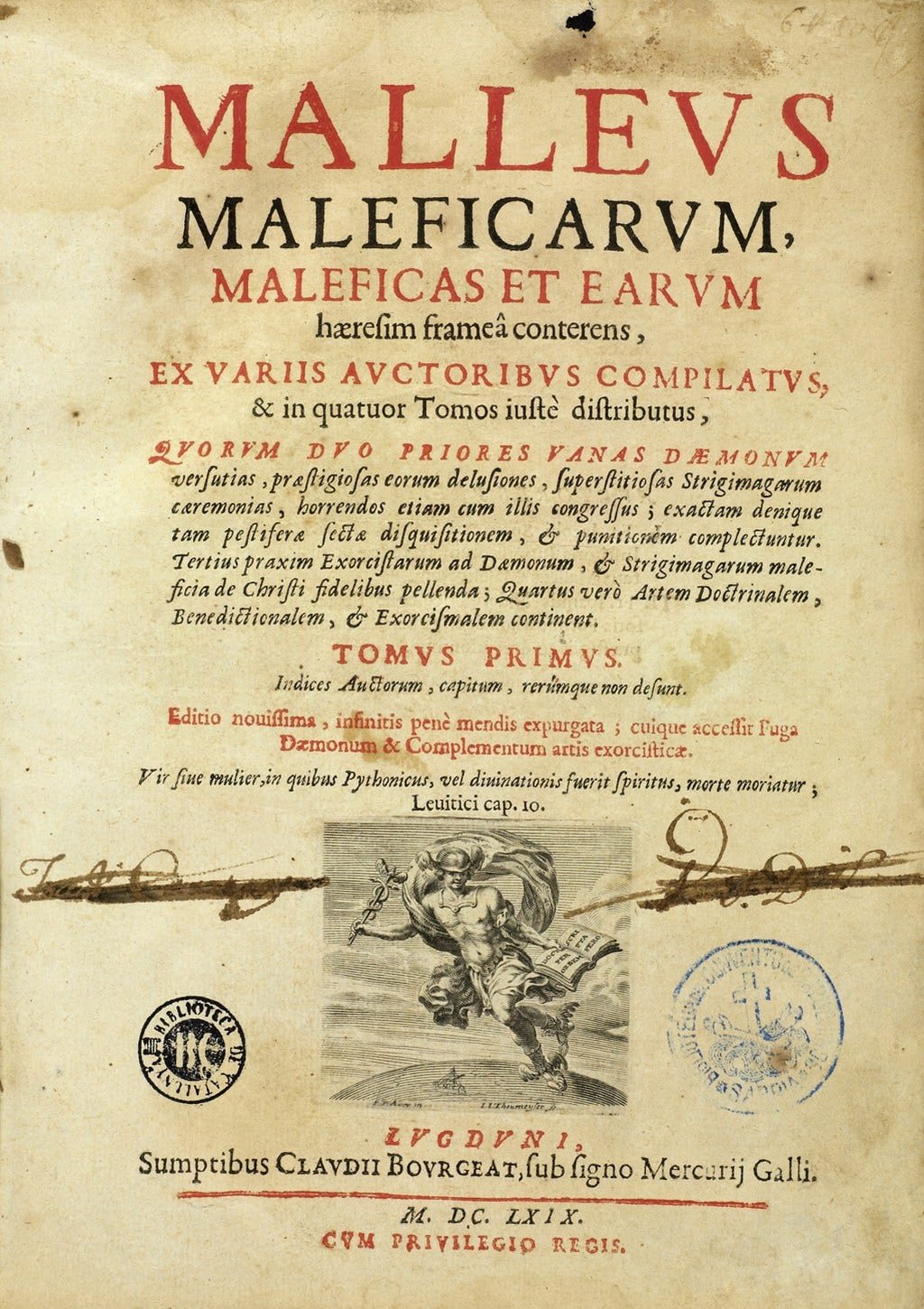
The Malleus Maleficarum, usually translated as the Hammer of Witches, was written by the German Catholic clergyman Heinrich Kramer (under his Latinized name Henricus Institor) and first published in the German city of Speyer in 1486. It was considered the authoritative work on witchcraft up through the 17th century.
An Invisible Coven
In early May 1692, the Salem Magistrate John Hathorne and Johnathan Corwin were busy men. The arrest of George Burroughs in Maine and his subsequent examination in Salem exposed a vast network of evil attacking the Puritan colonists from both outside — the Wabanaki — and inside — the colonists who had joined the forces of Satan. All over New England, witchcraft accusations, prosecutions, and confessions were erupting from within families, villages, and towns; the new accusations included prominent, respected members of colonial society, like George Burroughs, John Alden, Jr., and Rebecca Nurse.
The legal examinations were now perfunctory. It had already been common practice before the witch trials for colonial authorities to assume the guilt of anyone formally accused of a crime. Now claiming to be innocent of the charges against them made the accused look even more suspicious in the eyes of the citizens. On the other hand, those who openly confessed to being witches were given protection by Hathorne so that they would be able to inform on other still-hidden members of the conspiracy.
On May 13 the Magistrates began using a new technique for uncovering these Satanic infiltrators: the “touch test.” Abigail Soames, a 37-year-old single woman who was mostly bedridden while recuperating from smallpox, was accused of being a witch by Mary Warren. The examiners brought Mary to Abigail’s room in Salem Town, where Mary fell into especially painful fits as if she was being bitten by something invisible. Abigail was told to take Mary’s hand. When they touched, Mary instantly recovered. The examiners tried this experiment three times and got the same result. But Mary was unable to reach out and touch Abigail — when she tried, she fell into fits again. The authorities were convinced that the touch of a witch would heal his or her victim, so they incorporated the touch test into their examinations.
Just the authorities were uncovering more and more evil in their midst, the unstable political situation in the Massachusetts Bay Colony was upended yet again. On the evening of May 14, two men that had sailed from London arrived in Boston harbor. One of the men, Sir William Phips, was a native of Maine, a hero of the Indian Wars, and the newly appointed governor of Massachusetts. The other man was Increase Mather, he was one of the most powerful leaders of the colonial order. After the original Colony’s charter was revoked in 1688 he traveled to London to negotiate a new charter, hoping to preserve as much of the old Puritan privileges as possible. When Phips and Mather arrived from London that May evening, they brought with them from London a new charter establishing the Province of Massachusetts Bay. When this charter went into effect on Saturday, May 14, 1692, it created an entirely new political entity. Massachusetts was no longer a colonial settlement, it was a recognized province of the English crown, one which now absorbed Plymouth Colony, the Province of Maine, parts of upstate New York, New Brunswick, and Nova Scotia under its authority. (In theory, this meant Massachusetts would enjoy the benefits of full support from the Kingdom of England, in return for relinquishing its local autonomy. In reality this was the first paving stone laid on path to the American Revolution.)
News of the witchcraft trials hadn’t reached London, so as the celebrations of the new regime commenced in Boston Gov. Phips discovered to his horror that the jails in Salem and Boston were packed with 38 people awaiting trial for witchcraft. In order to convene the jury sessions and trials necessary to hear all the cases, Phips issued a commission on May 27 for a Court of Oyer and Terminer (from the French legal terms “to hear and determine”) and appointing nine judges, including Magistrate John Hathorne and the Lieutenant Governor, William Stoughton. These judges represented the traditional colonial (now provincial) authorities: men learned in law and theology, and wealthy merchants. Many of these men had served together in government or as militia officers; some of them were in-laws to each other.
The court was called into session at the Salem Town courthouse on June 2. The judges immediately had to decide which evidence was admissible and which should be ruled out, since witchcraft almost by definition generated few traces of physical evidence. Mostly they followed the standard legal guidance of the time, which meant looking for the use of charms, talismans, potions, or books on witchcraft owned or on the person of the accused. Accused witches could also be searched for devil’s marks on their body — blue or red spots, for example, or various other physical anomalies. Other tests could be administered in court, like the touch test or asking the accused to recite the Lord’s Prayer correctly.
The most weight was given to outright confessions of witchcraft. But the question remained of what to do with so-called “spectral evidence”, like those moments when the accused’s movements caused pain in the afflicted girls or when a witch’s specter was struck by a weapon and the witch’s physical body showed a wound in the same spot. Despite some misgivings by the judges, the Court decided to admit spectral evidence. But most of the numerous accounts of apparition, visions, and specters were entered directly into evidence — not presented to the jury.
On the first session of June 2, the court began with the case of Bridget Bishop. The official records of the court have been lost, but we can piece together what happened from other accounts. It seems that her trial followed a pattern that the other trials followed as well.
First the grand jury heard testimony from the afflicted, who frequently fell into fits. Then those who had confessed were brought in to add to or corroborate the previous testimony. Any witnesses to previous acts of witchcraft by the accused told their own stories. The accused’s body would be searched for witch’s marks and the results presented to the court. The accused would then speak in their own defense; under English law of the time, no criminal defendant was allowed to have an attorney, nor were they allowed to swear to their own innocence since if they were lying their souls would be damned to hell. Finally the jury would deliberate and deliver its verdict.
In the case of Bridget Bishop, she was convicted and sentenced to death. She was hung at Gallows Hill in Salem on June 10, 1692 — the first person from Salem executed for the crime of witchcraft.
The Invisible World
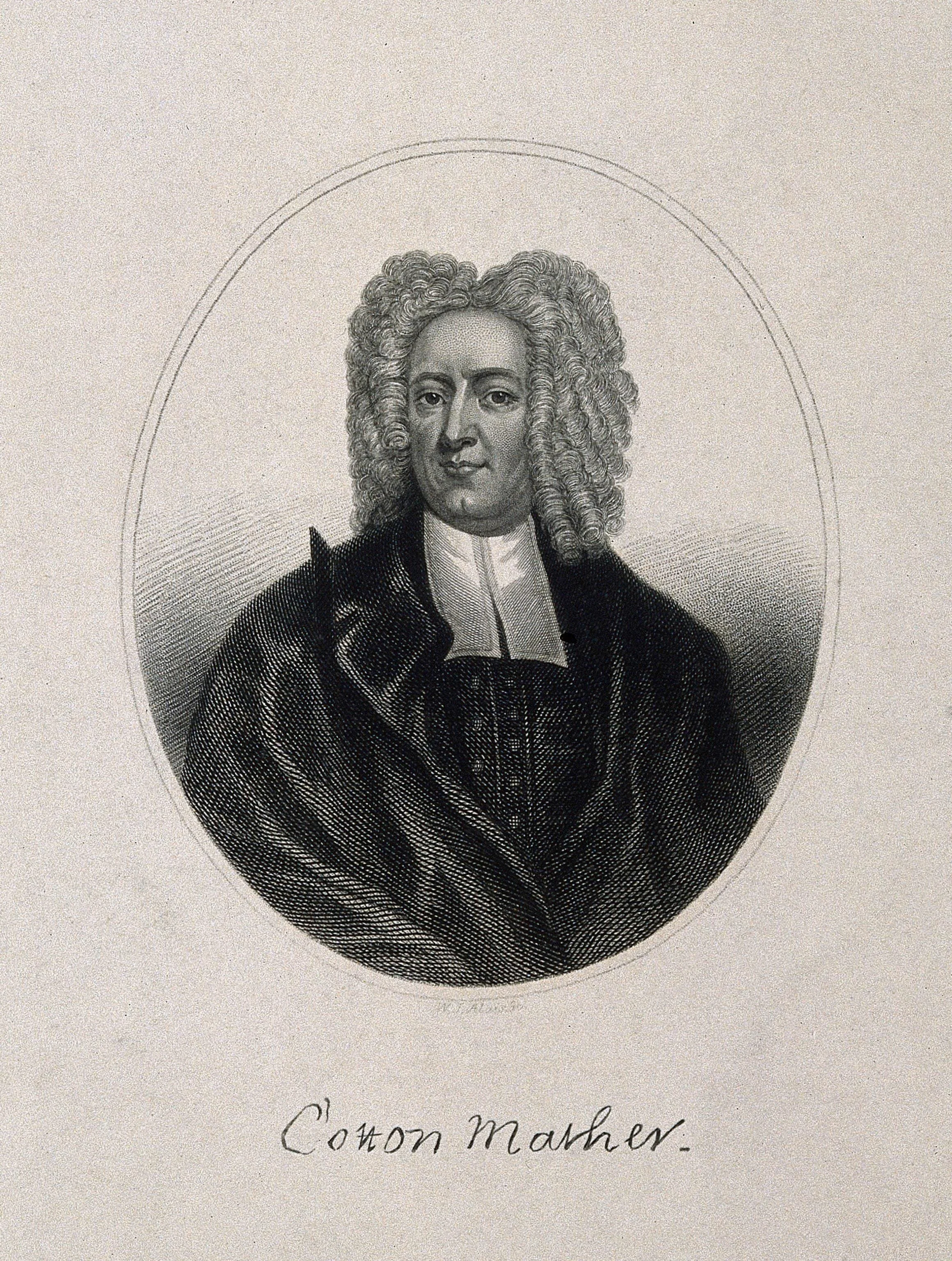
Cotton Mather was born in Boston in 1663. His father, Increase Mather, was one of the most important men in Massachusetts Bay, serving as a religious leader, a government official, and the President of Harvard University, a position he held during the Salem Trials. Mather himself graduated Harvard in 1678 at the age of 15. Soon after, he became assistant pastor at his father’s church, the North Square Church in Boston (he would take over as pastor in 1685), following closely the footsteps of his powerful father.
Mather was a also budding scholar who wanted to drink deep from the well of knowledge, but the intellectual and cultural world of colonial New England would seem to us a strange brew. The Puritans, as a matter of doctrine, coupled together literacy and worldly knowledge with godliness and piety. Puritan leaders combined the roles of preacher, pastor, and theologian into one figure, which meant there was no real distance between theological doctrines and disputes, worship, and everyday life. Figures like Mather were both what we would now recognize as intellectuals — for example, at this time in his life Mather was fascinated by the work of Robert Boyle, the Anglo-Irish scientist and philosopher — and doctrinaire theologians — for example, when he hit involved in the strange case of the four Goodwin children.
In the summer of 1688, Ann Glover and her daughter were living in Boston, working as housekeepers for John Goodwin and his family. One day the oldest child, 13 year-old Martha Goodwin, accused the daughter of Ann Glover of stealing some of the family’s linens. Ann denied it, and the argument between her and the Goodwins was ferocious. The Goodwin children then came down with an odd illness. Their doctor was baffled and in exasperation declared that the children might be bewitched.
Ann Glover was a true outsider in colonial Massachusetts: an Irish Catholic who could understand English but couldn’t speak it. Cotton Mather was her foremost accuser, and at first he and the others thought that she was speaking the devil’s own tongue, until they realized she was speaking her native Irish Gaelic. She couldn’t recite the Lord’s Prayer in English, and a search of her home turned up small figurines – probably saints or icons. Most of the accusations against Ann were naturally based on spectral evidence. When Mather interrogated her, he said that she claimed to pray to a host of spirits, which Mather took to be demons but were probably saints.
Once a group of doctors determined her to be of sound mind, she was pronounced guilty of witchcraft and hanged in front of a jeering crowd in Boston on November 16, 1688.
The following year, Mather published a book titled Memorable Providences, Relating to Witchcraft and Possession, A Faithful Account of Many Wonderful and Surprising Things, that Have Befallen Several Bewitched and Possessed Persons in New-England. His book described the ordeal of the Goodwin children and the trial and execution of Ann Glover. He argued that not only were witches real, they could manifest themselves in spectral form, and there were no natural explanations for the afflictions of those who were bewitched. His description of the fits of the Goodwin children was a close match with the fits experienced by the girls in Salem Village three years later.
When the Salem witch investigations moved into the Court of Oyer and Terminer, Mather was there at the start, advising the judges and influencing the entire proceedings in various ways. He pushed for the inclusion of the Massachusetts Lieutenant Governor, William Stoughton, to preside over the trials, seeing Stoughton as a potentially powerful ally for Mather’s own future ambitions. During the trials themselves, Mather wrote about them, publicized them, and praised them. He never doubted the validity of spectral evidence; he never once doubted that Puritan New England was under severe attack by a conspiracy of evil witches allied with hostile natives; he never doubted that all those executed for witchcraft in Salem were guilty.
In late 1693, when the trials were over, he put forth his views in a book titled Wonders of the Invisible World: Observations As well Historical as Theological, upon the Nature, the Number, and the Operations of the Devils. By that time it read like a defense of the recent trials and the actions of the authorities, rather than a call to action. One section reads:
The New-Englanders are a people of God settled in those, which were once the Devil’s Territories; and it may easily be supposed that the Devil was exceedingly disturbed, when he perceived such a People here accomplishing the Promise of old made unto our Blessed Jesus, That He should have the Utmost parts of the Earth for His Possession... Wherefore The devil is now making one Attempt more upon us; an Attempt more Difficult, more Surprizing, more snarl’d with unintelligible Circumstances than any that we have hitherto Encountered; an Attempt so Critical, that if we get well through, we shall soon Enjoy Halcyon Days, with all the Vultures of Hell Trodden under our Feet. He has wanted his Incarnate Legions to Persecute us, as the People of God have in the other hemisphere been Persecuted: he has therefore drawn forth his more spiritual ones to make an upon us.
After the witch trials, Mather went on to write over 450 published works, a body of work that loomed large in the theological debates and natural sciences of New England for decades. He became known as a leading proponent of inoculation to prevent the spread of smallpox — this involved making a small cut in someone’s skin and deliberately giving them a mild infection that could be easily treated, giving that person future immunity to the disease.
In November 1713, a measles epidemic claimed the lives of his wife, newborn twins, and two year-old daughter. Only two of his fifteen children survived him, and neither of his wives did. Mather himself passed away on February 13, 1728, the day after his sixty-fifth birthday, having never indicated a moment of regret over his role in the Salem witch trials.
An Invisible Enemy
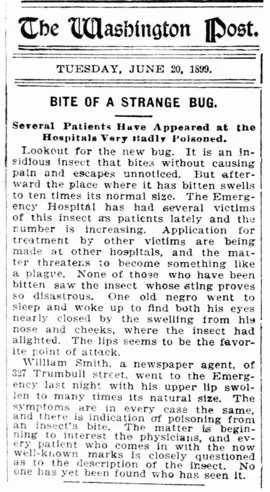
In the early summer of 1899, Washington City Emergency Hospital in Washington, DC was admitting patient after patient complaining of insect bites. A crime reporter for the Washington Post named James McElhone was on the hunt for a story, and when he heard about the high number of bug-bite victims at Washington City Hospital, he pounced.
He interviewed the victims and was puzzled to find that none of them remembered actually being bitten by any kind of bug — yet they were in the hospital with the symptoms of being attacked by some type of poisonous insect. One of the victims, a newspaper agent named William Smith, had “an upper lip swollen to many times its natural size. The symptoms are in every case the same, and there is indication of poisoning from an insect’s bite.” The fact that none of the victims actually saw the insect in question led McElhone to conclude that they had been bitten as they slept — and since their lips appeared to swell, it must have been what McElhone dubbed the “kissing bug.”
Look out for the new bug. It is an insidious insect that bites without causing pain and escapes unnoticed. But afterward, the place where it has bitten swells to ten times its normal size. The Emergency Hospital has had several victims of this insect as patients lately and the number is increasing. — The Washington Post, June 20, 1899
Once McElhone’s story was published in the Post other local newspapers ran with their own stories within days, warning of the dangers of the kissing bug epidemic spreading outward from the nation’s capital. Since no one could give a decent description of what the kissing bug actually looked like, anyone who got (or thought they got) a sting from any insect assumed it could have been the work of the dreaded kissing bug.
Just a few days after McElohne’s story ran, a new story titled "Kissing Bug at Work" described the pain experienced by three bite victims. One of these victims was an actress — she had been bitten on the forehead and her doctor would be operating on her if the swelling failed to go down. Reports about kissing bug attacks appeared across the United States. In one town where kissing bug attacks had occurred it was reported that "every residence in the town is closed airtight."
In mid-July a 33-year-old Chicago native named Mary Steger died of unknown causes. After determining that Mary had been bitten by a mysterious bug six days previously, her doctor, George M. Illingsworth, wrote her death certificate to read: "Chief and determining cause of death, sting of kissing bug. Consecutive and contributory cause: tonsilitis." The local doctors and other medical experts questioned this diagnosis, but when the coroner tried to conduct an autopsy on Mary’s body he discovered that she had already been embalmed, meaning there was no way to establish the true cause of her death. The story ran in the paper under the headline: “Cause of Death a Kissing Bug." New deaths were attributed to the bite of the kissing bug, even when there was no evidence that the deceased had any bug bites at all. Mary Steger’s death also inspired a preacher from Chicago named A.M. Leonard, who claimed that the kissing bug was a sign mentioned in the Book of Revelation, chapter nine, heralding the apocalypse. All the victims, he reasoned, were lacking in faith and thus marked for death by the will of God.
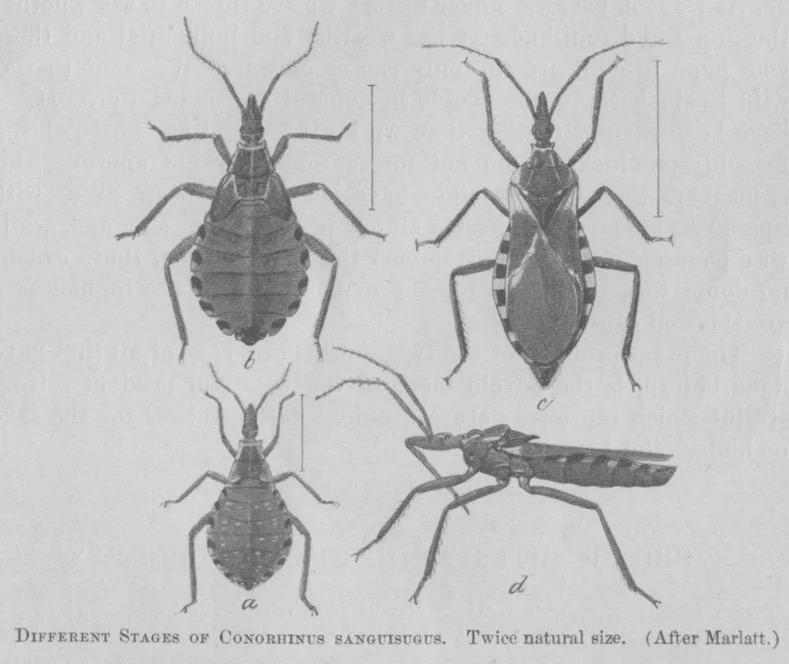
The actual kissing bug, despite being everywhere and possibly ending the world, remained elusive. Almost all the countless specimens of alleged kissing bugs sent in to various scientific organizations for identification, were common insects -- houseflies, beetles, bees, wasps; one person sent in a butterfly. One reporter had ventured to identify the elusive kissing bug as the black corsair, with the scientific name melanolestes picipes; but these insects lived deep in woodland areas – not the streets of Washington DC and Chicago – and they never attacked humans unless provoked.
The chief entomologist at the Department of Agriculture, a man named Leland Ossian Howard, tried to debunk the kissing bug panic in a widely-read article for Popular Science Monthly. He said that it was a "newspaper epidemic, for every insect bite where the biter was not at once recognized was attributed to the popular and somewhat mysterious creature.” At the Annual Meeting of the American Association for the Advancement of Science held in Columbus, Ohio, Professor John B. Smith said:
If anyone would bring me a live kissing bug I will let it sting to its heart's content. We are simply going through a craze like the one we had when spider bites were popular. Everybody who was bitten by any kind of an insect was bitten by a spider. The same is true now.
When the summer of 1899 came to an end, so did the kissing bug panic. Leland Ossian Howard went on to become one of the world’s leading entomologists, publishing over 1,000 papers and books, describing 47 new types of parasitic wasps and ants and more than 20 species of mosquitoes. He also conducted research that identified one of the most dangerous insects to humans because of the many diseases it spread: not the mysterious kissing bug… the common housefly.
They story might have ended there, but in 1909 Brazilian scientist Carlos Chagas discovered a disease carried by about 50% of the “real” kissing bugs — triatomine bugs. These bugs, Chagas found, carry a protozoan parasite, Trypanosoma cruzi, which infect the victim. The result is Chagas disease, also known as American trypanosomiasis, a terrible parasitic infection that slowly breaks down the victim’s heart and digestive system. Thankfully it’s curable if caught early, but it still kills about 10,000 people a year — according to the CDC, about 300,000 people in the US have it and about 8 million in Mexico, Central America and South America. Because most of the victims are in Latin America, rural, and poor, Chagas disease attracts virtually no attention from the medical establishment.
T. cruzi lives in the midgut and fecal matter of the triatomine bugs. The will usually come out at night looing to feed on blood, and since humans usually have our faces exposed while we sleep that’s where they tend to bite us. The bites infected with T. cruzi will often present as swelling on the victim’s face — including around the lips.
Continued in Part 5.