
Under an Evil Hand, Part 5
The Salem Witch Trials claim more lives; theories about the witchcraft crisis; and the New England Vampire Panic.
Note: this was originally posted to my Substack on Oct 20, 2022. I deleted that Substack a couple years ago and I’m posting these here so they don’t get lost.
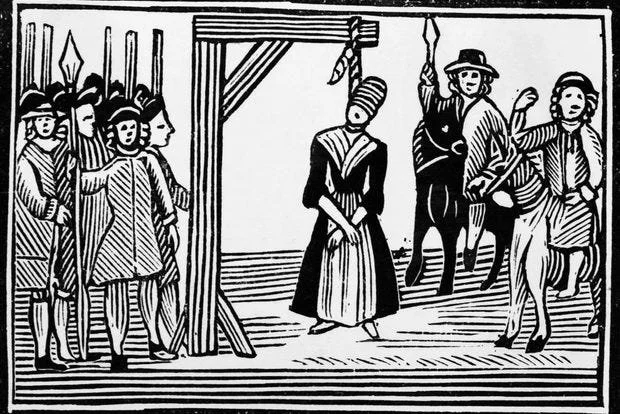
“The Devil Transformed into an Angel of Light”
After the execution of Elizabeth Bishop on June 10, 1692, there were two weeks of relative quiet. No new suspects were jailed and there were only (so to speak) three spectral attacks. During this lull the first reservations crept into the minds of some colonists. There had always been a few who spoke out loudly against the trials — which made them all the more suspect. By this point most of those dissenters were on trial themselves. Some of the local clergymen cautiously expressed their confusion and dismay about prosecution’s tactics in the court trials, always couched in effusive praise of the magistrates. Boston minister Reverend William Milborne started two petitions which he intended to present to the new Massachusetts assembly when it convened, condemning the charges against some of the prominent citizens that had been accused, like Rebecca Nurse, George Burroughs, and several others. But when Governor William Phips and his council got wind of it Milborne was ordered to either pay a large fine or be imprisoned. He stood by his convictions and was thus thrown in jail. Also during this time the family of Rebecca Nurse had been fighting back against her indictment for witchcraft, publicly attacking the credibility and character of her accusers, especially Abigail Williams, Betty Hubbard, and Mercy Lewis.
The court reconvened on June 28. Despite her family’s efforts, Rebecca Nurse was tried and found guilty, along with Sarah Good and three other women. One accused man, Roger Toothaker, had already died in prison on June 16, making him the trials’ second victim. On July 19, the five convicted women were executed by hanging at Gallows Hill.
Not only did these executions fail to stem the rising tide of paranoia, the killings only fed the expanding cycle of accusations and confessions which by now had spread to Andover, then Gloucester, then all of Essex County. As August 1692 began, Gov. Phips, who had prudently distanced himself from the court proceedings, traveled north to Maine to oversee the improvement of the province’s defenses. In his absence the convictions and executions continued.
On August 19, George Burroughs, John Proctor, Martha Carrier, and two other men were executed by hanging on Gallows Hill. Burroughs had been considered the leader of the witch conspiracy for several weeks. Local people had packed the courtroom during his trial and so they flocked to his execution. One observer noted that the condemned “forgave their accusers” and “seemed to be very sincere, upright, and sensible of their circumstances on all accounts.” Another man present described how Burroughs, before the gallows, made an eloquent speech declaring his innocence and finished by perfectly reciting the Lord’s Prayer, which brought many of the onlookers to tears. The authorities became concerned that the crowd was so moved they might try to stop the execution, so they hurried to hang Burroughs was hung before they could do so. As soon as Burroughs was hung, Cotton Mather leaped onto his horse and exhorted the people to remember that “the Devil has often been transformed into an Angel of Light.” This supposedly had the effect of calming the crowd. The executions would continue.
The court convened for another session on September 5, and over the two weeks the juries tried several more men and women, including Martha Corey. All of them were found guilty. Abigail Hobbs, who had confessed to being a witch several weeks prior, pled guilty, and found herself one of the few confessors who were prosecuted. The court seemed to be in a rush; it was no longer even following its own lenient standards for evidence and testimony. Eight more people, Martha Corey among them, were hung at Gallows Hill on September 22.
In the meantime, the court had to deal with the problem of Martha Corey’s husband, 81 year old Giles Corey. He stubbornly refused to enter a plea of guilty or not guilty to the court, despite being legally ordered to do so. As a result, on September 17, the sheriff led Giles Corey to a pit in the open field beside his jail. Following the law of the time the sheriff stripped Giles naked before the Court and other witnesses. He laid Giles on the ground inside the pit, then placed wooden boards over his stomach and chest. Six men put heavy stones one by one on the boards. Despite the pain, Giles remained silent. Over the next two days he was given a few mouthfuls of bread and water. He was asked three times to plead innocent or guilty to witchcraft, and each time he replied simply "more weight." As the rocks piled up, the sheriff would occasionally stand on them to add to the pressure. But Giles wouldn’t give in. On September 19, three days before his wife’s execution, Giles supposedly cried out “more weight!” one last time before finally dying — though other observers said that with his last breath he cursed both the sheriff and the town of Salem.
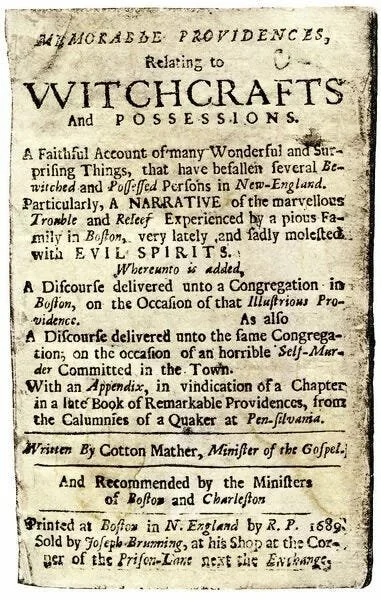
What Were the Salem Witch Trials?
The Salem witch trials of 1692 and 1693 stand out among the long history of witch trials in Europe. For one thing most of the Salem Village accusers were girls between the ages of 9 and 19 years old. There were older accusers, like Mary Warren, who was 20; Ann Putnam Senior, who was 30, and the oldest, Sarah Vibber, who was 36. But mostly the accusers in Salem Village and, later, Andover, were in their teens or younger. These young women had perhaps the least amount of social status in Puritan New England, apart from total outsiders like the Native Americans, the French, and the Dutch. But the adults in the colonies not only listened to these girls and took them seriously — they tried, convicted, and executed prominent members of their own community based mostly on their unreliable testimony.
The witch trials upended the social hierarchy in Salem, and that society, as we’ve seen, was already unstable, under severe attack from Indians and their allies and in a state of uncertainty at every level of government. These would be rational causes, but the sheer terror, the pervasive irrational fear at the heart of the Salem trials has remained a black box for historians who have tried to explain, or even just comprehend, what exactly happened in 1692 New England.
There are so many theories about the cause of the witch panic they can be grouped into types: physiological explanations, economic explanations, and psychological explanations. One well-known physiological theory holds that the accusers ate some rye infested with the ergot fungus, which caused hallucinations, pain, and convulsions, consistent with the accusers fits. But there is no real evidence to support this theory, or similar theories blaming encephalitis or an outbreak of Lyme disease.
Economic explanations are probably the most commonly accepted theories at the moment. One theory traces the source of the witch panic back to the global cooling that occurred between 1550 and 1800, known as the Little Ice Age. The coldest period fell between 1680 and 1730, meaning the ten years leading to the trials would have been especially difficult. The winters were severe, leading to food shortages and other hardships, and in turn — possibly — the scapegoating of outsiders into witches. Another theory points out the class difference between the relatively wealthy merchants of Salem Town to the east, with the relatively poor farmers of Salem Village to the west. This theory claims that the witchcraft trials were a way for the poorer Villagers to strike back at the unfairly privileged Towners. The economic explanations for Salem have the advantage of providing rational causes for the behavior of the Villagers, but that reasonableness is itself a problem. It’s hard to believe that the Salem folk were motivated by rational economic self-interest to tear their own society apart.
If we argue that the villagers were unconsciously motivated by economic factors, that Freudian language takes us into the realm of the psychological. The psychological explanations include the theory that the Villagers were suffering from (what we now call) post-traumatic stress disorder as a result of years of brutal warfare against the Wabanakis. Another psychological theory proposes that the girls were pushed into a kind of neurosis by straining against their strict Puritan upbringing and their low social status. Their fits supposedly stemmed from this mental struggle, and then the fits themselves became a tactic in continuing that struggle. A related theory posits that the girls felt controlled and constrained specifically by the older Puritan women. The girls used the accusations to project their own anger and resentment onto the married or widowed women, making those women responsible for the girls’ own rage which could not be openly expressed in any way.
The problem with these theories is that it’s difficult to either verify or disprove what anyone’s mental state is at any time, let alone hundreds of years ago. For these posts I’ve relied heavily on the work of Mary Beth Norton and her excellent book In the Devil’s Snare, mostly because she uses original sources wherever possible, creates a clear timeline of the witchcraft crisis, and incorporates the wider context of the bloody fighting between the colonists and the indigenous people. Many of the original records about the witchcraft trials were either lost or deliberately destroyed by those who participated in them, but enough have survived that we can at least understand what happened, if not why.
The simplest explanation, of course, is that it all really happened the way the accusers said it did: Cotton Mather was right, the Devil recruited a conspiracy of male and female witches and had them join forces with the Indians to drive God’s chosen out of their promised land. Of all the theories that try to explain the Salem witch trials this one remains the least popular of all.
The Last Vampire of New England
In June 1784, the Connecticut Courant and Weekly Intelligencer printed a letter to the editor from Councilman Moses Holmes of Willington, Connecticut. He warned locals to beware of “a certain Quack Doctor, a foreigner” who had urged families to dig up and burn dead relatives in order to stop the spread of “consumption,” i.e. tuberculosis. Homes, to his disgust, had witnessed several children’s corpses exhumed at the request of this Quack Doctor and was publicly calling for it to stop.
This practice of exhuming the bodies of those who had died of consumption — and usually burning part or all of them — was a New England tradition, ensuring that the dead would not rise from their graves to infect others. If multiple members of the same family died of TB, it was often blamed on the dead coming back to infect their living relatives. There were at least 80 exhumations dating as far back as the 1700s and as far west as Minnesota, but most were in rural New England in the 1800s.
In Connecticut, Rhode Island, and Vermont, the corpse would be exhumed, its heart cut out, and the heart burned; in some areas, it was thought that inhaling the smoke of the burning heart could cure those who were already sick with consumption. In 1793, hundreds of people attended a heart-burning ceremony at a blacksmith’s forge in Manchester, Vermont. In Woodstock Vermont, a heart was burned on the town green in 1830. Several corpses were exhumed at the same time in Jewett City, Connecticut in 1854. In Plymouth, Massachusetts, those who died of tuberculosis would be dug up, removed from their coffin (if they had one), flipped facedown, and reburied. That way if they tried to claw their way out of their graves they would end up going in the wrong direction.
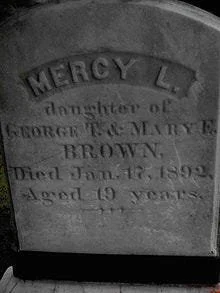
Gravestone of Mercy Lena Brown.
In the 1880s, George and Mary Eliza Brown lived in Exeter, Rhode Island, on a homestead of between 30 to 40 acres. Tragedy struck in December 1882 when Mary Eliza died of tuberculosis. The next year, their oldest daughter, a dressmaker named Mary Olive, died of tuberculosis at the age of 20. The whole town of Exeter came to funeral and sang hymns for her.
In 1891, George’s daughter, Mercy Lena Brown, and his son Edwin both came down with TB. Edwin was a large, healthy man — it seemed he might be able to beat the illness, so he traveled to Colorado Springs to recover. He returned in worse shape than when he left, which of course struck people as strange. The locals in Exeter began to wonder of perhaps Mary Eliza or Mary Olive Brown had returned from the dead to cause Edwin’s illness. When Mercy Lena Brown died in January 1892, it was decided that something had to be done. After months of pressure, George gave his permission to have his dead family members exhumed and examined. He also made it clear he would not be present.
On March 17, 1892, the villagers, a local doctor, and a newspaper reporter for the Providence Journal exhumed the bodies of the Browns. The examiners found that Mary Eliza and Mary Olive had significantly decomposed. Mercy Lena Brown, however, looked rather healthy. The doctor made some other incisions and pointed out the clear TB infection in Mercy’s lungs. Nevertheless she had blood in her heart and liver, which was taken as a sign that she was perhaps undead. (Of course, her body had been in an above-ground tomb in cold weather, which kept her preserved; she had only been dead two months; and the blood of dead bodies tends to pool in the chest cavity.)
Mercy’s heart and liver were cut out and burned on a nearby rock. The ashes and other remnants were mixed with water and given to the now-sickly Edwin to drink. It was supposed to cure him, but you will not be shocked to know he died two months later. It was, however, the end of consumption in the Brown family.
Mercy’s remains were reburied in the cemetery of the Exeter Baptist Church. Her grave, to the dismay of her descendants, has become a tourist attraction. Some have come to pay their respects to Mercy as someone whose body was desecrated in the name of superstition and fear. But the majority are tourists of superstition themselves — ghost-hunters, weird-history buffs, enthusiasts of the paranormal, looking for any hint that the world has ever been something other than what it seems. Mercy Lena Brown was the last of the New England vampires. Her end was also the end of era where it was simply understood there was no firm wall between the living and the dead.
The Providence Journal’s reporting on the Exeter ritual was read by George Stetson, a famous anthropologist of the time who had traveled to Rhode Island to investigate this “barbaric superstition.” His own account was published in a prestigious journal and shortly the story spread around the world. The New York World published their own story on Mercy Lena Brown in 1896. This story was read by a stage manager for the Lyceum Theatre in London, Bram Stoker, who was touring the United States with the theater company that year. Stoker was working on a novel he called The Un-Dead, which he changed right before publication in 1897 to Dracula. One of the characters in the book is named Lucy. She seems to suffer from something like consumption, though Van Helsing, the doctor, realizes that something more evil is afoot. Later, Lucy dies, and in a pivotal scene, her corpse is exhumed, a ritual presided over by the doctor. Eventually she is turned into a vampire, and the main characters have to destroy her, in part by driving a stake through her heart.
Continued in Part 6.