
Under an Evil Hand, Part 6
Climax and aftermath of the Salem Witch Trials; the 1791 slave uprising panic in New York City; and mass psychogenic illness in twenty-first century upstate New York.
Note: this was originally posted to my Substack on October 27, 2022 (hence the “Happy Halloween” at the end). I deleted my Substack a couple years ago and I’m posting these here so they don’t get lost.
The Devil Rides Out
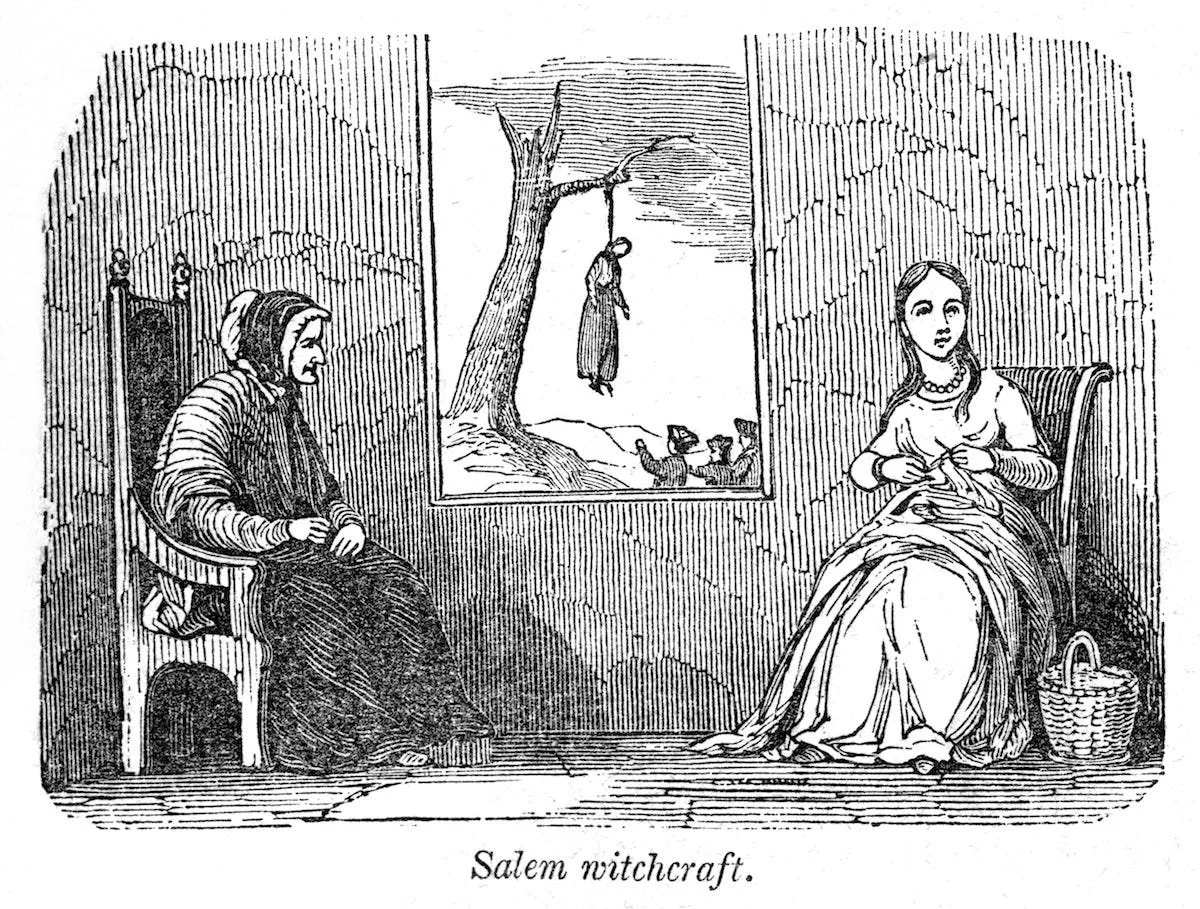
Massachusetts Bay Governor William Phips returned to Boston from his expedition to Pemaquid on September 29, 1692. In his absence, eight executions had taken place, defendants had been convicted on almost no evidence, and public opinion had turned against the witch trials. When Increase Mather himself denounced the use of spectral evidence on October 3, it was the beginning of the end. Without spectral evidence, the remaining cases had no ground to stand on.
The true end came when rumors spread about William Phips’ own wife possibly being implicated in the witch conspiracy. Enraged, Phips shut down the court proceedings, prohibited further arrests, and released many of the accused from prison. On October 29, Phips dissolved the Court of Oyer and Terminer. A new court was established that would convene in January 1693 to decide what to do with those still in custody. Throughout January and February defendant after defendant was found not guilty or cleared by proclamation of the Governor.
The last victim of the trials was a woman named Lydia Dustin, who died in custody on March 10, 1693. She had been found not guilty but wasn’t released because she was too poor to pay her jailer’s fees. The last trials were held on May 10, when five defendants were found not guilty, seven were cleared by proclamation, and a grand jury decided not to indict Tituba the slave, whose witchcraft had been blamed for the fits of Abigail Williams and Petty Parris a year and a half earlier.
“We walked in the clouds, and could not see our way”
Once it was clear the witchcraft trials no longer had the weight of the colonial government behind them, a fierce public backlash began. Families of the convicted spend decades trying to clear their names and get compensation. Publications appeared condemning the trials, though their authors were often harassed or even imprisoned for criticizing those in power.
William Phips came under attack for letting the trials go on so long; while the Mathers and their allies, the basis for his political power, turned on him for (in their minds) prematurely ending the trials. Despite his support from the Crown he had made too many powerful enemies in Massachusetts. He was recalled to England, where he was arrested on arrival in January 1965 on trumped-up charges of embezzlement. Before he could defend himself he fell ill and died at the age of 44.
Phips’ former ally, Increase Mather — whose work on witchcraft heavily influenced the trials; whose son Cotton was a driving force in the trials; who was present at the trial of George Burroughs, whose execution he celebrated — never expressed any remorse or even doubt about the righteousness of the trials. On June 27, 1692, while the trials were ongoing, Mather finished the charter for Harvard University and became its first president where he served until 1701. Even as Mather denounced spectral evidence he was preparing his book Cases of Conscience Concerning Evil Spirits which defended the trials and the judges. But the book was published in November 1692, after the backlash against the witch panic, so it included language cautioning the reader against acting too carelessly when hunting for witches.
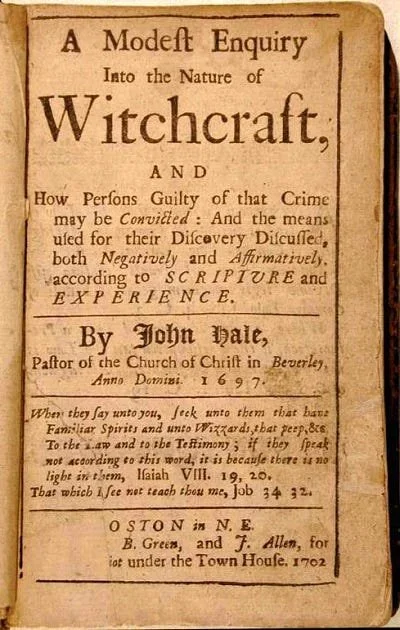
Unlike Increase and Cotton Mather, many of the New England worthies who had backed the trials eventually expressed their regrets. On December 17, 1696, the General Court ruled that there would be a fast day on January 14, 1697, "referring to the late Tragedy, raised among us by Satan and his Instruments." That same day, Samuel Sewall asked Rev. Samuel Willard to read aloud his apology to the congregation of Boston's South Church, "to take the Blame & Shame" of the "late Commission of Oyer & Terminer at Salem". He was the only judge who publicly renounced the trials. Thomas Fiske and eleven other trial jurors also asked forgiveness. John Hale, a minister in Beverly who was present at many of the examinations and trials, completed a book about the witch panic in 1697, where he wrote: "Such was the darkness of that day, the tortures and lamentations of the afflicted, and the power of former presidents, that we walked in the clouds, and could not see our way." The book wasn’t published until 1702, after Hale’s death.
On August 25, 1706, Ann Putnam Jr. joined the Salem Village church. She asked for forgiveness from the congregation, saying that she meant no harm, but the devil had tricked her into denouncing the innocent, like Rebecca Nurse. Ann was accepted for full membership in the church. If any other accusers had doubts or regrets, we have no records of them.

The present-day site of Gallows Hill, Salem, Massachusetts, in 2016.
Various individuals had their convictions overturned through the years but it wasn’t until October 31, 2001 when all the accused were finally, officially proclaimed innocent. In January 2016, the University of Virginia announced that a team of researchers from the school had finally determined the exact location of Gallows Hill in Salem, the site of nineteen executions — a small, barren, rocky ledge overlooking the town, positioned so that those witches hung from the surrounding trees couldn’t be missed by the villagers below. The site, owned by the city of Salem, now overlooks a Walgreens pharmacy. A memorial to the victims, designed by Martha Lyon, was dedicated on July 19, 2017, the 325th anniversary of the hangings of Sarah Good, Elizabeth Howe, Susannah Martin, Rebecca Nurse, and Sarah Wildes. Curving around the hill is a wall with the names of the nineteen victims engraved in the stones.
The New York Arson Panic of 1741, and Histories of Madness
In February 1741, three enslaved people in New York City robbed a small store owned by a white couple. One of the slaves, a man named Caesar, brought his loot to a tavern of ill repute down by the docks. The tavern was owned by a man named John Hughson, known for fencing stolen goods from slaves in exchange for alcohol. Before he could enjoy his spoils Caesar was caught and arrested along with one of his partners, a slave named Prince.
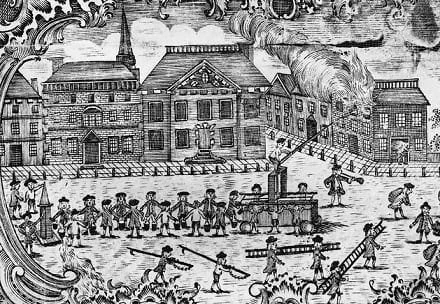
About a month later, on March 18, a fire broke out at Fort George, at that time the home Lieutenant Governor George Clarke. This was followed by a rash of unexplained fires across all of Lower Manhattan. The fires increased in number, reaching a climax on April 6 when four fires broke out in a single day. After a local enslaved man named Cuffee was seen running from one of the fires, he was arrested under the suspicion of having set it despite the lack of any proof he had done so.
A judge named Daniel Horsmanden was appointed to lead the investigation into the fires — at the same time he was presiding over the burglary trial of Caesar, Prince, and John Hughson. Judge Horsmanden was convinced that the burglary and the fires were was somehow connected. He and other white New Yorkers wondered if they might be facing a conspiracy, possibly a slave revolt using the weapon of arson.
The colonies had seen a major slave uprising in North Carolina two years previous, so it wasn’t hard to believe that another revolt was happening. And because Manhattan had the second-largest slave population of any city in the colonies (after Charleston, South Carolina), the idea of a slave revolt on the island was terrifying to white New Yorkers. Meanwhile Protestant Britain had been at war with Catholic Spain for the last two years and anti-Catholic bigotry was running high in the city amidst fears of an attack by Spanish forces. African-born slaves, Roman Catholics, and Black Spaniards were all suspect.
A jury was impaneled on April 21. Mary Burton, a 16 year-old Irish indentured servant at Hughson’s tavern, was brought in to testify before the jury. Under duress, Mary testified that Caesar, Prince, Cuffee, and a group of poor whites had indeed conspired to burn down the city, kill all the white men, claim the white women for their own, and elect a new king and governor from among their ranks. Burton also implicated a white prostitute named Peggy Kerry, who was connected to Caesar. Peggy Kerry was in turn forced to testify; to save herself, she implicated numerous other slaves in the conspiracy. Those she named were arrested and they too were also forced to provide testimony and name names.
In May 1741, Caesar and Prince were charged not with conspiracy, but with burglary; they were hanged. Peggy Kerry, who was pregnant with Caesar’s child; tavern owner John Hughson; and Hughson’s wife were arrested and publicly executed in June. Hughson’s body (and possibly those of his wife and Kerry as well) were hung on a gibbet and left to rot for all to see.
Despite the series of arrests, trials, and executions, Judge Horsmanden had still not uncovered any solid evidence of a plot to burn down New York City. He began to offer monetary rewards to anyone who could provide such evidence. By the end of the three-month investigation, about 150 people had been arrested and either testified or confessed. Mary Burton continued to accuse and implicate conspirators into the summer of 1741. She eventually accused more than twenty whites, including a man named John Ury, a Latin teacher who was supposedly using his Catholicism to influence the rebellion. He was eventually hung, along with about thirty enslaved people overall. About eighty others, mostly Black but some white, were deported and sent to Newfoundland, the West Indies, and the Madeira islands.
For whatever reason, the wave of fear had passed by the end of the summer and the accusations and trials ended. After all that bloodshed and horror, no real evidence of a plot was found. There might well have been a conspiracy to burn down Manhattan. It might have been a lone arsonist. It might have been a strange coincidence. It might be part of a pattern of “pre-emptive” violence against enslaved people. It might also be that human fear and cruelty slips through our attempts to rationalize and explain and thus comprehend.
Can a sane person write a history of madness? Sometimes the best we can do is record and observe, look for patterns, make some conclusions, and keep away from grand narratives. That’s why these posts are written in this style. I originally wrote most of this as a script to be read aloud, so the style is relatively simple and almost flat. Instead of embellishing it I kept it mostly as-is. To me there is still mystery at the core of the witch panic — as I’ve tried to show, I think it’s a force that socially recapitulates itself — and I don’t want to try to explain it away.
Thera Sanchez in 2012. Credit: CNN.
Psychogenic Illness In Upstate New York
Le Roy Junior-Senior High School sits in New York State about 50 miles east of Buffalo. In August 2011, a 16 year-old Le Roy student named Lori Brownell, passed out suddenly at a rock concert. A month later, Lori passed out again, this time at her school’s homecoming dance. Her doctors put her on Celexa, but she only got worse. Her fingers fluttered, her hands clapped, she shouted “hey,” almost like she was involuntarily cheerleading. She tried to manage her tics, outbursts, and seizures the best she could, while her doctors continued to look for some medical cause. They could find none.
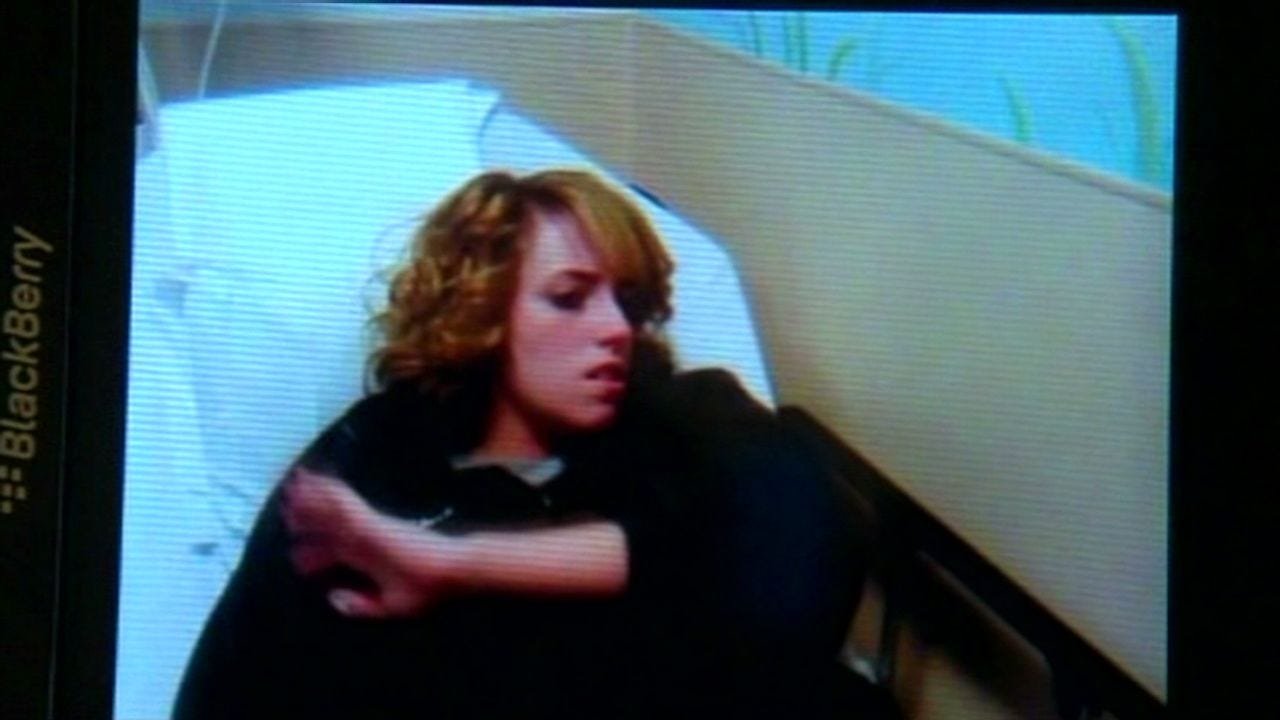
In the meantime other children at the Le Roy school had come down with the same or similar symptoms as Lori’s. Eventually 20 people, almost all of them girls who were students at Le Roy Junior/Senior High School, were suffering from verbal tics, spasms, nausea, dizziness, seizures, and other symptoms, as if they had all caught Tourette’s syndrome, except Tourette’s isn’t a contagious disease. The school and the state department of health looked for environmental factors that might have caused the outbreak but found nothing. Perhaps the symptoms were a side-effect of drugs, medications, vaccines, trauma, genetic factors, a rare condition known as PANDAS – pediatric auto-immune deficiency syndrome. Still nothing. The mysterious illness garnered local television and newspaper coverage of the girls, and eventually attention from national news and even the BBC in Britain. Meanwhile the girls were posting their own videos to YouTube showing their symptoms, and describing their ordeals on Facebook posts, attracting even more attention from around the globe.
By early January 2012, the authorities had settled on an explanation for what was affecting the girls but they were strangely reluctant to share it with the public. During a community meeting the New York State Department of Health said they couldn’t reveal their diagnosis because of concerns about the students’ privacy. Five days later, two of the girls appeared on the Today Show on NBC television to discuss their condition. They vented their frustration with the authorities for withholding information from the families affected.
As a result of this public pressure, a neurologist named Dr. Laszlo Mechtler, who had been treating most of the girls, was allowed to share the agreed-upon diagnosis: mass psychogenic illness. Psychogenic illness, aka conversion disorder, is a disorder that arises from a victim’s psyche dealing with stress, trauma, or depression by manifesting physical symptoms. The physical distress is real, and physical, but originates in the mind.
The families were mostly not pleased with this diagnosis. To them it seemed to imply that the girls were essentially making it all up or were simply crazy. And not everyone agreed; the environmental activist Erin Brockovich was convinced that the fits were caused by cyanide and an industrial solvent that spilled from a nearby train derailment back in the 1970s. According to Brockovich the spill had contaminated the soil around the La Roy school, though no trace of pollution was ever found.
Dr. Mechtler and others advised the girls to stop posting about their condition on the Internet and to stay off of social media in general as much as possible. Some of the girls did so and started to improve as a result. In June 2012, the symptoms began to clear up as suddenly as they appeared, except for two girls who were found to have actual cases of Tourette’s syndrome. As the school year drew to a close, the girls seemed to be healed and mostly moved on with their lives.
The exception was Lori Brownell. She and her mother had rejected the diagnosis of conversion disorder and its implication that what had happened to Lori wasn’t real. They had refused to allow Lori to be treated at the same neurology center as most of the other girls. Instead the Brownells decided that Lori was suffering from a chronic form of Lyme disease that was difficult to detect. This required long-term doses of intravenous anti-biotics and other treatments and appointments, which the Brownell’s insurance eventually stopped paying for. In the face of these struggles, Lori persevered. She graduated from high school in 2014 and has faded from the national spotlight as she, too, tried to move on with her life.
Since the Le Roy outbreak, various psychologists have come to the conclusion that mass psychogenic illness – which sounds like an updated term for what was once called “mass hysteria,” but isn’t — made a comeback in the 2010s after a long decline. The new technologies of communication and intimacy have allowed the old fears, the old paranoias, the visions, to spread wider than any time in human history. They have enabled that evil hand that was present in Salem Village to cast its shadow across the entire Earth.
Postscript: Season of the Witch
I wrote most of the above text in 2017. At that time I was fascinated and disturbed by the Q Anon Internet-cult that had just recently progressed from Pizzagate to Russiagate to openly venerating Donald Trump and his lackeys. At the time they were still a relatively on-line phenomenon that was just starting to break out into non-Internet reality in oddities and acts of violence. How quaint!
Jan 6 was the apotheosis of Q, the culmination of years of misinformation, hatred, bigotry, resentment, and pent-up backlash. Incoherent fears of Black Lives Matter “terrorists” who were joining with ANTIFA to literally burn cities to the ground; free-floating rage over the suffering inflicted by COVID, sublimated into rage at the hapless, half-hearted attempts to contain it; the perversion of America’s youth through critical race theory and/or trans rights; and of course a Satanic (etc.) conspiracy operating in the shadows — but also inside the government— who kidnapped, abused, and killed children, not to mention stealing elections. The right-wing disinformation engine realized the mass delusions brought in ratings and views, they co-opted the fanatics and con men who had appointed themselves as cult leaders, and they shoveled all that garbage like anthracite coal into the boiler of that engine until it exploded on January 6, 2021. That was also the day Q as a “movement” ceased to exist. Q had done its job becoming the dominant mindset (it’s not an ideology, that would take ideas) of the Republican Party. As soon as the fantasies of the Q cult transfigured from 8chan to the ballot, the cult abolished itself.
Like Q, it seems to me that past panics were viral paranoias wherein the more information someone received from others the more likely they were to join in the fear. The Internet would obviously magnify this effect a million times over. Based on the constant panics and terrors from 2017 to the present, that assumption turned out to be true.
I also believe that in an unforgiving, violent, unjust, nakedly cruel society — like ours — the instinct to push back and regain our autonomy hits against our need for self-preservation and a thousand other factors. Our desires for active resistance, passive resistance, self-destruction, and escape from the horrors of reality itself, all get braided together. This cable of contradiction can sometimes express itself in an individual through conversion disorder, and that individual expression can somehow spark the same in others, perhaps several others, creating a critical mass. Precisely how and why it all happens is the mystery of Salem and its descendants, a mystery I don’t think we can solve with the faculties of reason.
It happens that as I write this I’m in a hospital bed in Boston, being monitored 24/7. The neurologists want to see what it looks like when I have a seizure, so I have to wait here at least 5 days while they stress me out to see what happens. I don’t think they will find anything “physically” wrong with me — because I most likely have conversion disorder. It took two years to get to this point because all the CT scans and MRIs couldn’t peel the lid on my subconscious mind. It’s my own mystery now. Maybe I, like the Le Roy students and the Salem girls, will see my condition simply fade away.
In a way this gives me some sense of what the fits might have been like: uncontrolled, brought on by specific stressors, sometimes like panic attacks, other times as the loss of sensation, balance, and ability to speak, other times blacking out completely. I don’t want to presume, though. The eyewitness accounts make it clear that the fits of the Salem girls were more severe and probably even more debilitating.
It’s clear to me at least that the girls weren’t faking or acting. There were probably a few feedback loops going on: one among the girls; one between the girls and the audience at the trials, who were vocal enough to be participants; and one connecting the girls, the audience, and the judges. There’s no incentive for anyone in these loops (except skeptics and other outsiders) to pull back against the centrifugal force if these loops, just the opposite. Once the proceedings got big enough the “contagion” could spread to a wider area; then the process would start again until it hit an immovable object (like William Phips) or burned itself out for whatever reason.
There’s a bagful of morals to choose from regarding the witch trials. It’s a parable about repressive religion, feminist resistance to patriarchy, genocidal colonialism, what happens when rigidly hierarchical, highly unequal social structures begin to crack. It reflects the chaotic blowback from the complex internecine power struggles in colonial New England. It’s the tragic final chapter to an centuries-long era of witch hunting. It’s an organic outgrowth of the pseudo-modern blend of old theology and early science, which led the Mathers to believe they could hunt for witches using sound empirical data. In my opinion none of these contradict each other, and they are all fascinating. So is there a mystery after all? Is there just something that resists analysis because it’s closer to primal fright than higher reasoning?
The popular iconography in Salem itself of the witch trials is telling. The trials are always presented as theaters of insanity, horrors in their own right, where simply being accused was a death sentence. A trial where the evidence is made up of phantasms is a mockery of the idea of a trial. The trials are scary, as long as one rightly assumes that witches and witchcraft (as imagined by the Puritans) are fantasies.
On the other hand, fantasies have the strengths of imagination and desire behind them. The image of The Witch herself is everywhere in Salem: usually as an unthreatening caricature, sometimes as a woman of mystic power, but always there. The trials were full of imagined witches, too, also with ambiguity: empowered by the Devil to do evil but in the end defeated by Christ and his chosen.
These obscurities, trials that weren’t trials of witches who weren’t witches, don’t resolve at any point. Neither do the symptoms of psychogenic illness have a medical cure. The ambiguity shimmers in history and in our lives like mirages close enough to see but never to grasp. That eerie unknowability, that strange space we sometimes inhabit, is, after all, the essence of spookiness.
Happy Halloween…