Under an Evil Hand, Part 4
The first execution in the Salem Witch Trials; Cotton Mather, Puritan Witch Hunter; and the Kissing Bug apocalypse of 1899.
Note: this was originally posted to my Substack on October 13, 2022. I deleted that Substack a couple years ago and I’m posting these pieces here so they don’t get lost.
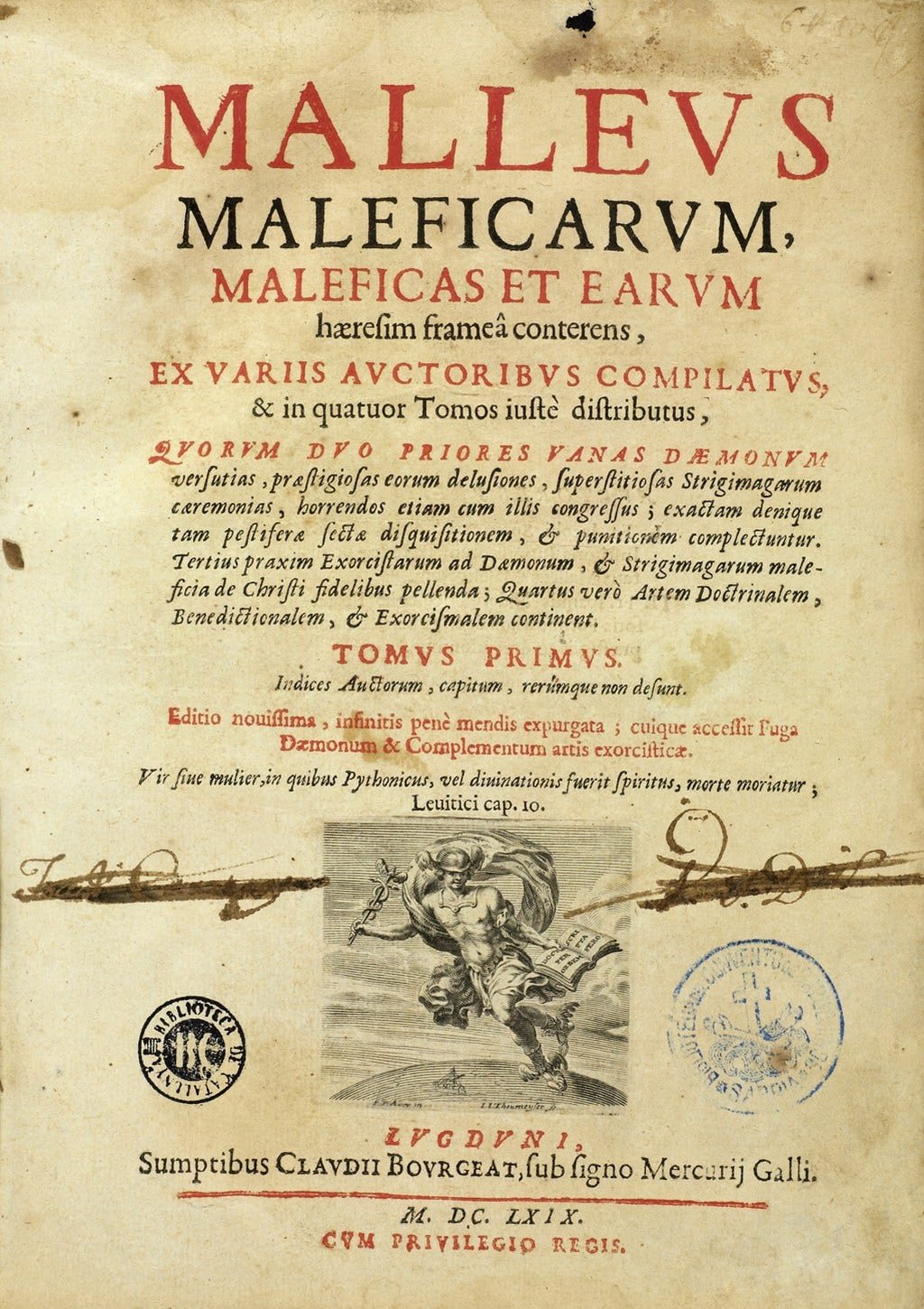
The Malleus Maleficarum, usually translated as the Hammer of Witches, was written by the German Catholic clergyman Heinrich Kramer (under his Latinized name Henricus Institor) and first published in the German city of Speyer in 1486. It was considered the authoritative work on witchcraft up through the 17th century.
An Invisible Coven
In early May 1692, the Salem Magistrate John Hathorne and Johnathan Corwin were busy men. The arrest of George Burroughs in Maine and his subsequent examination in Salem exposed a vast network of evil attacking the Puritan colonists from both outside — the Wabanaki — and inside — the colonists who had joined the forces of Satan. All over New England, witchcraft accusations, prosecutions, and confessions were erupting from within families, villages, and towns; the new accusations included prominent, respected members of colonial society, like George Burroughs, John Alden, Jr., and Rebecca Nurse.
The legal examinations were now perfunctory. It had already been common practice before the witch trials for colonial authorities to assume the guilt of anyone formally accused of a crime. Now claiming to be innocent of the charges against them made the accused look even more suspicious in the eyes of the citizens. On the other hand, those who openly confessed to being witches were given protection by Hathorne so that they would be able to inform on other still-hidden members of the conspiracy.
On May 13 the Magistrates began using a new technique for uncovering these Satanic infiltrators: the “touch test.” Abigail Soames, a 37-year-old single woman who was mostly bedridden while recuperating from smallpox, was accused of being a witch by Mary Warren. The examiners brought Mary to Abigail’s room in Salem Town, where Mary fell into especially painful fits as if she was being bitten by something invisible. Abigail was told to take Mary’s hand. When they touched, Mary instantly recovered. The examiners tried this experiment three times and got the same result. But Mary was unable to reach out and touch Abigail — when she tried, she fell into fits again. The authorities were convinced that the touch of a witch would heal his or her victim, so they incorporated the touch test into their examinations.
Just the authorities were uncovering more and more evil in their midst, the unstable political situation in the Massachusetts Bay Colony was upended yet again. On the evening of May 14, two men that had sailed from London arrived in Boston harbor. One of the men, Sir William Phips, was a native of Maine, a hero of the Indian Wars, and the newly appointed governor of Massachusetts. The other man was Increase Mather, he was one of the most powerful leaders of the colonial order. After the original Colony’s charter was revoked in 1688 he traveled to London to negotiate a new charter, hoping to preserve as much of the old Puritan privileges as possible. When Phips and Mather arrived from London that May evening, they brought with them from London a new charter establishing the Province of Massachusetts Bay. When this charter went into effect on Saturday, May 14, 1692, it created an entirely new political entity. Massachusetts was no longer a colonial settlement, it was a recognized province of the English crown, one which now absorbed Plymouth Colony, the Province of Maine, parts of upstate New York, New Brunswick, and Nova Scotia under its authority. (In theory, this meant Massachusetts would enjoy the benefits of full support from the Kingdom of England, in return for relinquishing its local autonomy. In reality this was the first paving stone laid on path to the American Revolution.)
News of the witchcraft trials hadn’t reached London, so as the celebrations of the new regime commenced in Boston Gov. Phips discovered to his horror that the jails in Salem and Boston were packed with 38 people awaiting trial for witchcraft. In order to convene the jury sessions and trials necessary to hear all the cases, Phips issued a commission on May 27 for a Court of Oyer and Terminer (from the French legal terms “to hear and determine”) and appointing nine judges, including Magistrate John Hathorne and the Lieutenant Governor, William Stoughton. These judges represented the traditional colonial (now provincial) authorities: men learned in law and theology, and wealthy merchants. Many of these men had served together in government or as militia officers; some of them were in-laws to each other.
The court was called into session at the Salem Town courthouse on June 2. The judges immediately had to decide which evidence was admissible and which should be ruled out, since witchcraft almost by definition generated few traces of physical evidence. Mostly they followed the standard legal guidance of the time, which meant looking for the use of charms, talismans, potions, or books on witchcraft owned or on the person of the accused. Accused witches could also be searched for devil’s marks on their body — blue or red spots, for example, or various other physical anomalies. Other tests could be administered in court, like the touch test or asking the accused to recite the Lord’s Prayer correctly.
The most weight was given to outright confessions of witchcraft. But the question remained of what to do with so-called “spectral evidence”, like those moments when the accused’s movements caused pain in the afflicted girls or when a witch’s specter was struck by a weapon and the witch’s physical body showed a wound in the same spot. Despite some misgivings by the judges, the Court decided to admit spectral evidence. But most of the numerous accounts of apparition, visions, and specters were entered directly into evidence — not presented to the jury.
On the first session of June 2, the court began with the case of Bridget Bishop. The official records of the court have been lost, but we can piece together what happened from other accounts. It seems that her trial followed a pattern that the other trials followed as well.
First the grand jury heard testimony from the afflicted, who frequently fell into fits. Then those who had confessed were brought in to add to or corroborate the previous testimony. Any witnesses to previous acts of witchcraft by the accused told their own stories. The accused’s body would be searched for witch’s marks and the results presented to the court. The accused would then speak in their own defense; under English law of the time, no criminal defendant was allowed to have an attorney, nor were they allowed to swear to their own innocence since if they were lying their souls would be damned to hell. Finally the jury would deliberate and deliver its verdict.
In the case of Bridget Bishop, she was convicted and sentenced to death. She was hung at Gallows Hill in Salem on June 10, 1692 — the first person from Salem executed for the crime of witchcraft.
The Invisible World
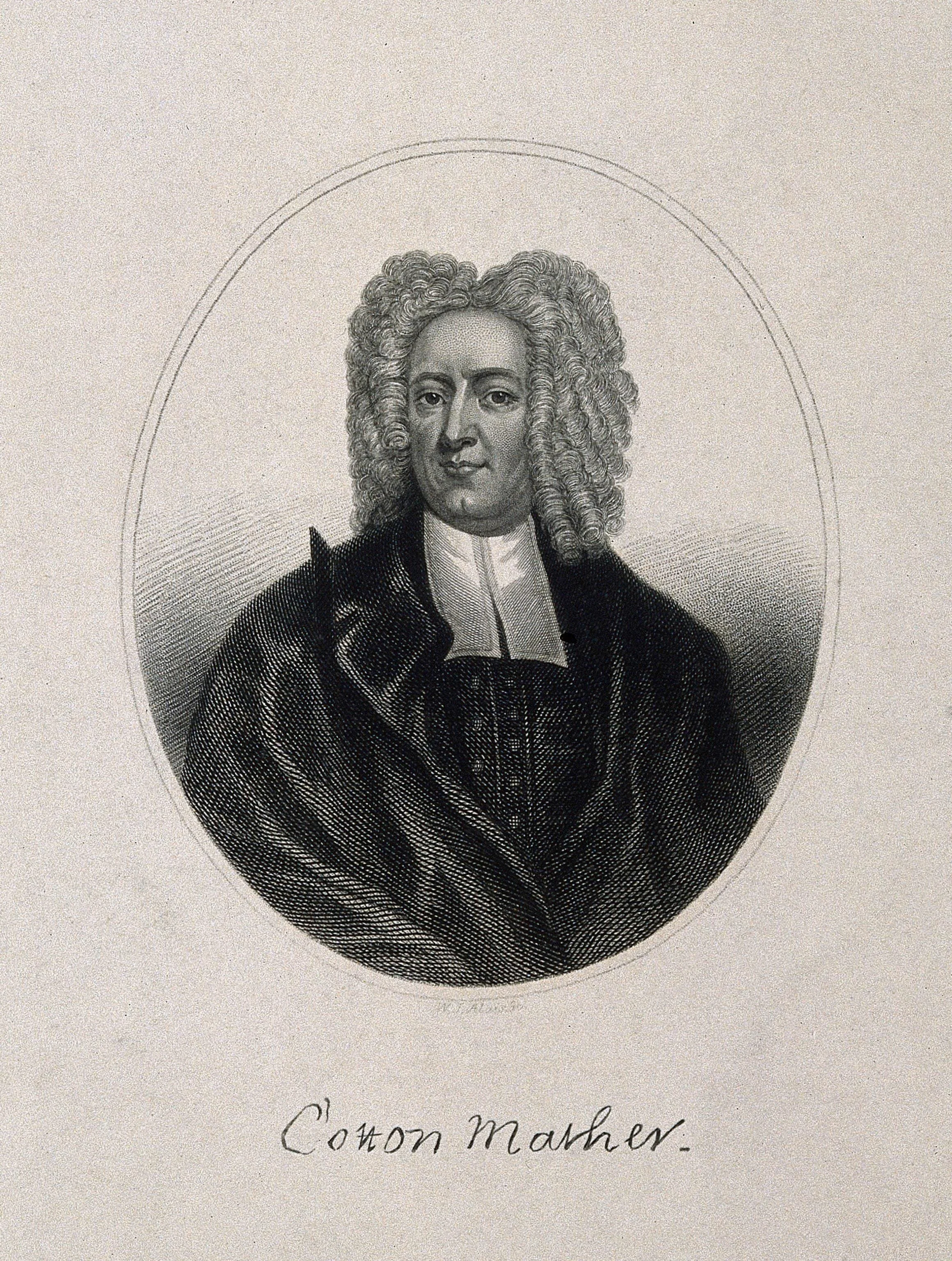
Cotton Mather was born in Boston in 1663. His father, Increase Mather, was one of the most important men in Massachusetts Bay, serving as a religious leader, a government official, and the President of Harvard University, a position he held during the Salem Trials. Mather himself graduated Harvard in 1678 at the age of 15. Soon after, he became assistant pastor at his father’s church, the North Square Church in Boston (he would take over as pastor in 1685), following closely the footsteps of his powerful father.
Mather was a also budding scholar who wanted to drink deep from the well of knowledge, but the intellectual and cultural world of colonial New England would seem to us a strange brew. The Puritans, as a matter of doctrine, coupled together literacy and worldly knowledge with godliness and piety. Puritan leaders combined the roles of preacher, pastor, and theologian into one figure, which meant there was no real distance between theological doctrines and disputes, worship, and everyday life. Figures like Mather were both what we would now recognize as intellectuals — for example, at this time in his life Mather was fascinated by the work of Robert Boyle, the Anglo-Irish scientist and philosopher — and doctrinaire theologians — for example, when he hit involved in the strange case of the four Goodwin children.
In the summer of 1688, Ann Glover and her daughter were living in Boston, working as housekeepers for John Goodwin and his family. One day the oldest child, 13 year-old Martha Goodwin, accused the daughter of Ann Glover of stealing some of the family’s linens. Ann denied it, and the argument between her and the Goodwins was ferocious. The Goodwin children then came down with an odd illness. Their doctor was baffled and in exasperation declared that the children might be bewitched.
Ann Glover was a true outsider in colonial Massachusetts: an Irish Catholic who could understand English but couldn’t speak it. Cotton Mather was her foremost accuser, and at first he and the others thought that she was speaking the devil’s own tongue, until they realized she was speaking her native Irish Gaelic. She couldn’t recite the Lord’s Prayer in English, and a search of her home turned up small figurines – probably saints or icons. Most of the accusations against Ann were naturally based on spectral evidence. When Mather interrogated her, he said that she claimed to pray to a host of spirits, which Mather took to be demons but were probably saints.
Once a group of doctors determined her to be of sound mind, she was pronounced guilty of witchcraft and hanged in front of a jeering crowd in Boston on November 16, 1688.
The following year, Mather published a book titled Memorable Providences, Relating to Witchcraft and Possession, A Faithful Account of Many Wonderful and Surprising Things, that Have Befallen Several Bewitched and Possessed Persons in New-England. His book described the ordeal of the Goodwin children and the trial and execution of Ann Glover. He argued that not only were witches real, they could manifest themselves in spectral form, and there were no natural explanations for the afflictions of those who were bewitched. His description of the fits of the Goodwin children was a close match with the fits experienced by the girls in Salem Village three years later.
When the Salem witch investigations moved into the Court of Oyer and Terminer, Mather was there at the start, advising the judges and influencing the entire proceedings in various ways. He pushed for the inclusion of the Massachusetts Lieutenant Governor, William Stoughton, to preside over the trials, seeing Stoughton as a potentially powerful ally for Mather’s own future ambitions. During the trials themselves, Mather wrote about them, publicized them, and praised them. He never doubted the validity of spectral evidence; he never once doubted that Puritan New England was under severe attack by a conspiracy of evil witches allied with hostile natives; he never doubted that all those executed for witchcraft in Salem were guilty.
In late 1693, when the trials were over, he put forth his views in a book titled Wonders of the Invisible World: Observations As well Historical as Theological, upon the Nature, the Number, and the Operations of the Devils. By that time it read like a defense of the recent trials and the actions of the authorities, rather than a call to action. One section reads:
The New-Englanders are a people of God settled in those, which were once the Devil’s Territories; and it may easily be supposed that the Devil was exceedingly disturbed, when he perceived such a People here accomplishing the Promise of old made unto our Blessed Jesus, That He should have the Utmost parts of the Earth for His Possession... Wherefore The devil is now making one Attempt more upon us; an Attempt more Difficult, more Surprizing, more snarl’d with unintelligible Circumstances than any that we have hitherto Encountered; an Attempt so Critical, that if we get well through, we shall soon Enjoy Halcyon Days, with all the Vultures of Hell Trodden under our Feet. He has wanted his Incarnate Legions to Persecute us, as the People of God have in the other hemisphere been Persecuted: he has therefore drawn forth his more spiritual ones to make an upon us.
After the witch trials, Mather went on to write over 450 published works, a body of work that loomed large in the theological debates and natural sciences of New England for decades. He became known as a leading proponent of inoculation to prevent the spread of smallpox — this involved making a small cut in someone’s skin and deliberately giving them a mild infection that could be easily treated, giving that person future immunity to the disease.
In November 1713, a measles epidemic claimed the lives of his wife, newborn twins, and two year-old daughter. Only two of his fifteen children survived him, and neither of his wives did. Mather himself passed away on February 13, 1728, the day after his sixty-fifth birthday, having never indicated a moment of regret over his role in the Salem witch trials.

An Invisible Enemy
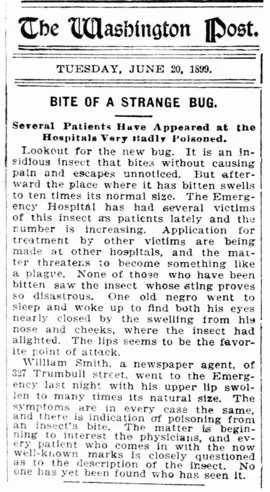
In the early summer of 1899, Washington City Emergency Hospital in Washington, DC was admitting patient after patient complaining of insect bites. A crime reporter for the Washington Post named James McElhone was on the hunt for a story, and when he heard about the high number of bug-bite victims at Washington City Hospital, he pounced.
He interviewed the victims and was puzzled to find that none of them remembered actually being bitten by any kind of bug — yet they were in the hospital with the symptoms of being attacked by some type of poisonous insect. One of the victims, a newspaper agent named William Smith, had “an upper lip swollen to many times its natural size. The symptoms are in every case the same, and there is indication of poisoning from an insect’s bite.” The fact that none of the victims actually saw the insect in question led McElhone to conclude that they had been bitten as they slept — and since their lips appeared to swell, it must have been what McElhone dubbed the “kissing bug.”
Look out for the new bug. It is an insidious insect that bites without causing pain and escapes unnoticed. But afterward, the place where it has bitten swells to ten times its normal size. The Emergency Hospital has had several victims of this insect as patients lately and the number is increasing. — The Washington Post, June 20, 1899
Once McElhone’s story was published in the Post other local newspapers ran with their own stories within days, warning of the dangers of the kissing bug epidemic spreading outward from the nation’s capital. Since no one could give a decent description of what the kissing bug actually looked like, anyone who got (or thought they got) a sting from any insect assumed it could have been the work of the dreaded kissing bug.
Just a few days after McElohne’s story ran, a new story titled "Kissing Bug at Work" described the pain experienced by three bite victims. One of these victims was an actress — she had been bitten on the forehead and her doctor would be operating on her if the swelling failed to go down. Reports about kissing bug attacks appeared across the United States. In one town where kissing bug attacks had occurred it was reported that "every residence in the town is closed airtight."
In mid-July a 33-year-old Chicago native named Mary Steger died of unknown causes. After determining that Mary had been bitten by a mysterious bug six days previously, her doctor, George M. Illingsworth, wrote her death certificate to read: "Chief and determining cause of death, sting of kissing bug. Consecutive and contributory cause: tonsilitis." The local doctors and other medical experts questioned this diagnosis, but when the coroner tried to conduct an autopsy on Mary’s body he discovered that she had already been embalmed, meaning there was no way to establish the true cause of her death. The story ran in the paper under the headline: “Cause of Death a Kissing Bug." New deaths were attributed to the bite of the kissing bug, even when there was no evidence that the deceased had any bug bites at all. Mary Steger’s death also inspired a preacher from Chicago named A.M. Leonard, who claimed that the kissing bug was a sign mentioned in the Book of Revelation, chapter nine, heralding the apocalypse. All the victims, he reasoned, were lacking in faith and thus marked for death by the will of God.
The actual kissing bug, despite being everywhere and possibly ending the world, remained elusive. Almost all the countless specimens of alleged kissing bugs sent in to various scientific organizations for identification, were common insects -- houseflies, beetles, bees, wasps; one person sent in a butterfly. One reporter had ventured to identify the elusive kissing bug as the black corsair, with the scientific name melanolestes picipes; but these insects lived deep in woodland areas – not the streets of Washington DC and Chicago – and they never attacked humans unless provoked.
The chief entomologist at the Department of Agriculture, a man named Leland Ossian Howard, tried to debunk the kissing bug panic in a widely-read article for Popular Science Monthly. He said that it was a "newspaper epidemic, for every insect bite where the biter was not at once recognized was attributed to the popular and somewhat mysterious creature.” At the Annual Meeting of the American Association for the Advancement of Science held in Columbus, Ohio, Professor John B. Smith said:
If anyone would bring me a live kissing bug I will let it sting to its heart's content. We are simply going through a craze like the one we had when spider bites were popular. Everybody who was bitten by any kind of an insect was bitten by a spider. The same is true now.
When the summer of 1899 came to an end, so did the kissing bug panic. Leland Ossian Howard went on to become one of the world’s leading entomologists, publishing over 1,000 papers and books, describing 47 new types of parasitic wasps and ants and more than 20 species of mosquitoes. He also conducted research that identified one of the most dangerous insects to humans because of the many diseases it spread: not the mysterious kissing bug… the common housefly.
They story might have ended there, but in 1909 Brazilian scientist Carlos Chagas discovered a disease carried by about 50% of the “real” kissing bugs — triatomine bugs. These bugs, Chagas found, carry a protozoan parasite, Trypanosoma cruzi, which infect the victim. The result is Chagas disease, also known as American trypanosomiasis, a terrible parasitic infection that slowly breaks down the victim’s heart and digestive system. Thankfully it’s curable if caught early, but it still kills about 10,000 people a year — according to the CDC, about 300,000 people in the US have it and about 8 million in Mexico, Central America and South America. Because most of the victims are in Latin America, rural, and poor, Chagas disease attracts virtually no attention from the medical establishment.
T. cruzi lives in the midgut and fecal matter of the triatomine bugs. The will usually come out at night looing to feed on blood, and since humans usually have our faces exposed while we sleep that’s where they tend to bite us. The bites infected with T. cruzi will often present as swelling on the victim’s face — including around the lips.
Continued in Part 5.
Under an Evil Hand, Part 3
The Salem Witch trials escalate; power and politics in the Massachusetts Bay Colony; and the first flying saucer sighting.
Note: this was originally posted to my Substack on October 6, 2022. I deleted that Substack a couple years ago and am posting these again so they don’t get lost.
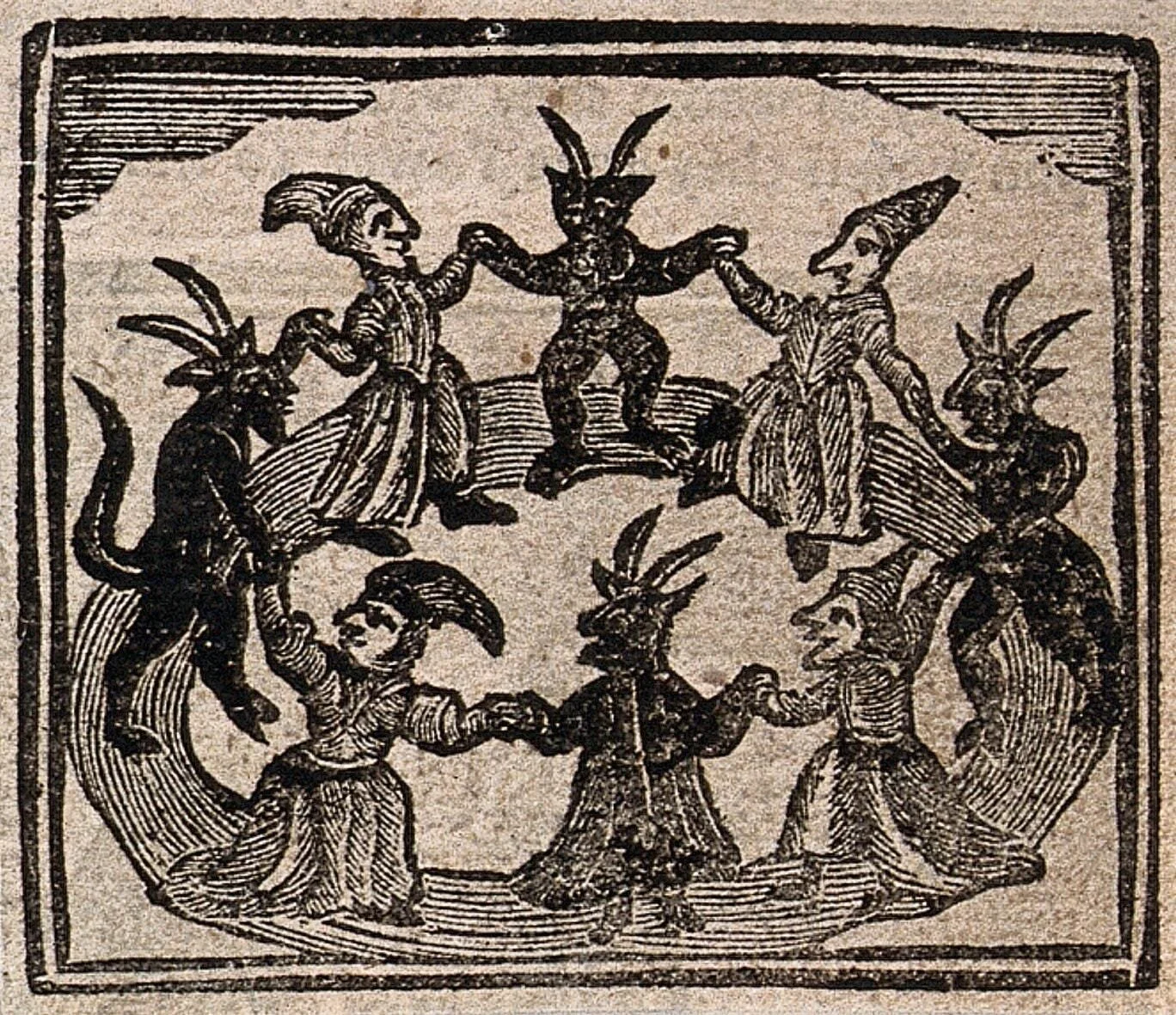
Devil’s Dominion
Early March 1692 saw more victims of witchcraft appear: Ann Putnam, Jr., Mercy Lewis, Mary Walcott, and Mary Warren were all affected.
The next woman labeled a witch was a woman who lived on the outskirts of the Village: Martha Corey, the third wife of 80-year-old Giles Corey. She was currently a member of the church in good standing, but many years earlier she had borne a child out of wedlock to a father who wasn’t white.
On March 12, Martha Corey visited the Putnam family. 12 year old Ann Putnam Jr. suddenly went into fits as she saw a vision of Martha roasting a man alive on a spit. Mercy Lewis, who was also visiting the Putnam house, began having fits. A few days later Ann Putnam, Sr. said she was being attacked by Martha Corey’s specter — Martha wanted Ann to add her name to the Devil’s book and join his legions.
The next day, two men from the village complained to the Magistrates about Martha Corey; on March 21 she was examined before the congregation. During the questioning, Abigail Williams cried out there was “a black man whispering in her ear,” by which she meant an Indian man. 17-year-old accuser Mary Walcott claimed to see him as well. Magistrate Hathorne demanded that Martha Corey tell them what the black man was saying. Martha, of course, said she didn’t hear anything. The girls went into fits; Corey, flustered, bit her lip, and the accusing girls said they were being bitten; she moved her hands nervously and the girls said they were being pinched; one of the girls hit Corey on the head with her shoe and all the girls wildly stamped their feet. Finally Hathorne had to end the examination and ordered Corey jailed in Salem Town.
The next day, Ann Putnam Sr. was visited by the specter of Rebecca Nurse, a respected seventy-year-old member of the Salem Town church who had a longstanding legal dispute with the Putnam family. A group of villagers confronted Rebecca at her home. She was completely baffled at being among the accused. Two of the Putnams filed a formal complaint against her for having afflicted Ann Putnam Sr. and Abigail Williams, their complaint including an accusation against 12-year-old Dorcas Good, the daughter of Sarah Good. Both Rebecca Nurse and Dorcas Good were arrested and held at the inn.
On March 24 they were brought before the Magistrates and the congregation. Dorcas Good, clearly terrified by the entire proceeding, quickly confessed. Rebecca Nurse, however, refused to confess, and like Martha Corey her movements were mimicked by the girls and met with cries of pain from the accusers. This time people in the audience, ostensibly there to observe, joined in the cries of pain. At one point Ann Putnam Sr. went limp and couldn’t move; her husband had to carry her out of the meeting house. Next accused was Elizabeth Proctor, the wife of John Proctor, who had loudly proclaimed his disbelief in witches and witchcraft. Their servant, Mary Warren, had become one of the accusers. Sarah Cloyce, the sister of Rebecca Nurse, was also accused of being a witch, after trying to defend her sister against that same charge.
The seriousness of the situation had finally become apparent to the local authorities. On April 11, Sarah Cloyce and Elizabeth Proctor were taken to Salem Town to be examined before Deputy Governor Thomas Danforth and members of the Governor’s Council. During the examination, Abigail Williams and Ann Putnam Jr. went into severe fits, they saw Elizabeth Proctor’s specter on the ceiling, they accused John Proctor of being a witch, then all the girls fell into chaos. Sarah Cloyce and the Proctors were jailed in Salem Town. Rebecca Nurse, Martha Corey, and Dorcas Good were all sent to prison in Boston.
At this point, Mary Warren, who had originally accused Elizabeth Proctor of witchcraft, suddenly changed her story. She admitted she had been lying and said the other accusers were lying too. As a result, she was — not surprisingly — accused of being a witch all along.
It seemed all of New England was under attack by witches. Reports of witchcraft attacks came from Malden, Stamford, and elsewhere, the accusers claiming there were many witches working together across the country. In Salem, meanwhile, on April 13 Ann Putnam Jr. accused Martha Corey’s husband Giles Corey of witchcraft. Then 14 year old Abigail Hobbs was accused by Ann Putnam Jr., Mary Walcott, and Mercy Lewis. The more Villagers were accused, the larger the coven seemed to grow.
On April 19, when Bridget Bishop, Giles Corey, Mary Warren, and Abigail Hobbs were examined, Abigail did something no one, including her accusers, expected: she confessed to practicing witchcraft. She had seen the devil once “at the Eastward at Casco Bay,” the site of one of the worst raids inflicted on the colonists by the Wabanakis. And three or four years ago Abigail said she had met Satan in the woods near Falmouth — another target of the Wabanakis — and made a covenant with him.
The accusers watched in silence. Some observers noted that the girls were as stunned as anyone to hear what Abigail was saying. Shortly afterwards, Mary Warren, under pressure from the court, the afflicted, and the audience, reversed herself again and rejoined the ranks of the accusers. The congregants of Salem Village and Salem Town were shaken yet again: not only could anyone, including respected members of the church and community leaders, be a witch in disguise, those witches might be working in secret on behalf of the devil’s minions, their adversaries the Wabanakis.
The next night, Ann Putnam Jr. was visited by the apparition of a former minister in Salem and in Maine named George Burroughs. The specter of George Burroughs described the terrible acts of witchcraft he had committed, including using his magic against the soldiers in Maine that had been fighting the Wabanakis. The morning after that, Abigail Williams also saw an apparition of Burroughs, this time on the road to a tavern; he then appeared again, inside the tavern. Both times the specters implied that George Burroughs, a man of authority, was the hidden leader of the witches assaulting New England. Soon after these visions of Burroughs, the other afflicted girls all saw visions and were attacked by specters. The number of accusations and imprisonments increased dramatically.
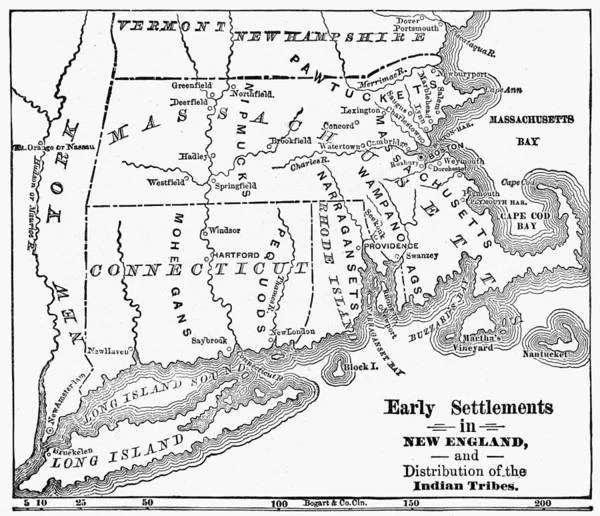
Colonial Chaos
The governance of the Massachusetts Bay Colony was in dispute from the very founding of the colony in 1628.
The Massachusetts Bay Company was chartered by the crown of England to colonize North American territory claimed by the English. In Massachusetts Bay especially the English population were almost all Puritans, with the government dominated by a small group of solidly Puritan leaders. In 1630 a group of emigrants bought all the Massachusetts Bay Company’s stock and brought the original charter to America, which meant that neither the Crown nor Parliament could any longer exert much direct influence on the colony.
The first meeting of the colony’s General Court was in October 1630. Fatefully, only eight freemen were present at the meeting. These men declared themselves the first Council of Assistants, and quickly decided that contrary to the original colonial charter they alone should elect the colony’s governor and deputy governor. In 1631 another one hundred sixteen freemen joined the General Court, but the Council of Assistants kept the power to govern for themselves. They also decided that the only men qualified to vote were men who had passed the religious examinations to become an official member of one of the colony’s Puritan churches. Dissent, especially religious dissent, was not tolerated. Anglicans, Quakers, Baptists, and others were routinely jailed or expelled from Massachusetts Bay.
This power structure fractured when the colonial government and the towns started to rancorously argue over tax collection. The General Court ordered each town to send two representatives, called deputies, to the Court, where they would settle any taxation disputes. After three years of this, the deputies, for various reasons, came to question the authority vested in the Court and the Council. The deputies demanded to examine the original colonial charter, which the Council of Assistants had literally kept hidden and inaccessible. When the deputies finally saw the charter for themselves, they realized that all freemen of the colony, not just church members, were supposed to be included in the General Court — which was meant to be the actual governing body of the colony, not the self-appointed Council of Assistants.
The deputies wanted the original charter put into action, but Governor John Winthrop pointed out that the recent influx of freemen into the colony would make for a General Court so large as to be unworkable. As a compromise, the General Court would be made up of the two deputies elected by each town. It was the very first step towards representative democracy in the colonies.
The first code of laws was formally adopted in 1641, the Massachusetts Body of Liberties, a mix of 100 civil and criminal laws mostly based on Biblical principles. It included provisions like equal protection and double jeopardy next to the criminalization of smoking tobacco, non-religious dancing, sleeping in church, and playing cards.
The governance of the colony was upended yet again the following year with the outbreak of the English Civil War. Emigration to the colony slowed, then virtually stopped. Not only did the population stop growing, it shrank as many men returned to England to fight, almost all on the side of Parliament and Oliver Cromwell’s Roundheads. When King Charles II was restored to the throne in 1660, this made for rather tense relations between crown and colony. Massachusetts Bay resisted English efforts to allow Anglican churches in their territory; to forbid the persecution of Quakers; to restrict their commerce to trade with England alone; and general efforts by the crown to rule the colonies more directly.
In the aftermath of King Philip’s War, the resiliency of the colonies inspired the King and his ministers to make the colonies official English provinces. The original colonial charter was revoked in 1684, and in 1686 the Massachusetts Bay province became part of the Dominion of New England under King James II, administered by the King’s chosen Governor, Edmund Andros. After the Glorious Revolution ended with the overthrow of James II in 1688, Andros, who was unpopular with the locals – and an Anglican to boot – was overthrown by a well-organized but bloodless insurrection in Boston in April 1689, a few months before Salem Village formally organized its first official church.
The Massachusetts colonial government was yet again re-established, but it no longer had a valid charter. Some dissenters from the old Puritan order refused to return to that old charter-based form of rule and protested in various ways, including not paying taxes. Without an organized governing body, settlements like Salem Village and even Salem Town were thrown into legal limbo. The litigious Puritans, notorious for constantly suing each other, couldn’t get their disputes settled. Instead, as 1692 began, resentments and recriminations were left to linger and fester between the Salem families.
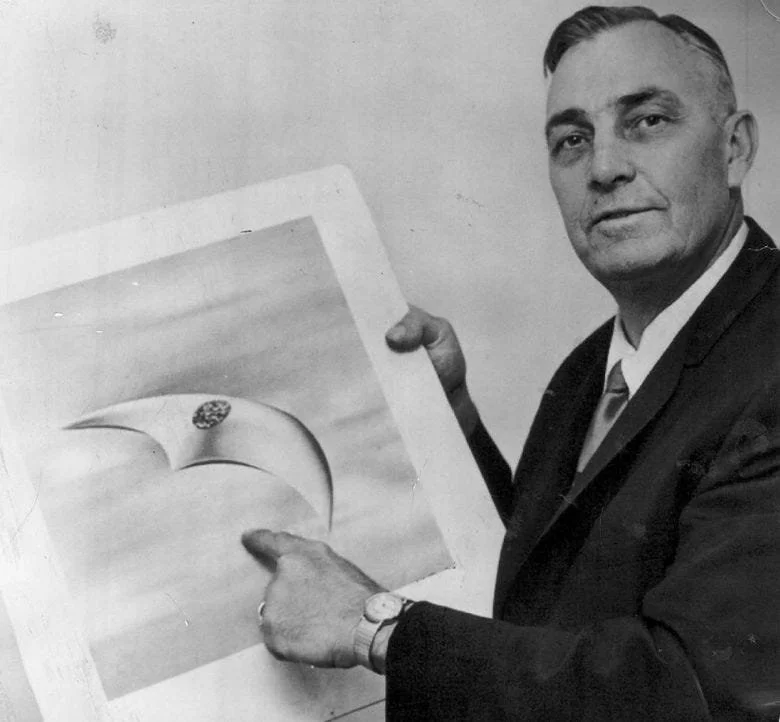
Kenneth Arnold in 1966, pointing to a drawing portraying the flying craft he saw in 1947.
Echelon Ascending
On June 24, 1947, an amateur pilot from Idaho named Kenneth Arnold was flying his small plane over Mineral, Washington. He was looking around near Mount Rainier on his way to an air show in Oregon — a Marine Corps transport plane had crashed in the area, and he was hoping to find the wreckage and claim the $5,000 reward.
Suddenly Arnold saw a flash of bright blue-ish light. He looked around for the other plane that the flash must have come from, but there was only a non-flashing DC-4 about 15 miles away. Then the light came back, this time flashing rapidly. Arnold saw nine bright objects flying in an “echelon formation,” moving in perfect unison, “like the tail of a Chinese kite.” And they were fast: it took the objects a minute and 42 seconds to travel between Mount Rainer and Mount Adams, which meant they were traveling roughly at 1700 miles per hour, three times faster than any other aircraft at that time. It occurred to Arnold that it didn’t seem like anyone was piloting them, and an “eerie feeling” came over him as he watched.
He landed an hour later, at 4:00 pm, at an air strip in Yakima, Washington. He told the staff about his strange experience, then refueled and continued on to Pendleton, Oregon. One of those air strip staffers called someone in Pendleton, and word of Arnold’s encounter started to spread. The next day, June 25, Arnold talked to a reporter at the East Oregonian paper in Pendleton, describing the movements of the strange objects. He didn’t mention it to the newspaper reporters, but he had begun to think of the objects as some kind of living organism, not flying machines at all. They flew, he said, “like a saucer if you skip it across the water.” The reporters who interviewed him were impressed by the fact that Arnold didn’t seem to be embellishing his story, let alone making it up — he was definitely a credible witness.
As the story was picked up by other newspapers and re-reported, Arnold’s description of the objects flying “like a saucer” was mutated into the description “flying saucer.” Once those reports were published, it didn’t take long for more reports of flying saucers, or unidentified flying objects, to appear. In 1947 alone, there were over 850 reports of flying saucers, from almost every state in the US and some from Canada. On July 4, a United Airlines flight crew saw another group of nine UFOs over Idaho, the first major sighting after Arnold’s.
Four days after that, a press release was sent out by the 509th Operations Group of the Eighth Air Force. The press release said that the group had recovered a craft that had crashed on a ranch in Roswell, New Mexico, a craft that was a “flying disk.” The Commanding General of the Eighth Air Force later issued a statement contradicting the earlier press release; he claimed that what crashed in Roswell was just an experimental weather balloon…
Disoriented by nuclear-age technology, frightened by the bomb, deep in Cold War fear of both the Russian government and their own leaders, the American public started seeing UFOs with alarming regularity. The US Air Force instituted Project Sign to investigate these reports, followed by Project Grudge in 1949 and Project Blue Book in 1952. By that time, UFOs had become a trope in American books, movies and television, as well as an entire new mythology built around flying saucers, with associated public speakers, writers, promoters, reporters, and true believers. Project Blue Book collected and analyzed over twelve thousand six hundred reports of UFO sightings; in most cases, they found that the sightings could be explained as natural phenomena, conventional aircraft, or, in many cases, CIA reconnaissance aircraft, especially the U-2 and A-12 planes, which flew above 60,000 feet, well above the 10 to 20,000 feet of commercial airliners in the 1950s.
Even after this analysis, however, there were still a small percentage of UFO reports that remained unexplained. But since there was never any evidence of these being extraterrestrial vehicles, let alone a threat to national security, the project was shut down at the end of 1969. As of now, the US military uses the Unidentified Aerial Phenomena Task Force, which mostly studies the many strange encounters of Navy pilots from the last 20 years. Their research and findings are so classified few Americans know the task force even exists, let alone its findings. This is mostly because the scant footage and other evidence suggests these sightings can mostly be explained away as high-tech unmanned drones or other craft. On the other hand, there have been confirmed sightings, Navy personnel took two videos years apart, on opposite coasts, of similar objects flying through the sky, visible through night vision goggles. The task force is confident these were both drones. The crafts were both triangle-shaped, supposedly an illusion caused by light passing though the night vision goggles, then being recorded by a SLR camera. It’s worth noting, however, that these UFOs has the same shape as the echelon seen by Kenneth Arnold in the 1940s.
The number of sightings worldwide has continued to decline since the 1970s. In 2017 it reached a record low point worldwide, though the US still has 300 times the global average of UFO sightings. It seems that Americans are seeing few flying saucers anymore, though sightings of strange lights in the sky have recently increased. No one knows why.
Continued in Part 4.
Under an Evil Hand, Part 2
The Salem Witch Trials begin, King Philip's War, and the original Satanic Panic of the 1980s-1995.
Note: this was originally posted to my Substack on September 29, 2022. I deleted my Substack a couple years ago and I’m posting these pieces here so they don’t get lost.
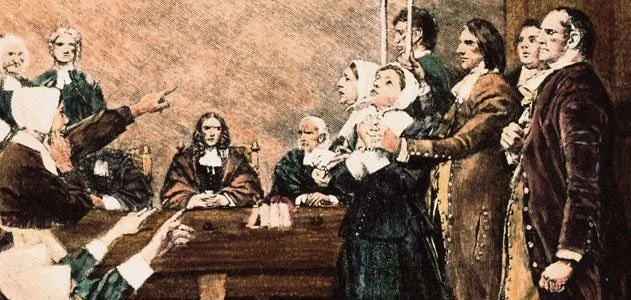
Fear in Salem Village
On March 1, 1692, the Magistrates John Hathorne and Jonathan Corwin began interrogating the accused witches, starting with Sarah Good. The interrogations took place in public at the Salem Village meetinghouse, with most of the Villagers in attendance along with the four accused.
Going by an old Massachusetts law defining a witch as one who “hath or consulteth with a familiar spirit,” Hathorne asked Sarah Good: “What evil spirit have you familiarity with?” “None,” she replied. “Have you made no contract with the devil? “No.” “Why do you hurt these children?” Sarah Good continued to insist that she was innocent.
Finally Hathorne turned to the four girls, the accusers, who were seated together. Look at Sarah Good, Hathorne said to them, and see if she was the person who hurt you. Yes, they said, it was her, as they fell into tormented fits. It wasn’t me, Sarah Good cried in fear and anger, it must be Sarah Osborne, she’s the one attacking those girls. The transcripts indicate that Sarah Good was by turns enraged and sarcastic in her responses; but now even her own husband, William, wondered about her innocence.
Sarah Osborne was next. She was asked the same questions, and gave the same responses. She was told that Sarah Good had accused her of tormenting the children. “I do not know,” she said, but “that the devil goes about in my likeness to do any hurt.” Hathorne asked the four afflicted girls asked to look at Sarah Osborne, and again they screamed and cried out. Then suddenly some of the Villagers spoke up. Someone noted that she hadn’t been attending church lately. Someone else said that Sarah Osborne had once seen a thing that looked like an Indian, all black, that had grabbed her by the neck; or maybe Sarah had dreamt it?
Finally it was Tituba’s turn to be interrogated by the Magistrates, who didn’t know that Samuel Parrish had beaten her until she agreed to confess to being a witch. The devil, she said, had appeared to her and commanded her to serve him; she tried to resist, but he sent his emissaries to frighten her into doing his will. She had seen Sarah Good and Sarah Osborne hurt the children, along with the specters of two other women, and a man from Boston. Sarah Good had a familiar, a yellow bird that sucked blood from between her fingers. Sarah Osborne had two familiars, a thing with a head like a woman with two legs and wings, and a short, hairy creature that walked like a man.
The girls listened to Tituba’s confession in silence. When she finished they once again cried out in torment; Betty Hubbard had “an extreme fit”. They all agreed that Sarah Good was guilty; Tituba complained that Sarah Good and Sarah Osborne were attacking her at that very moment, preventing her from saying anything more.
That night, Sarah Good was jailed at the house of the constable. Betty Hubbard was recuperating at the house of her master, the doctor William Griggs, when she cried out in fear; she saw Sarah Good’s apparition standing on a table staring at her. A local man named Samuel Sibley who had been watching over Betty, rushed in to help. He saw nothing, but he struck out with his staff at the space above the table where Betty said she saw Sarah Good’s spectral form. That same night some Villagers saw Sarah Good lurking in Salem Village, free from her captivity. They told the constable but he found Sarah still locked up in his house; the constable’s wife, however, noticed that Sarah’s arm was bloody, in the same spot, it occurred to her, where the specter of Sarah Good had been struck by the staff of Samuel Sibley at the house of William Griggs earlier that night.
Over the next few days the Magistrates interrogated Tituba in jail. She said she had given in to the Devil and signed his book with a mark in her blood to join his legion; then the Devil showed her the marks of Sarah Good and Sarah Osborne. There were nine signatures in all. Word of this reached the Villagers and there was no doubt: the Devil had come to Salem Village, and he was there to do the Devil’s work. And they wondered: who else among them had signed the Devil’s book?
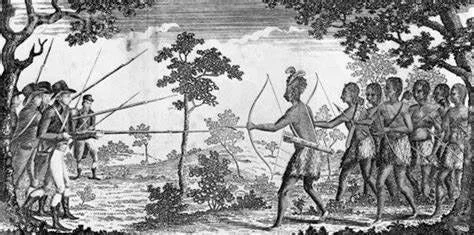
Death in Massachusetts
If the Pequot War was a crisis for the English Puritans, King Philip’s War was a catastrophe.
The war was started by the Wampanoag chief Meatcom, the second son of Massasoit. Massasoit had good relations with the Pilgrims (the English settlers who arrived on the Mayflower) and in those better days Metacom had adopted the English name “Philip”. But those days were long gone by the time Metacom became chief in 1662.
The Europeans kept settling on indigenous lands, leading to a constant state of tension. The spark was struck in 1675, when three Wampanoags killed an Indian who had converted to Christianity; in response, officials in Plymouth Colony captured the three men and hung them. This incident prompted the Wampanoags and other tribes to form an alliance to push back against the European invaders. Metacom’s forces attacked, raided, and ambushed the colonists again and again, while the colonists fought back just as violently.
In December, Metacom moved north and set up his winter camp in New York, where he hoped to enlist the aid of the Mohawk against the colonists. But the Mohawk had refused to help. Then, in February 1676, the Mohawk ambushed 500 of Metacomet’s warriors and killed most of them. It was the beginning of the end. Metacomet withdrew back to New England to continue his war into the spring of 1676, but even though his warriors could infiltrate deep into Colonial territory -- assaulting Plymouth Colony, burning Providence to the ground – it was too late for the Wampanoags to annihilate the English. It had always been too late. Smallpox, typhoid, measles, and spotted fever brought by the earliest European settlers decades earlier had wiped out most of the Algonquian population, so that by 1676 there were only about 2,500 warriors in Metacomet’s forces, compared to about 16,000 colonial militia.
By July 1676 Metacomet’s coalition was breaking up and hi allies were leaving him. He knew the war was lost, so he went back to where it began, hiding out in the Assowamset Swamp south of Providence. On August 12, he was tracked down by colonial rangers and shot by a Christianized Indian named John Alderman, who later received Metacomet’s severed hand as a trophy. Metacomet’s corpse was drawn and quartered; his limbs were hung in trees to rot. His severed head was mounted on a pike at the entrance to Plymouth where it was prominently displayed for more than twenty years. His widow and child were captured and enslaved.
The fighting continued in northern New England for two more years, ending in 1678. By the end of the war more than half of the towns in the New England Confederation had been attacked; twelve were completely wiped out. The colonists were literally decimated – one tenth of all men available for military service had been killed. The colonial economy almost collapsed. Even if the English crown had been interested in aiding its colonial subjects, they were an ocean away.
The colonies managed to survive and rebuild on their own. The brutality of King Philip’s War had changed them. They had been through terrible suffering, and inflicted horrible suffering in return; the violence marked them as a separate people, still English, still subjects of the Crown, but with a new identity just beginning to take hold. And there were still violent incidents between the colonists and the Native peoples. Tensions between New France (now Canada) and the English settlers in the 1680s led to open warfare between the French and their Wabanaki allies and the English and their Iriquois allies in 1690. Again, whole towns were destroyed and hundreds killed. The district of Maine was almost emptied of English settlers as they fled deeper south into Massachusetts to escape the attacks. On January 25, 1692, hundreds of Penobscot Wabanakis raided the town of York in the district of Maine. They destroyed the town, killed about 100 colonists, and captured at least eighty, who were forced to walk to New France where they were ransomed. The attack stunned the New England colonists, who called it the Candlemas Massacre.
A week earlier, Abigail Williams and Betty Parris had fallen into fits at the house of Samuel Parrish.
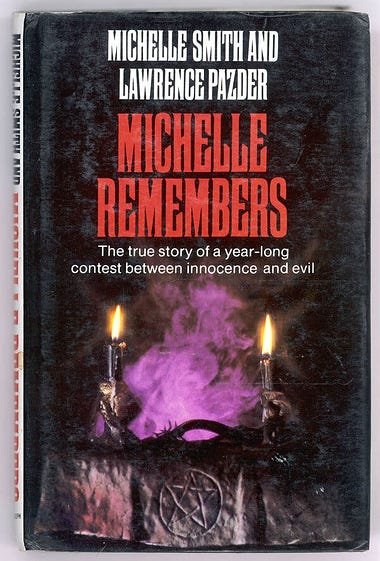
Satan in America
The book Michelle Remembers was published in 1980. It was co-written by Michelle Proby under the pen name Michelle Smith, along with her psychiatrist, Lawrence Pazder, whom she later married. It was framed as Smith’s autobiography, but it really consisted of Smith’s tales of horrific physical abuse at the age of five at the hands of a satanic cult based in Victoria, British Columbia, Canada, between 1954 and 1955. Smith had repressed these memories, but Lawrence Pazder extracted her stories in the course of 600 hours of hypnosis over 14 months, during which they also became romantically involved. The final memory was of an 81-day-long ritual that summoned the devil himself; Jesus and the Virgin Mary appeared in person to stop it, and the Archangel Michael removed Michelle’s physical scars - received over the previous year – and blocked her own memories of what she had suffered, explaining why she had not recalled it earlier.
The book garnered national press coverage and sold well. The term “ritual abuse,” coined in the book, entered the popular discourse, and Pazder became a recognized authority in the new field of Satanic ritual abuse investigation. Pazder and others promoted the idea that this Satanic ritual abuse was the work of a worldwide conspiracy of evil abusers; the fact that there was never any evidence to support this claim simply showed how powerful and far-reaching the conspiracy was.
A fear of an evil network of child abusers took root in the American suburbs of the early 1980s, which were designed to be racially, politically, and culturally homogenous – they were overwhelmingly white, conservative, and Christian. At the same time, new laws mandating the reporting of child abuse had begun to show just how widespread child abuse was in these communities. Rather than confront the awful reality - that the abusers were the husbands, male relatives, teachers, coaches, pastors, and youth leaders whom parents had trusted with their children – the parents preferred to blame an evil conspiracy working in the shadows. Not only did this play into the natural fear that parents have for their children’s safety, it dovetailed with a rising tide of fundamentalist and Evangelical Christianity that preached warnings of widespread demonic and Satanic influence in the government and popular culture.
A turning point came in 1983, when Peggy McMartin and Ray Buckey were charged with ritually abusing the children at their preschool. Despite the lack of evidence, the intense media coverage, and the ensuing public fear, triggered a wave of accusations against over a hundred preschools across the US. In 1987, the journalist Geraldo Rivera devoted an episode of his popular television show to Satanic ritual abuse, claiming that there were “over one million Satanists … linked in a highly organized, secretive network.” People like Lawrence Pazder and other self-appointed experts traveled the country making numerous presentations to church groups, law enforcement officers, parents groups, and psychology conferences; they often used the Geraldo Rivera episode in the course of their talk. This triggered a large movement among police, social workers, therapists, and clinicians to investigate claims of Satanic ritual abuse. In 1989, Oprah Winfrey interviewed Michelle Smith and Lawrence Pazder on her popular talk show; Sally Jesse Raphael did two programs on the topic.
But the actual evidence of Satanic ritual abuse never appeared, despite hundreds of investigations. The McMartin case resulted in no convictions after a three-year trial. The book Michelle Remembers was discredited when it was found that many of the things Michelle Smith described in the book either didn’t happen or couldn’t have happened. By the early 1990s the public had begun to turn skeptical. A 1992 report by an FBI agent found no credible evidence for a single case of ritual abuse. In 1994, the National Center on Child Abuse and Neglect, under the federal Department of Health and Human Services, released a report also finding no evidence of ritual abuse. Psychologists and other mental health workers who studied the ritual abuse cases found that the methods used by forensic investigators to elicit stories of abuse from the children were suggestive at best and coercive at worst.
In 1995, HBO aired the film Indictment: The McMartin Trial, portraying the McMartins as victims of overreaching prosecutors and media hype. The popularity of the film signaled the shift towards skepticism in the general public towards ritual abuse claims. By 2000, most prosecutors no longer took these claims seriously. Lawrence Pazder died in 2004, shortly after it came to light that all along there had been, in plain sight, an actual wide-ranging network of serial child abusers protected by powerful individuals and secretive institution — not based in Satanism, but in the Catholic Church and various Protestant denominations.
To be continued in Part 3.
Under an Evil Hand, Part 1
The origins and first days of the Salem Witch panic; the Clown Sightings of 2016 and beyond.
Note: this was originally posted on my Substack on Sep 22, 2022. I deleted that Substack a couple years ago and I’m posting these pieces here so they don’t get lost.
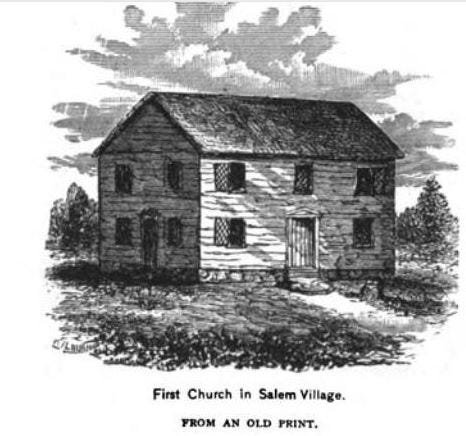
The Devil Rides to Salem Village
In the cold mid-winter of 1692, in the middle of January, in the house of the Reverend Samuel Parris, in the Puritan settlement of Salem Village in the Massachusetts Bay Colony, a young girl - about eleven or twelve years old - was sick. Her name was Abigail Williams. Apart from her name, and the fact that she was probably Reverend Parris’s niece, we know almost nothing about her. We know her sickness was strange and terrifying, and apparently contagious; soon Betty Parris, the Parris’s daughter, also fell ill with the same strange sickness. A visiting clergyman named John Hale said that the two girls were “bitten and pinched by invisible agents, their arms, necks, and backs turned this way and that way, and returned back again, so as it was impossible for them to do of themselves, and beyond the power of any epileptic fits, or natural disease to affect … Sometimes they were taken dumb, their mouths stopped, their throats chocked, their limbs wracked and tormented.”
For weeks Samuel Parrish and his wife Elizabeth consulted various doctors, but none could help, while the girls only got worse. In the middle of February a doctor named William Griggs proclaimed that the children were, as he put it, “under an Evil Hand.” They were victims of witchcraft. This was humiliating to Reverend Parrish, because it implied that he, the spiritual leader of Salem Village, was not pious enough to keep the devil away from his own home.
Revered Parris was not well-liked in Salem Village. He often preached about the importance of church membership when three-fourths of the Villagers were not full church members. The Puritans believed that only God’s chosen, the elect, should be church members, so members of the community had to apply for church membership. Every applicant had to personally testify to their own experience of God, writing out their own story of conversion in an autobiography. The organized church in Salem Village only had 27 members, including Samuel Parris - an exclusive group. The other Villagers had to leave the meetinghouse after the sermon was over; on sacrament days, they couldn’t get their infants baptized unless they had at least one parent who was a church member; they weren’t even considered full citizens within the colony. By 1691 the Villagers were fed up with Parris. They stopped contributing to his salary, they stopped supplying him with firewood, they tried to get him removed from the church. And when they heard that the devil himself had infiltrated the Parris household, they believed it.
A woman named Mary Sibley lived near the parsonage and saw in person how the children suffered. But instead of fasting and praying to God, she decided to fight magic with magic. The Parris family had two slaves, both American Indians, a couple named Tituba and John. Mary Sibley told them to make her a witch cake - a cake mixed from rye meal and urine taken from the two girls, Abigail Williams and Elizabeth Parris, then baked in ashes. Mary believed that if she fed it to the Parris’s family dog, the identity of the witch afflicting the girls would be revealed… and it worked. After the Parris’s dog ate the witch cake, the girls cried out that the witch was Tituba herself, “she did pinch, prick, and grievously torment them … they saw her here and there, where nobody else could.”
Samuel Parris was stunned, angry, and confused. He went to other ministers and local men for help. They agreed the girls were bewitched and they advised him to pray and be patient. But they also questioned Tituba herself. She was not from New England, but probably from Florida or the Georgia Sea Islands, and she claimed that while “she herself was not a witch” her “mistress in her own Country was a Witch” and had taught Tituba some good magic. By the time the local authorities learned all this, two more girls had come down with fits. One of them was Ann Putnam (usually called Ann Putnam, Junior), the twelve year old daughter of two church members, Thomas and Ann Carr Putnam. The other was Betty Hubbard, the maidservant of doctor William Griggs, the same doctor who said that Abigail Williams was “under an Evil Hand.” She was also seventeen years old, which meant that (since she was over fourteen) she could legally testify in court.
What the girls were saying was truly frightening. Not only Tituba but two other women in Salem Village were witches - Sarah Osborne and Sarah Good. Sarah Osborne was 49; after her first husband died she married a young servant man and purchased his indenture, which was considered scandalous; then she got involved in a prolonged dispute with the father and uncle of Thomas Putnam, the father of Ann Putnam, Jr. Sarah Good was 38, from a well-off family but now poor herself; she was known to be bitter from two bad marriages and an inheritance that was unfairly withhold from her, angry with even those who tried to help her. Other Villagers had always suspected that she used evil magic to bewitch her neighbors and their livestock; now it seemed they had proof. On February 29 based on formal complaints from Thomas Putnam and three other men, Magistrates John Hathorne and Jonathan Corwin issued arrest warrants for Tituba, Sarah Good, and Sarah Osborne.
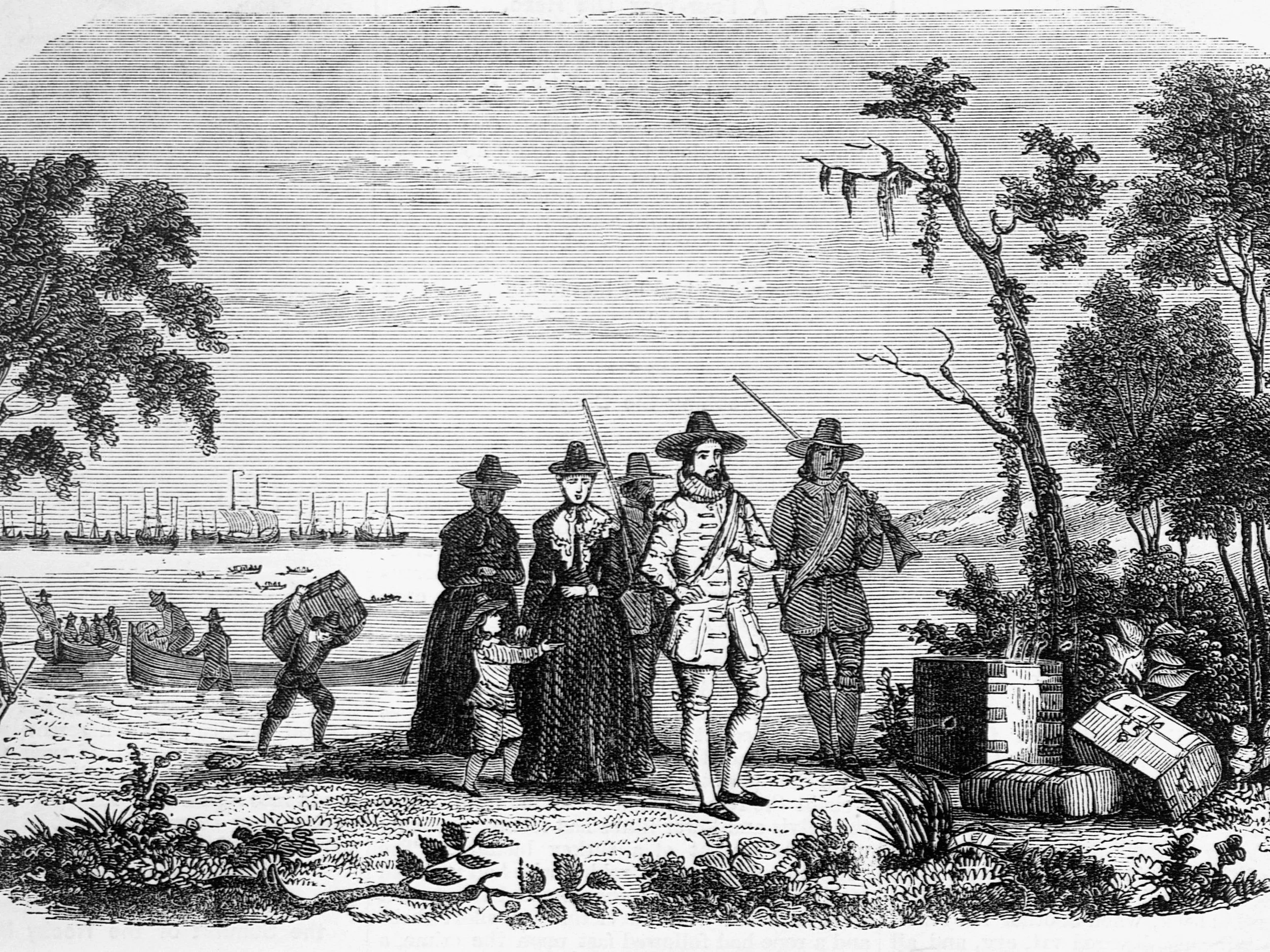
The Puritans Land in Massachusetts
When the first English Puritans arrived to create the Massachusetts Bay Colony in 1628, they knew that the land was already occupied by others. The Wabanaki, the Mikmak, the Passamaquoddy, the Maliseet, and other indigenous peoples had lived there for at least twelve thousand years. But the Puritans wanted to serve their God by founding a new land for his elect few - the true church. The investors of the Massachusetts Bay Company were, of course, concerned with profit. Unless they could be converted or forced to work for the colonies, the original occupants were an inconvenience. The American Indian population had been decimated by smallpox, brought by the first Europeans years ago. Too weak to push the Puritans back into the sea, they tried to find some advantage in their presence, especially through trade. It must have seemed the Puritans had come to extract resources to send back across the water – in Massachusetts Bay they took timber and dried fish to send to the West Indies and Europe. Perhaps the Wabanaki and their neighbors thought there was surely a limit to the amount of trees and cod that any one people could want; besides, the land was bountiful and there was enough to go around. But the appetite of the European empires was insatiable. The more they ate, the larger they became, so that their hunger only grew.
More settlers came to Massachusetts Bay only to find the early settlements like Boston and Salem had become thriving port towns and had no room for them. The local government would grant new land for new towns about 40 acres at a time, always next to an existing town for mutual support and protection. So the Puritans kept moving inland, along with the Dutch and other colonial settlers, pushing into what had been Native American territory. At the same time, the Pequot people were fighting the other American Indians to consolidate their political and trading power in the Connecticut River Valley.
In 1636 a series of violent incidents between the Pequots and the settlers became a war of raids between the two sides. The Pequots besieged Fort Saybrook until they were driven off by an alliance between the English, the Mohegans and the Narragansetts. On May 26, 1637, the English and their Indian allies attacked the Pequot fort in the village of Mistick. Almost 500 Pequot men women and children were burned alive inside the fort by the soldiers. The Pequot war ended soon after, with the English victorious. Even before the fighting, the English settlers had begun to shift the government of Massachusetts Bay from a trading company controlled by a small board of directors and run like a corporation towards something more democratic. Now they had a new sense of identity. In their minds, God had chosen them to win against the Pequots, just as he had chosen them for spiritual salvation. John Mason, one of the English leaders, wrote in his account: “the Lord was pleased to smite our Enemies in the hinder Parts, and to give us their land for an Inheritance.” These inheritors took their victory as proof of their righteousness. And events seemed to prove them right: there were years, then decade of peace between the English and the Indians. Until 1675.
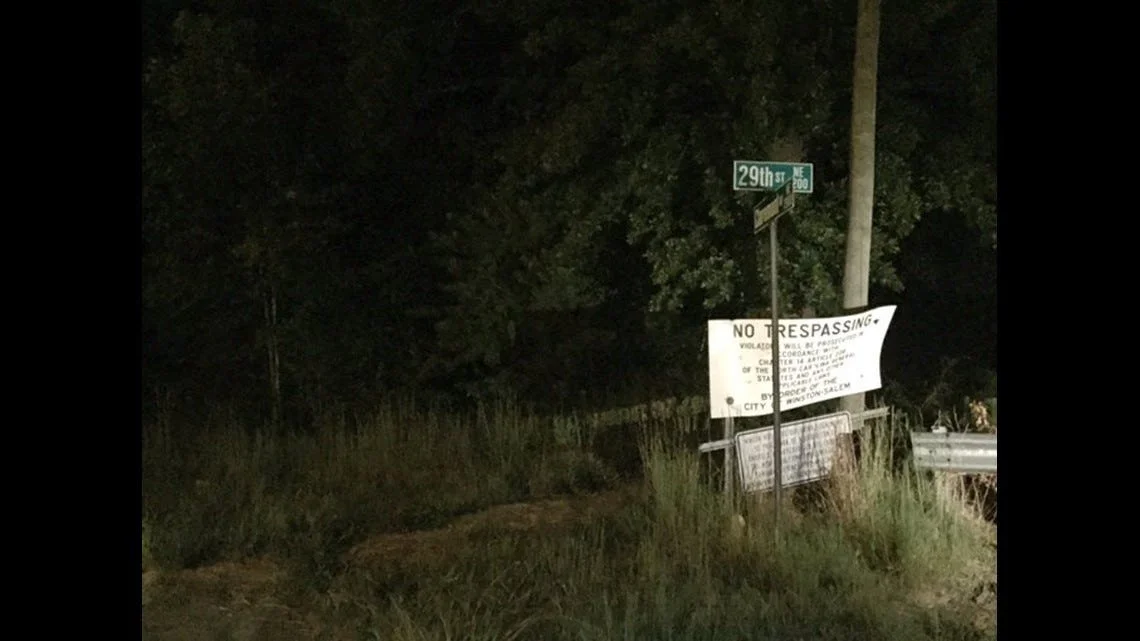
Greenville County, South Carolina, during the time of the 2016 clown sightings.
The Clowns Creep in Carolina
Around 8:30 PM, on August 21, 2016, a nine year-old boy in Greenville County, South Carolina was walking along a man-made trail that cut through the woods near his home. As he walked down the trail he suddenly came upon… clowns. They were whispering to each other and making strange noises. Terrified, he ran back home and told his mother. She didn’t believe him, of course, so he led her to the spot where he had seen the clowns - and she saw them. They flashed green laser lights at her then ran away into the dark woods. Meanwhile, back at their house, the woman’s older son heard noises outside their front door, sounds like chains being dragged, then someone banging on their door.
When the woman got home she called the police, who dutifully took down their descriptions. The deputy assigned to the case decided to ask around to see if anyone else in the Fleetwood Manor Apartments saw anything strange that night. One woman said that, come to think of it, she had seen a clown outside around 2:30 AM on the morning of August 21. The police report says that he was “a large-figured clown with a blinking nose, standing under a post light near the garbage dumpster area,” who “waved at her, and she waved back.” Some local children told the police that clowns would sometimes come out of the woods and offer them money to entice them to go with them. All the kids knew the clowns lived in a house on the edge of the pond at the end of that trail that cut through the woods. Deputies searched the house repeatedly but found nothing. They never found any evidence of any clowns.
Maybe that would have been the end of it. Then three days later the property manager for Fleetwood Manor Apartments posted copies of a letter on all the doors. It warned them to be careful, watch out for your children, call the police if you see anything suspicious. A few days later there were two new sightings in two other apartment complexes not far from Fleetwood Manor; a 12 year old girl told police she saw a man taking pictures of children, with another man wearing a black jacket and a clown mask; another child saw a man in a clown costume and their parents called 911. The following night, another sighting, this time at Shemwood Apartments; this time the children chased two clowns, who broke through a wooden fence and jumped in a waiting car, where another clown drove off in a black Honda. The next evening a girl walking home from school saw a clown lurking in the woods by a local school; at the same time someone at the Park Haywood apartments saw a clown in the complex’s laundromat; he was a middle aged man with his face painted white, a red line around his mouth, a white swimmer’s cap on his head with red hair poking out the sides, smelling of house paint, just standing and staring. T
here was never any surveillance footage, no physical traces left behind. One woman tried to take a picture, but it was too dark to make out. The police investigation continued, and community leaders held a press conference to plead for caution and safety. The sightings continued through September, and then in early October, sightings were reported in Canada, then United Kingdom, then Australia, New Zealand, Singapore, Latin America. By mid-October there were numerous sightings in almost every US state, most of Canada, and 18 other countries. But there was still no evidence. It seemed to be building to a climax at Halloween, October 25, when the clowns would all emerge from their shadowy places at the same time to do something terrible. But almost nothing happened. There was no clown invasion. This wave of clown sightings, the latest since they started around 1981, was over.
Continued in Part 2.
Archives and the Fruits of Crime
Short stories about malfeasances of memory
Note: this was originally posted on my Substack on September 9, 2022. I deleted that Substack a couple years ago and I’m reposting these so they don’t get lost.
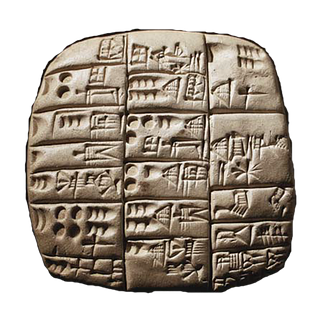
Ancient Sumerian clay tablet. The earliest of these were created about 3200 BCE. The vast majority of them are financial records. So many were created that about half a million to two million have survived to the present, though only about 10,000 have been translated.
Stairway to Heaven
From 2011 to 2019 I taught a class called Introduction to Archival Management and Services (i.e. Archives 101) at the Simmons University College of Organizational, Computational, and Information Sciences. Most of my job was trying to keep the exhausted grad students alert from 6:00 to 9:00 PM once a week. The capstone assignment was the “Process Yourself Project.” Each student chose material that they created or owned; this was their collection. The had to take these items and write a finding aid for it — an overall description that a hypothetical patron would use to access their collection. It was a way for them to show their ability to appraise, organize, and describe documents and artifacts from their own life history. Usually archivists never meet the donors of any given collection; in this case the student was the donor. For some students the experience of going back over the traces of their lives was profound — they were mostly in their in their 20s, used to facing forward not looking backwards.
I was flexible about what constituted a “collection,” as long as they could write a finding aid and provide context I would accept it. One student wrote a whole finding aid about his Magic: the Gathering card collection. Another student asked if she could catalog her father’s collection of Led Zeppelin vinyl record albums. Her father had recently died and the two of them had been re-connecting the last couple years, bonding over his favorite music. Make sure to give the context, I said. Give the release years, catalog numbers, etc., but let people understand why this collection exists, what it means to you. Make them comprehend how these songs are the sounds of your memories.
Bring it On Home
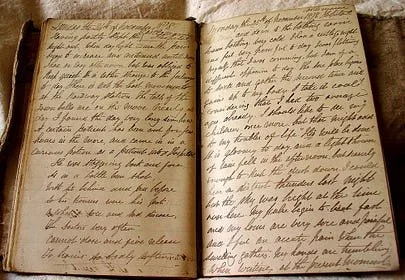
One of 25 diaries of Joseph Jenkins (1818-1898), a Welsh farm laborer who immigrated to Canada, then returned to Wales. His writings, in English and Welsh, include both his poetry and his detailed everyday observations. Original at State Library of Victoria, Canada.
At the repository where I work most of the collections are based around individuals, what we call “personal papers.” Archival repositories in general are built to house institutional records and want little to do with personal papers. The problem with personal papers: archives use standardized language to describe their material the way libraries do. But applying a set of standard bibliographic categories to a bound volume — a tidy packet of information — is one thing. Any given letter might touch on numerous different subjects; what is it “about”? A diary might include observations about the weather, important appointments, pressed flowers, quotes from other writers, or all or none of those.
Cataloging always conceals as much as it reveals. This slipperiness is a problem for the students and historians who try to study material culture and, in the words of E.P. Thompson, “history from below.” Letters, diaries, mementos, and other “non-records” are exactly what these scholars are looking for, but because they’re difficult to describe they’re difficult to find. Everybody wants archivists to digitize as much as possible of this kind of material because in theory it’s easier to access. But that doesn’t solve the description problem, and it often makes it worse. “Digitizing personal papers” usually means disaggregating material that has been physically grouped together — often by the creator and/or donor, so that the arrangement itself can be significant context — into numerous discrete digital objects, each of which each needs a base level of decent-quality descriptive metadata in order to be discoverable by online search and browse functions. The limited access of personal papers isn’t just analog vs. digital, it’s the limits of descriptive language and even language in general.
In My Time of Dying
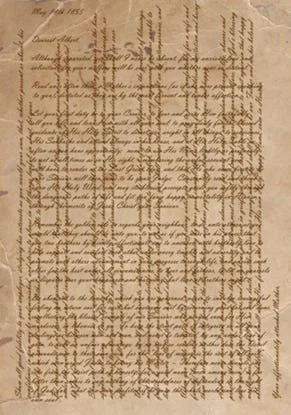
An example of cross-writing from the mid-19th century. This was done to save on the cost of paper and postage.
Archivists who work with the collections of individual people are professional hauntologists. We deal in traces left behind by people who mostly never imagined the surviving evidence of their existence would be boxed, cataloged, and curated. Personal papers can include quotidian objects everyone accumulates: diaries, journals, photo albums, letters, postcards, souvenirs, children’s drawings, maybe a pocket watch, some clothing, family Bibles, mementos and “ephemera.” One of our collections includes two bullets (possibly) dug out from the corpse of a soldier killed in World War I, kept by his grieving mother. Inhabiting this residue is like looking into a little abandoned room. Processing a whole collection can feel like temporarily possessing someone else’s body.
Institutional records on the other hand are selectively chosen and carefully pruned by archivists and records managers. “Personal” records, i.e. anything created by an individual for their own private use, are weeded out as much as possible. It’s not always an easy call to make but the policies and procedures for stewarding these records are standardized and comprehensive. Trouble creeps in when you can’t distinguish between personal and institutional records — when a person is the institution — like the Executive Office of the President.
Houses of the Holy
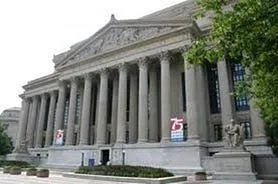
National Archives and Records Administration, Washington DC. NARA was created by FDR in 1934, expanded under the General Services Administration in 1949, and became its own agency in 1984.
Most US Presidents since Franklin D. Roosevelt have donated their papers to the US in the form of Presidential Libraries, a system started when FDR donated his records in 1939. Every President from Hoover through Obama has their own Presidential Library. Most Americans think that (a) this donation is compulsory; (b) the libraries are, for the most part, politically neutral, designed to teach history, not propaganda. Neither of these are true.
Prior to the Presidential Records Act of 1978, all Presidential records were legally the private property of that President. FDR could have kept his papers to himself, but he decided to donate them to the National Archives and Records Administration. This set a public precedent for the next few Presidents, though privately they more or less hated it.
This gentleperson’s agreement was torched by Richard M. Nixon. On his way out the door from his resignation in disgrace he decided he would use his papers’ status as his personal property to keep them for himself and mostly destroy them. Congressional legislators realized they had no way to stop him so they hurriedly passed the Presidential Recordings and Materials Preservation Act of 1974, which only applies to Nixon’s papers. The PRA was broader, converting all Presidential records from public to private and ensuring at least some public access to inactive records using the 1966 Freedom of Information Act (with the usual nine exceptions). The specific procedure for transferring the records wasn’t fully codified until 1989 by Reagan administration. George W. Bush’s administration struck this down in November 2001 and replaced it with an order locking down both Presidential and Vice Presidential records, in line with their general disdain for public access. Obama reverted the PRA back to the Reagan guidelines in 2009, which meant material that had been declassified under Reagan and re-classified under W was again declassified.
Presidential papers might be public records but Presidential Libraries aren’t public institutions. When Truman decided to follow FDR’s example with his own papers, his administration created a system whereby private endowments front the money for the library building while civil servants preserve, catalog, and administer access to the actual records. The exhibits are also determined by the private foundations, which by definition are set up by supporters of the various Presidents. This leads to some straight-up propaganda like the “Decision Points Theater” exhibit in the George W. Bush library. The exhibit gives you various Presidential choices to make and shows you the potential consequences of your decision, along with what GWB actually did; if you decide that going to war in Iraq was the wrong choice, the exhibit responds with “sorry, wrong answer! Try again!” So you can imagine the bullshit that will fill the Trump Presidential Library.
(As a side note, trying to get access to the records of the Office of Presidential Libraries is practically impossible, despite those records being public. The OPL didn’t want their records subject to NARA’s retention schedule, so they just stopped sending them to NARA circa 1964. That puts them in the category of “operational” records and thus unavailable to the public.)
Trampled Under Foot
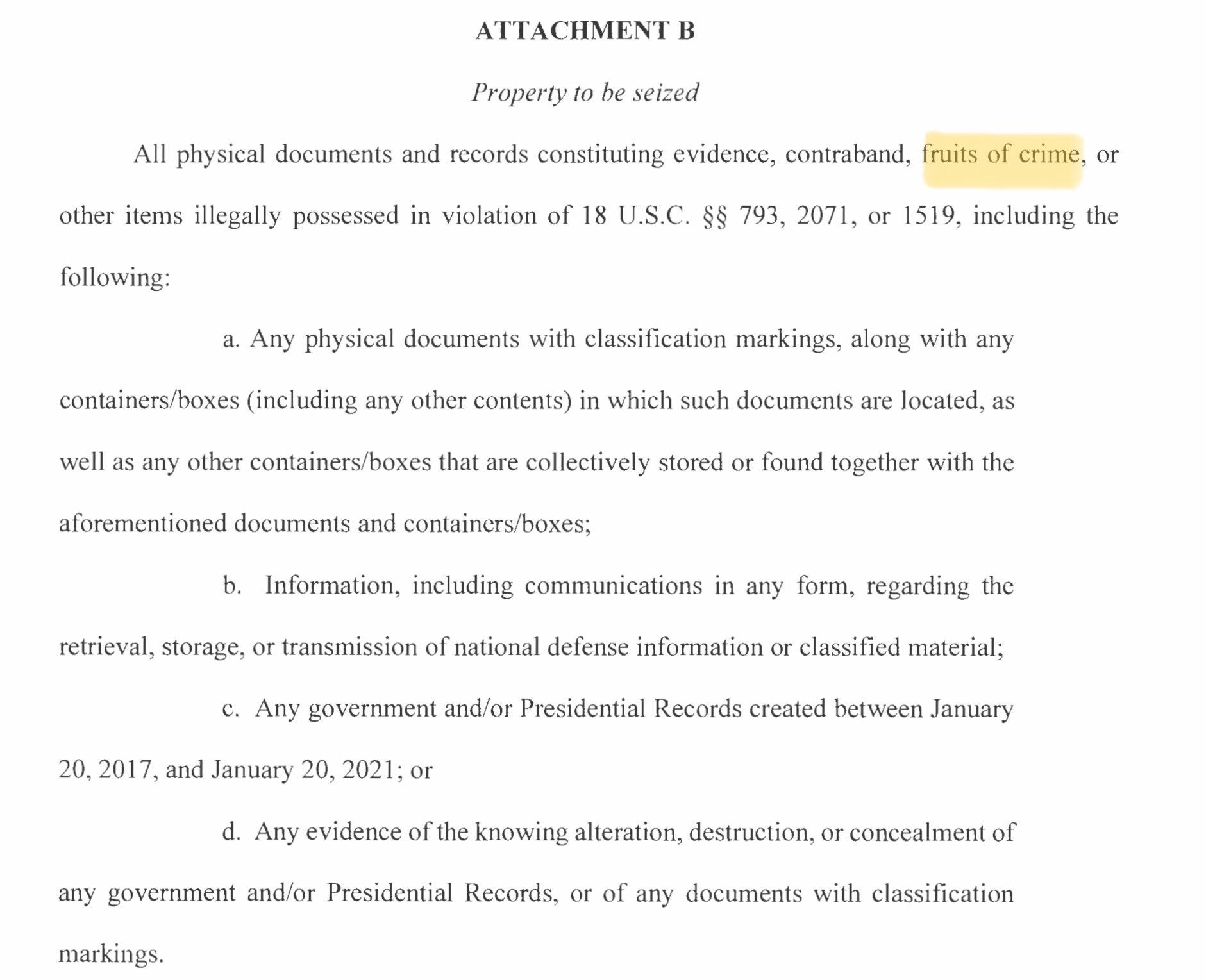
FBI search warrant for Mar-a-Lago, August 11, 2022.
What makes Trump’s attitude towards his Presidential records is, as usual, his brazen honesty about the fact that the American Chief Executive is bound by no rules. When he was done reading a memo, a letter, or anything else, he would rip it up and throw it on the floor or sometimes in the trash. We now know he would flush papers down the toilet, despite his lies to the contrary. This was obviously against the PRA but to say that Trump didn’t give a damn is an understatement.
His aides are always happy to enable Trump so they scooped up his refuse and sent it to NARA, where it was the thankless job of two NARA records management analysts, Soloman Lartey and Reginald Young, Jr., to literally Scotch tape the fragments back together so they could be filed. In Spring 2018 they were both fired without warning; maybe Trump or his people realized what they were doing they told NARA’s head of human resources to get rid of them. But maybe they were just victims of the 2018 purge of civil servants by Trump.
Good Times, Bad Times
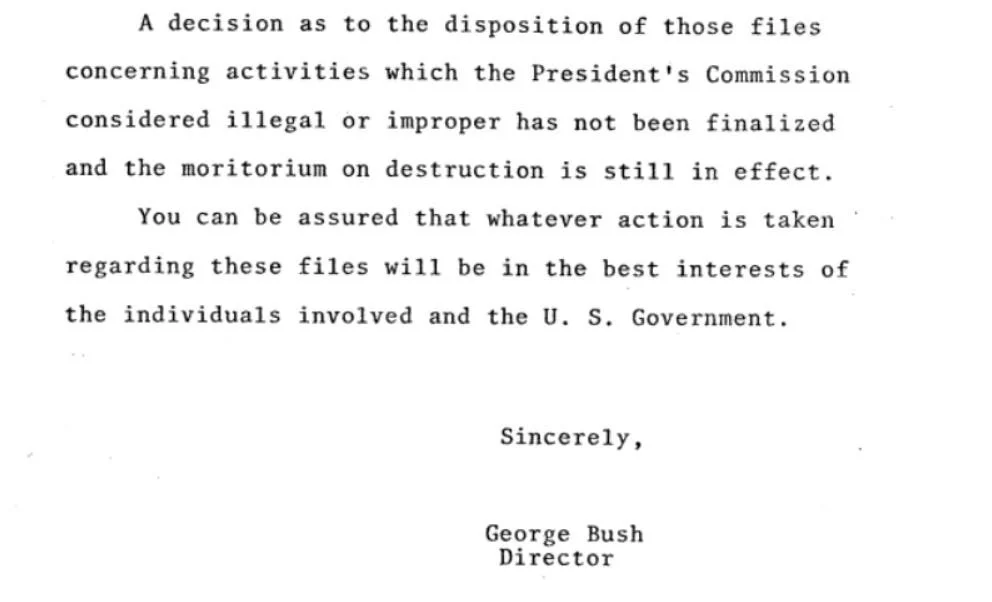
Draft memo by CIA Director George H.W. Bush, 1976. Bush was responding to Bella Abzug’s concern about the CIA purging its records. The Agency rewrote this to say the CIA would act ““in accordance with Presidential directives and as permitted by law” but this memo reflects their actual proprietary stance towards their own records.
Trump isn’t the first President to bury or destroy his own records. It’s common knowledge by now that Warren G. Harding was a sex maniac; his family managed to keep Harding’s letters to one of his mistresses under seal for as long as they could. When Republicans howled over Hillary Clinton’s private email server during her run, Democrats retorted that nobody in the GOP cared when George W. Bush’s staff deleted about 22 million emails instead of sending them to NARA. When NARA’s security office told Dick Cheney to hand over his Vice Presidential records, Cheney ignored them, then decided it would be simpler to abolish the security office. In 2003, Sandy Berger, a National Security Adviser under the Clinton Administration, stuffed a bunch of classified documents into his clothes and walked out of the NARA facility with them.
Then there’s the garden-variety restriction and/or destruction of records by various US government bodies. For example: soon after it came out that the CIA were running secret prisons in Eastern Europe, they destroyed ninety videotapes of their officers torturing captives. Bush’s White House Counsel Gina Haspel ordered their destruction; in 2018 she was named director of the CIA and retired comfortably in 2021.
Candy Store Rock
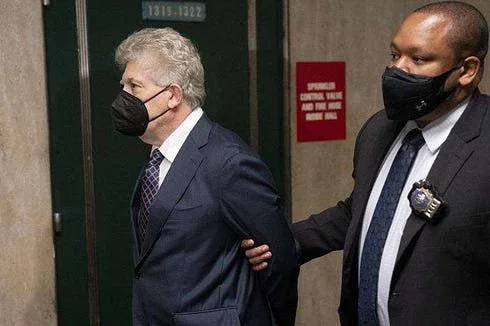
Book and manuscript dealer Glenn Horowitz being led into court, July 2022. Creator: Gabriella Bass | Credit: Gabriella Bass for NY Post.
Apart from the officially sanctioned crimes against archives, there’s an economy of rare books and manuscripts that operates in the shadows: purchases from dealers who don’t ask many questions about provenance by wealthy private collectors building their treasure hoards. (In this shadow economy museums are in a class by themselves since so much of their holdings are stolen.) In this grey zone, forgeries and fraud are rampant. Phil Collins, an obsessive collector of material about Texas and The Alamo, was probably conned into purchasing large amounts of forgeries from a historian and an antiquities dealer working together. Mark Hoffman made a whole career out of forging documents about the LDS Church. Even the venerable auction houses Christie’s and Sotheby’s colluded to artificially inflate market prices — since the value of any given book or manuscript, as with any other commodity, is only worth as much as the most someone is willing to pay for it.
There’s a long list of thieves that have stolen from NARA. Maps are particularly valuable to collectors, so thieves like Gilbert Bland and Edward Forbes Smiley III are the reason many private map collections exist. Barry Landau stole thousands of Presidential documents and artifacts partly for the money and partly for his love of collecting. The FBI created the Art Crime Team in 2005 because of the high level of international theft. The FBI steps in if: the material is over 100 years old and valued over $5,000; or under 100 years old and valued over $100,000. They also maintain a National Stolen Art File of items valued over $2,000, but of course these are only the items they know about.
In addition to this dark economy, there’s an open, legal economy of papers and archives. A donor can get their collection appraised at a certain value, donate that material to a repository as a gift, and take a tax deduction for the amount on the appraisal. The only catch is you can’t donate your own personal papers this way and the repository can’t hire the appraiser. If you’re a private collector with some valuable material, you can use this system to create your own tax loophole — just keep donating highly-appraised material every year and watch your taxable income go down. If you don’t care about the tax implications and you want to give your own papers to an archive — but not for free — you can sell them to the highest bidder. The record for sales is currently the University of Tulsa buying Bob Dylan’s papers for between $15 to $20 million (George Kaiser and his Kaiser Family Foundation chipped in a large amount of that). On the other side, if an archive is willing to pay top dollar it can engage in multi-million dollar buying sprees for major collections, like Thomas Staley did to get the Harry Ransom Center at the University of Texas at Austin some of the most prestigious archival collections in the world.
Brokering these deals snags a nice payday for the middleman. If they do it right, they quietly build up a reputation with the right people while mostly keeping their own name out of the news; discretion is extremely important to private collectors and large institutions alike. If they get too cocky or greedy, they can end up in jail like Glenn Horowitz, dealer to the gentry of the super-rich. Trying to convince Don Henley to buy his own stolen documents from you is a bold move! So is claiming that you got them as a present from Glenn Frey, who happens to be dead!
There’s yet another economy of archival information and cultural heritage, a more recent development that operates on a giant scale. These are companies like Clarivate, Adam Matthew Digital, and Ancestry.com. Clarivate and Adam Matthew repackage digitized material and sell those packages as proprietary products, such as educational resources or databases of newspapers and other periodicals. In the case of Clarivate, they own the rights to their databases, so if you want your library users to have access to their digital material prepare to subscribe to their services. They don’t say how much they charge, but in 2021 they made hundreds of millions of dollars. Ancestry.com is notorious for putting public records like death indexes and genealogical records behind a paywall. In order for these companies to exist you need low-wage labor to digitize the material, loopholes in intellectual property that allow for proprietary platforms to do mass distribution, and the Internet. One insidious development of this economy is the recent emergence of marginalized groups finding their own records secured behind paywalls and trademarks so these companies can claim to be more diverse.
Immigrant Song
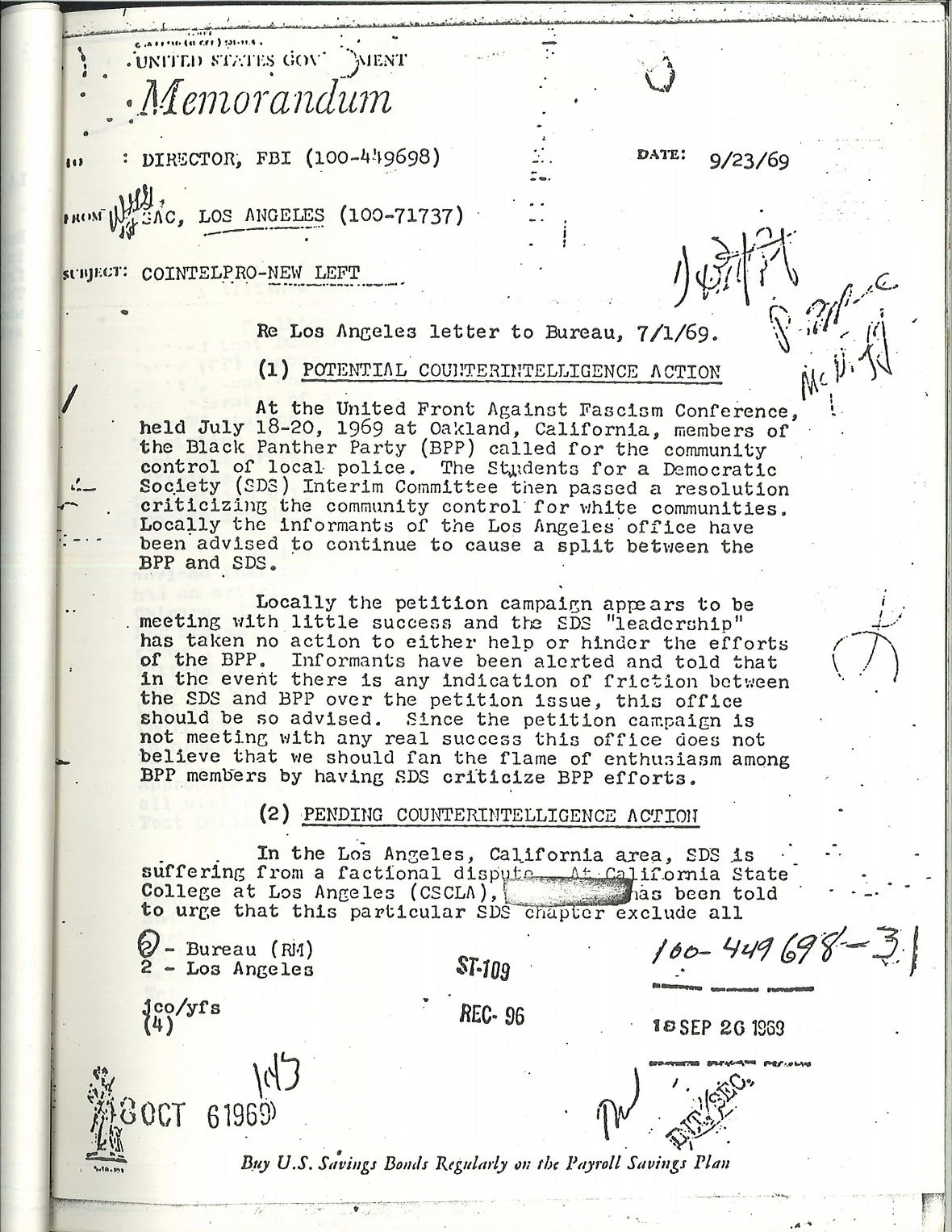
Memo from the FBI, part of the COINTELPRO operation, to informants instigating a split between the Black Panther Party and the Students for a Democratic Society, September 23, 1969.
The truly dark economy of records has almost nothing to do with money. Instead it deals in social control and naked power. Official bureaucratic records have been used to discipline and punish various groups for centuries, with archives playing their role to preserve these weaponized records.
The aftermath of World War II gave rise to a giant international legal structure designed to control large displaced populations trying to move between national borders, especially those trying to enter Western Europe or North America. This system merged organically with a growing public-private surveillance apparatus that ballooned after 9/11 and hasn’t stopped expanding. Archives and archival theory play crucial roles in the maintenance of this American bureaucratic panopticon.
Internally, one of the largest archives of domestic surveillance is the archive of the Federal Bureau of Investigation at NARA. The FBI even has a searchable website of publicly available records, selected from the hundreds of boxes of records. But the FBI’s most valuable, though unintentional, contribution to American history are its COINTELPRO files. Their carefully documented hounding of various groups and public figures makes for a trove of primary sources, as long as you keep in mind that much of the information comes from unreliable informants — usually criminals — and disgruntled agents. Also disturbing is the fact that many subjects of the FBI’s attention have no idea that a file on them exists, nor is there a way for them to get the Bureau to seal or purge their file.
Just as sinister are the records kept, or not kept, by US Customs and Border Patrol. CBS of course has a long tradition of records as a way to keep out refugees, asylum seekers, or anyone else they want, often brutally and sometimes in open defiance of the US government.
Archivist Anne J. Gilliland sums it up this way:
Those who have never undergone the profoundly destabilizing experience of migration, especially as a result of forced displacement, may not have had to think very much or very often about how or why or even where records are kept or adjudicated or how they might have a crucial effect on their own lives and wellbeing or those of family members or loved ones who are with or are separated from them. They may not have experienced linguistic or procedural confusion, literary challenges, dread or even flashbacks when confronted with having to fill in an official form. they may not have experienced similar affect when having to write a letter to an official agency in the country of settlement, whose bureaucratic processes may be steeped in different language and cultural norms, or even to an agency in the country from which they fled; when having to interact with a document that is replete with the language, script, and symbolism of those who oppressed them; or when they are required or challenged to produce identity documentation. … Archival theory insists upon the arrangement and description of records in accordance with the authority, agent or function (“provenance”) responsible for their creation and accumulation and thus emphasizes and reinforces not only the categorizations but also the power of the agency or state.
When it comes to the CBP’s own records, they are eager to destroy them and/or shield them from NARA and automatically destroy them.
What Is and What Should Never Be
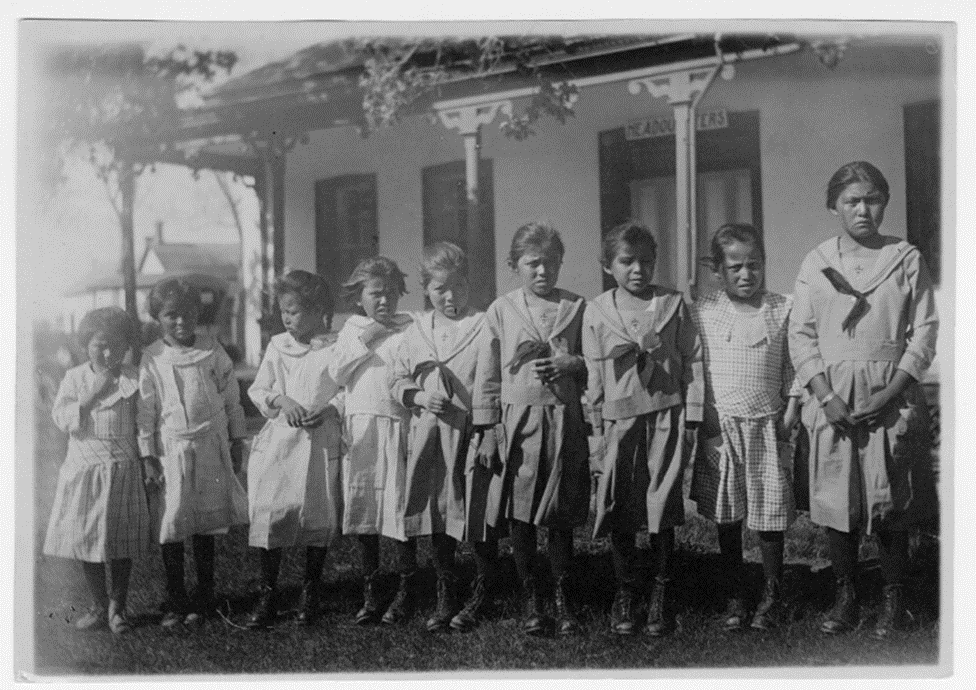
“First girl attendants on the day they were received after having been ‘changed,’” June 19, 1923; Records of the Bureau of Indian Affairs, National Archives.
There are archives that are victims of crimes, there are archives that perpetrate crimes, and there are archives which exist because of crimes.
The history of the US, like the history of most Great Powers, contains a long chain of atrocities going back to America’s origins as a nation founded on enslavement. Some of these atrocities and injustices, like the American Indian Treaties, have reams of documentation, with others, like records regarding slave ships, are relatively rare. Even when records do exist, like the thousands of documents generated by centuries of American slavery, the people who are the subject of those records remain hard to grasp because of the bureaucratic and archival insistence on making surnames and birth dates markers of identity. Speaking of which, white Americans love researching their genealogy — especially using Ancestry.com and DNA sampling — in part because having an immigrant-based identity allows them to slip out of their complicity with white supremacy when it’s convenient for them. On the other hand, white supremacists are obsessed with using genetic ancestry tests to prove their whiteness without a doubt — which doesn’t work because whiteness is a social category, not a biological one. Meanwhile Ancestry.com’s services makes it almost impossible to find out if one’s ancestors owned slaves or were involved in the slave trade.
Some archives of atrocities are hidden in plain sight. When historian James Jones was researching the Tuskegee Syphilis Study for his book Bad Blood, he happened to discover US government records about the Tuskegee study at NARA while researching a different topic altogether. This was in 1969; “needless to say,” he wrote, “I did not know that the experiment was still going on.” In another case of human experimentation, the papers of John C. Cutler were processed and described at the University of Pittsburgh and restricted until after shortly after his death. Cutler was one of the lead doctors conducting the Guatemala syphilis experiments; his papers consisted of government records (which he stole) about the US Public Health Service intentionally infecting prisoners, soldiers, and asylum inmates with the disease in order to see how it would spread through the general population. Other collections document the Japanese-American internment camps operating during World War II and the Indian Boarding Schools, though the latter collections are full of gaps and lost records.
The issue of Black historical archives captured by predominantly white institutions would double the size of this piece, so I’ll have to you give a quote from the incredible Dorothy Berry, the Digital Curator for the Smithsonian National Museum of African American History and Culture:
Academics continuously loosen the concept of the archives in vigorous debate and flowery speech, while hundreds of linear feet of Black history are stacked in secure shelving, unbeknownst and inaccessible to implicated communities. “Why do we even have this?” is a recurring question whispered across institutions as complex histories of provenance and acquisitions lead to single box collections with titles like “Miscellaneous Slavery Documents,” a collection of Freedman’s Bureau papers and Bills of Sale I recently encountered. In the face of this guilt-inducing backlog, special collections have turned towards digitization as a solution, prioritizing getting images of Black people online and hoping that will be enough. I’ve commiserated with colleagues about demands to streamline digitization with the feeling that getting things online will increase access- even without full description or detailed metadata, the things that guide digital discovery. Digital collection development has been presented as a liberatory access provider, with the idea that reparative access is primarily a workflow adjustment.
There is an idea born equally from the enormous backlogs of patron requests and from idealism. If everything is digitized, regardless of metadata or image quality, the resulting hoard would solve a host of issues. Researcher discomfort in dealing with racially insensitive reading room staff? Solved. Physical awareness of marginalized status being the only Black person in the building? Solved. Criticisms that existing digital collections are too White? Immediately solved, with references. No longer would there need to be as heavy a focus on the White-supremacy inflected structures of archival repositories- those issues can be fixed in their own time, and researchers can safely access content at home. … Institutional possessors of primarily Black collections obfuscate access through rules and roadblocks of their own design.
If this subject interests you, you should absolutely read her entire essay.
Dazed and Confused
“Silent Sam” pro-slavery statue toppled in Chapel Hill, North Carolina, August 15, 2017.
The atrocity archives create headaches for the academic institutions that house them, especially because so many American institutions of higher learning were either funded by blood money, built on stolen land, or both. Perusing their own university archives too closely would force an unwelcome reckoning with their own legacy. Universities hate being caught between the modern forces of capital and their original charter to create knowledge and further social mobility. On the other hand, they also hate institutional self-critique that might drive away potential big donors and alumni boosters.
University archives tend to embarrass higher-ed institutions founded on white supremacy. The Julian Shakespeare Carr Papers, Southern Historical Collection, The Wilson Library, University of North Carolina at Chapel Hill contain the text of his speech at the unveiling and dedication of the confederate monument “Silent Sam,” placed on the UNC campus by the Daughters of the Confederacy, on June 2, 1913. The loquacious speech praised the Confederacy to the heavens. Then there was this passage:
I trust I may be pardoned for one allusion, howbeit it is rather personal. One hundred yards from where we stand, less than ninety days perhaps after my return from Appomattox, I horse-whipped a negro wench until her skirts hung in shreds, because upon the streets of this quiet village she had publicly insulted and maligned a Southern lady, and then rushed for protection to these University buildings where was stationed a garrison of 100 Federal soldiers. I performed the pleasing duty in the immediate presence of the entire garrison, and for thirty nights afterwards slept with a double-barrel shot gun under my head.
When this came to light in 2017 the students were so disgusted they tore down the Silent Sam statue itself shortly afterwards. The Carr Papers, as noted above, are part of the Southern Historical Collection, a renowned archival resource collected and maintained by avowed white supremacist J.G. de Roulhac Hamilton. Hamilton has a campus building named in his honor, though that may soon change. Changing a building’s name is a welcome gesture but it also happens to be good PR. Harvard University’s public apology and promise of reparations might be genuine and is admirable. It also poses no reputational risk to Harvard, unlike, say, an examination of their current relationships with war criminals.
Some schools lost large portions of their research collections after the passage of the 1990 Native American Graves Protection and Repatriation Act (NAGPRA), which requires any institution that receives federal funding to return “cultural items” like “human remains, funerary objects, sacred objects, and objects of cultural patrimony” to their rightful indigenous owners. In response, some university archives and museums decided to simply hand-wave NAGPRA away. Other schools have ghoulishly held on to human remains in their archives. Some of these collections are remnants of “race science” and physical anthropology, like the Morton Collection of a thousand human skulls. Then there are the stolen bones of two children killed in the 1985 MOVE bombing in Philadelphia, used as teaching materials.
Gallows Pole
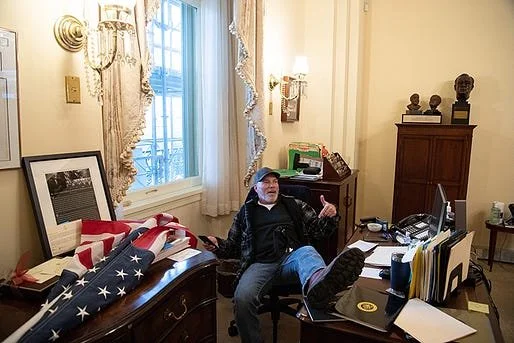
Richard Barnett in the office of Congressional House Speaker Nancy Pelosi with his boot on some government records, January 6, 2021. He later bragged about stealing mail from the office. Creator: Saul Loeb | Credit: AFP via Getty Images.
Trump understands that being in trouble is a fake idea. People who get mad about rule-breaking can’t understand why Trump keeps getting away with everything. He’ll get away with this too. There is almost no one on Earth, especially no one in America, willing to even try to impose rules on the President of the US, much less when it comes to respect for proper government documentation procedure. He’ll get away with selling the details of Israel’s nuclear program to Saudi Arabia (which is likely what he did) because he broke a rule and no one can or will do anything about it. From an archives point of view, though, it’s a perfect scandal. It combines the scramble of personal and Presidential papers; disdain for the PRA; historical documents as fungible commodities; destruction of public records; the archives of the national security state; and institutions embarrassed by the content of their own collections.
The people who aren’t getting away with it are the rioters who wrecked the Capitol building in 2021. They were such good archivists, proudly documenting their crimes for posterity, in real time. Another archive of crime, created by criminals, to document the greatest crime of their lives. [Editorial correction from 2026: for the most part they did actually get away with it.]
Night Flight

Photograph of the crash site (the black smudge in the center) of the SpaceIL Beresheet rocket, April 2019.
In 2018, SpaceX successfully launched their Falcon Heavy rocket into space. The rocket needed a test payload, so in a monument to Elon Musk’s pathological ego they used the first Tesla Roadster his company ever sold. SpaceX dumped the car into an orbit around the sun, theoretically to travel through space for millions of years. Tucked in the glove compartment of the Roadster is a high-tech optical disk loaded with a digital copy of Isaac Asimov’s Foundation trilogy. Will some far-future civilization be using CD-ROMs? Regardless, four years into it’s 30-million-year journey the Roadster is falling apart, so at some point the disk will either fall into the sun or fly off into the void.
The Asimov disk is a creation of the Arch Mission Foundation, a futurist-utopian project of Nova Spivack who is fixated on the idea of creating multiple “archives” of all human knowledge and shooting them into space. In 2019, Spivack funded his own moon shot, using a SpaceIL Beresheet lunar lander built by Israel Aerospace Industries. The rocket would be the first private spacecraft to land on the lunar surface, and its payload would be “Billion Year Archive,” aka the Lunar Library (tm). Unlike the Asimov disk, the BYA uses analog technology — high-res, nano-scale images engraved onto 25 micron-thick layers of nickel, viewable through a microscope with 1000x magnification. Layers 1 through 4 hold 60,000 images of book pages, looking something like an old microfiche loaded with thousands of novels, textbooks, Wikipedia (in English), hair follicles and blood samples from Spivack and few other people (to include human DNA), and weirdest of all a few thousand dehydrated tardigrades. To be useful, future humans would have to (1) somehow rebuild civilization after the coming climate collapse (2) find and process the massive amounts of fossil fuel needed to shoot a manned rocket to the moon, and (3) find the disk — because right before it was supposed to land on the lunar surface Beresheet crashed. Spivack is positive that the disk somehow survived and has planned to deliver a second installment of the Lunar Library (tm) as a hitchhiker on the Astrobotic Peregrine Mission One lander in 2022.
The Song Remains the Same
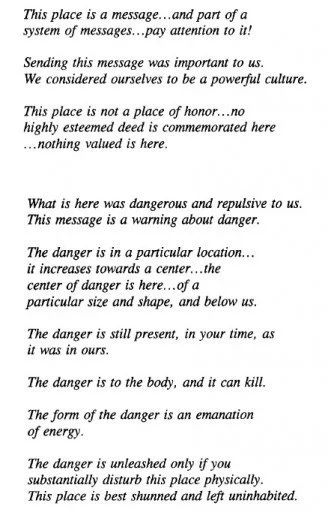
Version of the textual warning at the Yucca Mountain nuclear waste facility, part of a design to keep visitors away for the next 10,000 years. For context, 10,000 years ago Homo sapiens was just starting to learn agriculture.
Shooting these info-disks into space feels like a tacit admission that Homo sapiens’ time on Earth is drawing to a close and we need to leave a suicide note behind. It’s also part of a long tradition of wealthy and powerful men leaving monuments to themselves intended to keep their fame alive for all future generations. The survival of the monuments testifies to the superiority of analog records over digital technology.
That brings me back where I started: the Sumerian clay tablets and the personal papers. People in the Internet age have a general anxiety about the records of our recent history becoming inaccessible or just disappearing. They’re not wrong! Digital records sacrifice longevity for portability. But archivists understand that all memory is mortal and what’s remembered is defined by what's forgotten. It’s an accident that thousands of Sumerian contracts, jokes, and squabbles can still be read centuries later while the original footage of the 1969 moon landing was almost lost forever. Time isn’t selective in how it winnows. Archivists like me are the janitors of history, sweeping up what remains, cleaning things up as best we can, doing it again, and again, and again.